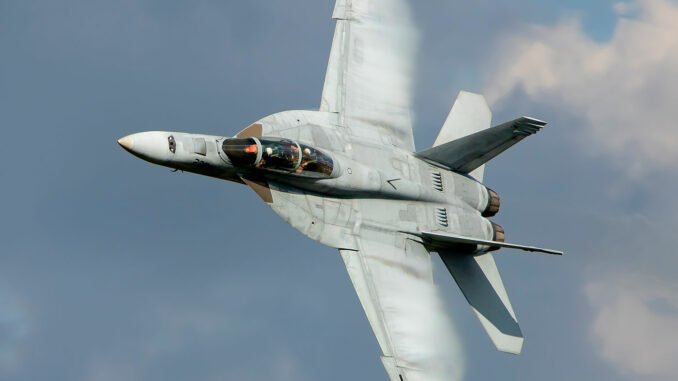
Finland is reevaluating the Super Hornet in the HX program, alongside the Rafale, Typhoon, F-35, and Gripen, in a strategic process that will remain open until the end of 2025.
In summary
Finland has not yet made its choice to replace its F/A-18C/D Hornets, despite successive announcements that seemed to indicate a preference for stealth solutions. The HX program, launched to guarantee the country’s air defense capabilities until the 2060s, is once again promoting the Super Hornet as a credible option. Helsinki believes that operational continuity, integration costs, and consistency with existing infrastructure remain decisive criteria in the face of more innovative but more expensive proposals. The latest report from the Finnish Ministry of Defense, reaffirmed at the end of 2025, confirms that all platforms—Super Hornet, Rafale, Eurofighter Typhoon, F-35 Lightning II, and Saab JAS 39 Gripen—remain in competition. The challenge is clear: to maintain a robust defense posture in a tense strategic environment, manage a budget that already exceeds $10 billion, and ensure a risk-free operational transition.
Strategic assessment of a critical replacement
The HX program is one of the largest ever launched by Finland. The objective is simple but vital: to guarantee air superiority in a country bordering Russia, with 1,340 km of land border. The current Hornets will reach the end of their operational life in the late 2020s, making their replacement imperative.
The 2015 report from the Finnish Ministry of Defense, which is updated annually, states that all candidates must meet the same requirements: air defense, long-range interception, multi-role combat, strike missions, and robustness in an advanced jamming environment. This institutional neutrality explains why no aircraft had been officially ruled out by the end of 2025.
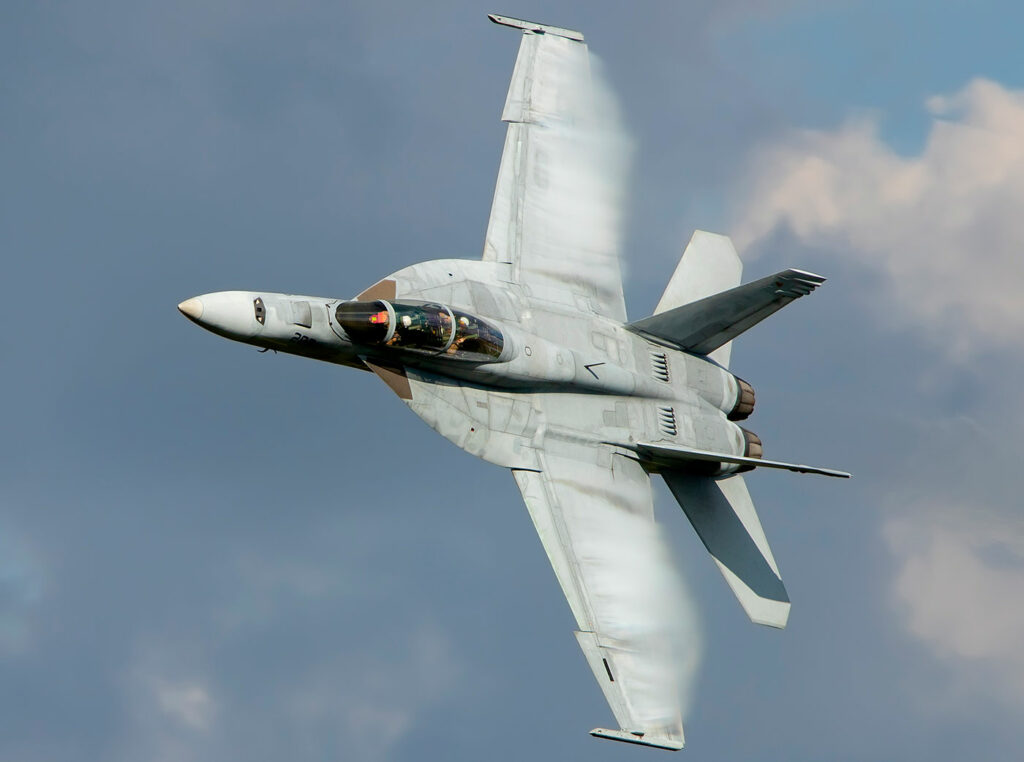
The Super Hornet retains a clear advantage: it is a technical continuation of the Hornet, which has been in service since the 1990s. Infrastructure, maintenance procedures, supply chains, and mechanic training would be less expensive to adapt. Finland recognizes that the replacement must maintain operational consistency without imposing excessive disruption.
Integration of the Super Hornet into the Finnish Air Force
Finland’s F/A-18C/Ds currently perform air policing, interception, and guided strike missions. The Super Hornet, in its F/A-18E and F/A-18F versions, would offer a natural transition.
It follows the same operating logic as the Hornet but with modernized avionics, a reduced radar signature, and superior endurance. Its range is approximately 722 km, compared to less than 600 km for the current Hornets. This structural difference would allow Finland to cover its vast airspace more effectively, particularly over the Baltic Sea.
The aircraft is compatible with weapons already mastered by Finnish pilots, such as the AIM-120 AMRAAM, which would reduce transition costs. Its payload capacity, which can exceed 8,000 kg, meets the needs of a country that requires a versatile aircraft capable of changing roles in a matter of minutes.
In terms of infrastructure, the bases at Rovaniemi, Tampere-Pirkkala, and Kuopio would require little major modification: the Super Hornet can cope with short runways and harsh winter conditions, which are characteristic of Finnish aviation.
Competition between European and American aircraft
The HX program pits five very different aeronautical philosophies against each other. For Finland, this choice reflects not only military requirements, but also diplomatic considerations.
The Dassault Rafale offers a sovereign European solution, with exceptional agility and proven effectiveness in overseas theaters. Its AESA RBE2 radar and SPECTRA electronic warfare suite are major assets. However, Helsinki stresses the need to assess interoperability with its Nordic partners, most of whom are equipped with American aircraft.
The Eurofighter Typhoon offers superior air-to-air performance, particularly at high altitudes thanks to its EJ200 engines. It would be a logical choice to strengthen interception capabilities, but its operating cost—often estimated at over €17,000 per flight hour—raises questions in a country that is mindful of its spending.
The F-35 Lightning II represents the stealth option, with state-of-the-art avionics and data fusion capabilities that profoundly change the way combat is conducted. But its integration requires a massive investment, secure infrastructure, a level of maintenance centralized in the United States, and an operating cost that can exceed $30,000 per hour.
Finally, the Saab JAS 39 Gripen E is the closest option geographically and politically. Its advanced electronic warfare system and low cost appeal to some members of the general staff. Its ability to operate from dispersed routes makes it a serious contender in Finland’s resistance doctrine. However, its relatively low payload capacity compared to the Super Hornet raises questions.
The weight of the budget in Finland’s decision
Replacing the Hornets represents a colossal expense. The overall budget for the HX program is estimated at between €10 and €12 billion, including the acquisition of aircraft, weapons systems, training, and infrastructure.
Finland, known for its budgetary prudence, is examining each offer from the perspective of total cost of ownership. The Super Hornet falls in the middle range: more expensive than the Gripen, but less expensive than the F-35 or the Typhoon.
Operating costs, parts availability, ease of maintenance, and structural life play a key role. An annual availability rate of over 70% remains essential, especially in a country where the air force serves as the first line of deterrence.
Manufacturers must also submit industrial offset offers. Boeing promises to strengthen Finland’s aerospace industry by relying on Patria and local maintenance. This ability to create long-term value is a decisive factor.
Strategic thinking that prolongs indecision
If Finland keeps all candidates in the competition at the end of 2025, it is not out of hesitation, but out of rigor. Each platform provides a different response to a rapidly evolving threat.
The Super Hornet focuses on continuity, reliability, and immediate operational mastery. The F-35 relies on stealth and technological evolution. The Gripen offers a model of territorial resilience. The Rafale provides European autonomy. The Typhoon guarantees recognized air-to-air excellence.
Finnish decision-makers know that choosing an aircraft for the next 30 years means anticipating unknown strategic contexts. Tensions around the Baltic Sea, the modernization of Russian air forces, and the evolution of regional alliances require a long-term vision.
A perspective that opens up further debate
The HX program is not just a technical tender. It reveals the country’s strategic priorities. Finland is not simply looking for a new aircraft; it is looking for a platform capable of strengthening deterrence, integrating into its territorial defense model, and fitting into a controlled economy.
The Super Hornet remains among the credible options, proving that continuity and operational robustness remain strong arguments in the face of newer technologies. The debate, which will continue until the end of 2025, shows that Finland wants to weigh every risk and every benefit before embarking on a major transformation of its combat aviation.
Sources
– Ministry of Defense of Finland, HX Program reports
– Boeing communication materials
– Public parliamentary discussions on HX acquisition
– Open-source analyses of competing aircraft
War Wings Daily is an independant magazine.