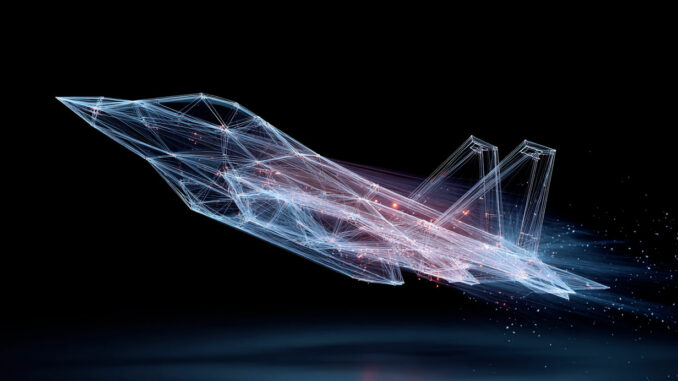
Europe wants to build a highly secure, NATO-interoperable European combat cloud to connect NGF, Remote Carriers, satellites, and ground forces in real time.
In summary
The European combat cloud project is no longer just a subsystem of SCAF/FCAS: it is becoming its backbone. The ambition is to create a multi-domain combat network capable of connecting the New Generation Fighter (NGF), Remote Carriers combat drones, current aircraft, ground sensors, surface vessels, C2 centers, and satellites in near real time. Technically, this Multi-Domain Combat Networking (MCN) is based on a decentralized, resilient architecture combining very low-latency data links, distributed tactical cloud, and embedded processing. Security is no longer limited to conventional cryptography: Europe must anticipate the threat of quantum computers and switch to quantum security (post-quantum cryptography, QKD) compatible with NATO standards. This project directly impacts issues of NATO interoperability, digital sovereignty, and industrial sharing between Airbus, Dassault, Thales, Indra, and their partners. Behind the slogan “combat cloud” lies the backbone of European information superiority for decades to come.
The European cloud combat at the heart of the system of systems
The SCAF/FCAS is not just a 6th generation fighter jet. The official concept refers to a system of systems: an NGF surrounded by Remote Carriers, sensors, electronic warfare capabilities, all connected by a combat cloud. Airbus, the prime contractor for the Multi-Domain Combat Cloud (MDCC), describes a decentralized, cyber-resilient network covering air, land, sea, cyber, and space domains, with data sharing “at mission speed.”
The objective is clear: to provide NGF crews and Remote Carrier operators with a common operational picture, continuously enriched by all available sensors. A long-range ground radar, an observation satellite, a MALE drone, an AAW frigate or a surface-to-air battery must be able to feed into and exploit this same “tactical data cloud”, regardless of their country of origin.
The figures give an idea of the scale of the project. The FCAS is estimated to cost more than €100 billion in the long term, and a significant part of this effort is now focused on the European combat cloud and the MCN, to the point that several German and French officials are discussing the possibility of saving the “combat cloud” even if the agreement on the NGF aircraft were to stall.
The technical architecture of Multi-Domain Combat Networking
The ultra-low latency transport network
A multi-domain combat network starts with a robust transport layer. These are no longer simple Link 16-type data links, which are limited in throughput and easily saturated. The European combat cloud aims to create a mesh of links:
- line-of-sight (LOS) broadband radio between NGF, Remote Carriers, and 4th generation aircraft;
- directional Ku/Ka band links and possibly optical links for very high throughput;
- relays via low (LEO) or medium orbit satellites to cover distances of several thousand kilometers.
Latency constraints are a determining factor. A geostationary satellite relay at 36,000 km typically introduces around 240 milliseconds of round-trip delay. To coordinate supersonic interceptions or swarms of drones within a few dozen kilometers, the goal is to remain within a range of a few milliseconds to a few dozen milliseconds. Hence the interest in LEO constellations, aerial relays, and highly distributed architectures.
This transport layer must remain operational in environments saturated with jamming: frequency hopping, spread spectrum waveforms, directional antennas, and cognitive radios are becoming the norm.
Distributed tactical cloud and embedded processing
Above the transport layer, the combat cloud implements a distributed tactical cloud. The idea is not to send all raw data to a single data center, but to process it as close as possible to the source: on the NGF’s embedded processors, in Remote Carriers, in MARS modules or equivalents installed on air and ground platforms.
These are hardened micro data centers capable of performing data fusion, targeting, electronic warfare, or embedded AI functions in the form of software containers. The network topology must be able to tolerate degradation: if some bricks fail, others take over the load without causing the entire architecture to collapse.
The challenge is twofold. On the one hand, to limit the load on the links by only transporting pre-processed data (merged tracks, threat prioritization). On the other hand, to enable rapid local decisions: a swarm of Remote Carriers must be able to reconfigure its formation or redistribute its roles in a matter of seconds without waiting for a centralized order.
The security requirements of European cloud combat
The rise of quantum security requirements
The prospect of quantum computers capable of breaking current cryptographic schemes weighs heavily on European cloud combat. A network that must remain in service in the 2040s and 2050s cannot rely on algorithms that are vulnerable to quantum attacks.
NATO has officially adopted a quantum strategy that emphasizes the transition to quantum-safe communications, combining post-quantum cryptography and, where possible, quantum key distribution over fiber or optical links. The Alliance supports the deployment of post-quantum solutions across all its C3 networks and strategic links.
The combat cloud will therefore need to integrate:
- standardized post-quantum cryptographic suites, resistant to machines with several million qubits;
- key management infrastructures (KMS) capable of supporting mixed fleets (older aircraft and NGF);
- quantum key distribution channels on certain strategic links (terrestrial backbones, fixed optical links).
The dilemma lies in balancing maximum security with operational constraints. Overly heavy cryptography can degrade latency and saturate the onboard computers of drones or missiles. European MCN must therefore be designed from the outset to be “quantum-ready,” with replaceable cryptographic modules and adaptable levels of protection depending on the criticality of the data flows.
Resilience to cyber and electronic warfare
Multi-Domain Combat Networking is a priority target for cyberwarfare. An adversary who manages to disrupt, saturate, or manipulate the European combat cloud would gain a decisive advantage without firing a single missile.
The architecture must apply a “zero trust” logic: each node is considered potentially compromised, authentication is strong, rights are segmented, and flows are constantly monitored by anomaly detection functions. On the physical level, engineers must provide for degraded modes: switching to more robust links, operating in isolated “digital islands” if NATO links are cut.
Finally, resilience requires diversity: diversity of suppliers, technologies, and software layers. A homogeneous, single-supplier cloud combat system would be an ideal target. The European compromise aims for a common core (standards, interfaces, cyber foundation), but a plurality of national solutions above it.
NATO interoperability constraints of the MCN
The European cloud combat cannot be a closed silo. French, German, and Spanish forces already operate within NATO frameworks where the concepts of Multi-Domain Operations and Digital Backbone impose standards for data, formats, and procedures.
This means that the European MCN must:
- speak NATO languages: STANAG for tactical messages, standard formats for air tracks, ISR images, and operational orders;
- integrate with Federated Mission Networking architectures, where each nation retains control of its data but exposes it via service “federations”;
- comply with classification constraints: strictly separate French nuclear flows, sensitive national data, and shared NATO information.
NATO is now pushing a “data-centric” approach: it is no longer applications that are in control, but data, described, cataloged, and shared via layers of abstraction. The European combat cloud must therefore be thought of as a producer and consumer of NATO “data services,” not as an autonomous bubble.
The difficulty is as much political as it is technical. France wants to preserve its deterrence and certain electronic warfare capabilities; Germany insists on maximum interoperability with the United States; Spain and other partners seek to have a say in governance. The design of the MCN is becoming a balancing act between sovereignty, standardization, and operational efficiency.
A structuring industrial project for European defense
The creation of this combat cloud is already mobilizing a constellation of players. Airbus is the prime contractor for the Combat Cloud, with Thales and Indra as main partners on the sensor, secure communications, and C2 layers. Dassault, as the NGF leader, must ensure that the future fighter is natively designed to be a key node in the network, rather than an autonomous aircraft to which a data link is “plugged in” at the last minute.
The industrial stakes go far beyond FCAS alone. A successful European combat cloud could be reused for:
- cooperative naval projects (frigates, submarines, surface drones);
- collaborative land systems, such as future connected tanks or armored vehicles;
- broader NATO cooperation around a common data backbone.
Conversely, failure would condemn Europe to long-term dependence on American JADC2-type architectures, with the risk of technological and political capture.
Ultimately, the battle for Multi-Domain Combat Networking is at least as strategic as that for the next fighter jet. The credibility of European strategic autonomy will depend on the ability to build a multi-domain combat network that is secure into the quantum era and truly NATO-interoperable. The star aircraft may change, but the need for a robust tactical data cloud will remain.
Sources (selection):
– Airbus, “Future Combat Air System – Multi-Domain Combat Cloud” and FCAS/NGWS fact sheets (combat cloud, MDCC, MARS).
– Dassault Aviation, “Europe’s Future Air Combat System: on track for its first flight” (industrial organization, Combat Cloud).
– Wikipedia / specialized reports on the Future Combat Air System (FCAS/SCAF, NGF, Remote Carriers, Combat Cloud).
– JAPCC, documents “Multi-Domain Combat Cloud in Light of Future Air Operations” and 2021–2022 conferences.
– NATO, “Multi-Domain Operations and Digital Transformation: Enabling Converging Effects”; “Data Centric Reference Architecture for the Alliance.”
– NATO, “Summary of NATO’s Quantum Technologies Strategy”; RAND studies, SIPRI and European analyses on post-quantum cryptography and QKD.
– Recent European press articles on SCAF and the “combat cloud” as the core of the project, notably Opex360, Opexnews and Reuters dispatches.
War Wings Daily is an independant magazine.