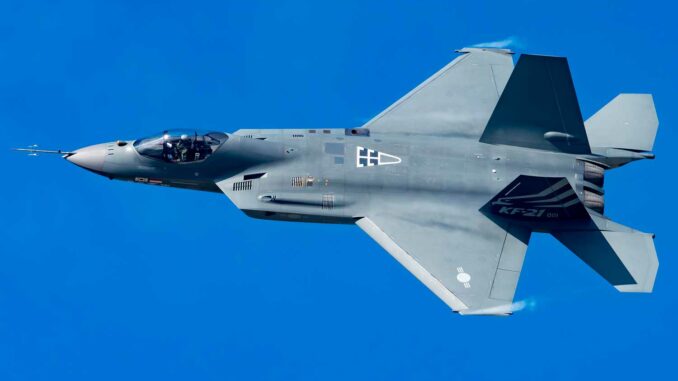
$11 million contract: the KF-21 adopts the APX-127(V)1 for a more secure IFF, compatible with Mode 5/Mode S, and better aligned with allies.
Summary
On December 15, 2025, Korea Aerospace Industries awarded BAE Systems an $11 million contract to integrate a new friend-or-foe identification system on the KF-21 Boramae. The choice of the AN/APX-127(V)1 replaces the equipment installed on test aircraft, without any change in size, in order to speed up certification. Deliveries are expected in 2026 for the first batch of 40 production aircraft destined for the Republic of Korea Air Force, which is scheduled to enter service in 2026. Technically, the benefit is not cosmetic: modern IFF reduces the risk of misidentification in a saturated environment, facilitates combined operations, and allows for software updates rather than costly hardware modifications. In short, this discreet contract touches on a key aspect of aerial warfare: knowing who is who, quickly, in a secure and jamming-resistant manner. It adds Mode 5, Mode S, and ADS-B In listening.
A contract that may seem small, but has a big impact on operational credibility
The announced amount of $11 million (approximately €10 million depending on the exchange rate) may seem modest in the context of a modern fighter program. However, this is typical of “essential” avionics components: they cost little compared to the entire aircraft, but they determine its actual use on a daily basis, in times of peace and crisis alike.
The contract covers the integration of an updated identification friend-or-foe (IFF) system. In concrete terms, this is radio identification equipment that allows an aircraft to “question” and “respond” according to standardized and encrypted modes, to avoid confusing an ally with an adversary. This is a technical issue, but a very concrete one: uncertain identification in a dense area can lead to hesitation, delayed firing, or, at worst, fratricide.
The timeline is also revealing. The units are to be delivered in 2026 for integration and certification. The implicit message is clear: South Korea wants to lock in identification standards as the KF-21 transitions from prototype to series production. This is a sign of maturity. You don’t “fine-tune” an IFF when everything is going well. You do it when you are preparing realistic missions with partners, strict rules of engagement, and interconnected command networks.
The IFF function remains a blind spot in many analyses of fighter jets
Public debates about fighter jets often focus on stealth, missiles, or radar. This is logical, but incomplete. IFF is less spectacular, and therefore less talked about. However, in a coalition, it is one of the systems that builds trust.
IFF is not just a “badge.” It is part of a decision-making chain: sensors, data fusion, tactical links, radar tracks, and then identification. In congested airspace, an aircraft can receive tracks from multiple radars, multiple platforms, or even a command center. If identification is not robust, the pilot is left to make a decision with residual doubt. And that doubt costs seconds, and therefore distance, and therefore survival.
It is also a question of coalition discipline. Partners demand common standards. Without strong compatibility, an air force is quickly confined to peripheral missions or “deconflicted” areas. Conversely, with modern IFF, it can be integrated into systems closer to the heart of the maneuver. This is exactly where the concept of interoperability takes on operational meaning.
Technical reasons for the transition to APX-127(V)1
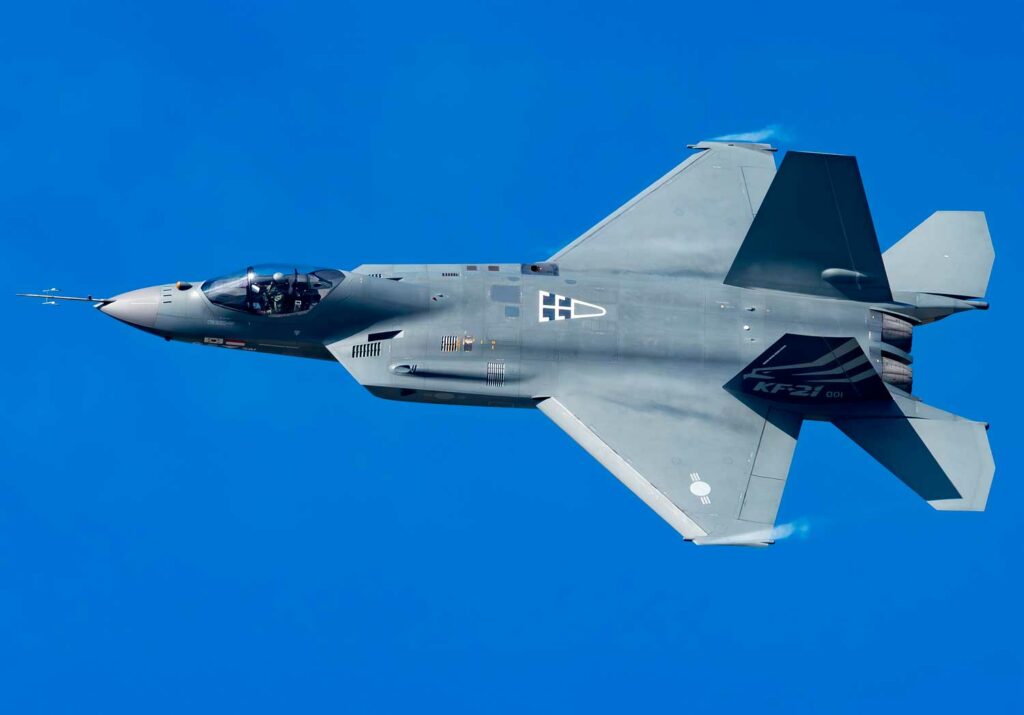
The most important factor is that it is a “drop-in replacement.” The APX-127(V)1 uses the same format as the previous equipment used on test aircraft. This is a key point. It reduces integration risks, limits wiring modifications, and speeds up testing. In a program with tight deadlines, this is a rational choice.
Essentially, the equipment is Mark XIIB certified and supports Mode 5 and Mode S. These are technical terms, but they sum up the generational leap: secure modes, encrypted exchanges, compatibility with standards used by allied forces, and the ability to evolve.
The reference article also specifies concrete points: open architecture, resistance to crypto requirements, resistance to jamming, and cybersecurity requirements. This is not just marketing talk. An identification system is a logical target for an adversary. The scenario is not just jamming. There is also the temptation to imitate, disrupt, or create doubt in the identification chain. In this context, the advantage of an open architecture is pragmatic: it facilitates software updates, instead of having to re-qualify heavy hardware with each evolution.
Finally, the APX-127(V)1 adds reception channels for “passive” acquisition, including ADS-B In listening. Simply put, the aircraft does not just interrogate. It can also capture information transmitted in the environment and enrich identification in a complex scene. It is not a magic wand, but it is a useful building block when the airspace mixes military aviation, civil aviation, drones, and multiple trajectories.
The place of this building block in the KF-21’s industrial trajectory
The KF-21 is often presented as a “4.5-generation” fighter with fifth-generation elements depending on the blocks and standards used. This classification debate is of little importance compared to the main fact: South Korea is transforming a development effort into production capacity.
Public milestones indicate a first flight in 2022, ramp-up of production, and a target for first deliveries in 2026. The first batch of 40 production aircraft, often associated with Block I, is to serve as the initial backbone. In this context, an IFF aligned with allied standards is not a “plus.” It is a prerequisite if the air force wants to operate with the United States and other partners without unnecessary friction.
The industrial equation must also be considered. BAE highlights a significant installed base with the US and allied forces, with cumulative delivery figures in the thousands. For KAI, this is a way of reducing the technological risk on a critical function, while focusing national efforts on other subsystems. It is a classic trade-off: we accept dependence on a specific component to ensure commissioning, then we retain the ability to upgrade the system via updates.
Let’s be frank: this type of choice also says something about the hierarchy of priorities. Total sovereignty is an expensive slogan. Useful sovereignty, on the other hand, is measured by the ability to put an aircraft into service, maintain it, and integrate it into a coalition. With an IFF, compatibility and certification often take precedence.
The concrete effects expected in operations and training
The most immediate improvement is the reduction in the risk of identification errors during combined exercises and joint operations. This is a prosaic but decisive benefit. In large modern air campaigns, the difficulty is not only to “see” a target. It is to identify it correctly in a dynamic scene.
The second, less visible effect concerns the rules of engagement. The more reliable the identification, the faster the decision-making chain can be, and the more authorities can delegate actions without multiplying the number of locks. Conversely, an IFF deemed insufficient forces the addition of confirmations, and therefore delays. And in air combat, delay is measured in kilometers traveled in a matter of seconds.
The third effect concerns continuous modernization. A system designed to be updated by software limits the life cycle cost. This point is important over 20 to 30 years of operation. It also matters when modes, encryption keys, or threats evolve faster than industrial schedules.
Finally, there is an image effect, but it is real. The KF-21 is also targeting the export market in the medium term. However, in evaluations, the question of “coalition-ready” carries a lot of weight. An aircraft may perform well on paper, but if it does not fit easily into allied architectures, it loses points.
The fundamental question that this contract raises about modern air warfare
This contract says one simple thing: identification has once again become a strategic constraint. Recent conflicts have shown environments to be more cluttered, more saturated, and more ambiguous. Drones are multiplying the possibilities. Deception and electronic means complicate interpretation. And coalitions require common standards, or risk fragmentation.
The choice of a certified, scalable IFF that is compatible with partners is therefore a “real war” decision, not a conference room decision. It is also a way to protect the credibility of the KF-21 program at the critical moment when the aircraft is coming out of testing. Prototypes can tolerate compromises. An operational fleet cannot.
The next step will be to monitor one specific point: how this system integrates with data fusion, tactical links, and command procedures. A good IFF is not enough if the ecosystem does not follow suit. But without a good IFF, the rest quickly becomes theoretical.
Sources
FlightGlobal — “BAE Systems to supply updated IFF system for Seoul’s KF-21 Boramae fighter”
European Security & Defense — “BAE Systems to provide latest IFF for KAI’s KF-21 Boramae fighter”
EDR Magazine — “BAE Systems awarded Korea Aerospace Industries contract…”
Wikipedia — “KAI KF-21 Boramae” (milestones, volumes, public schedule)
War Wings Daily is an independant magazine.