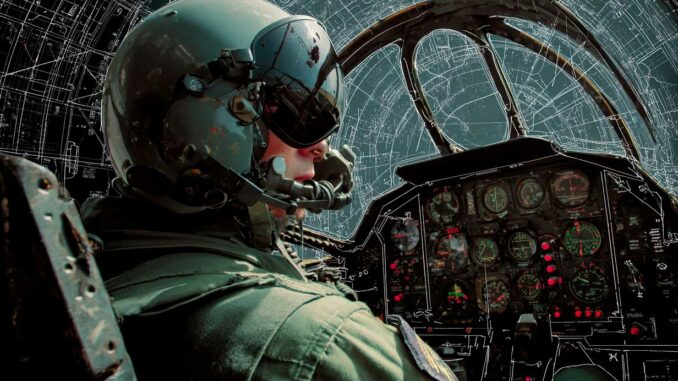
Perceiving, understanding, anticipating: situational awareness decides the outcome of a dogfight. Endsley model, OODA loop, data fusion, and cognitive traps.
In summary
In aerial combat, situational awareness is the pilot’s ability to build a reliable mental representation of the sky from incomplete and changing signals. Endsley’s model describes three stages: perceiving useful clues, understanding their tactical significance, and then projecting the likely action in the coming seconds. This skill determines the speed of decision-making and therefore survival. Loss of SA leads to tunnel vision, altitude errors, forgetting fuel, or late detection of a missile. Modern cockpits help, but they do not eliminate the human factor under stress. Data fusion, helmet-mounted displays, Link 16, and smart alerts can reduce the load, provided they are designed and trained to avoid overload, false confidence, and bias. Ultimately, SA is not a screen: it is dynamic reasoning, maintained by scanning routines, clear priorities, and decision discipline.
The operational definition of a “mental radar”
Situational awareness is not an abstract quality. It is a combat function. It allows the fighter pilot to maintain a coherent representation of the tactical scene, in three dimensions, at high speed, with threats appearing and disappearing. In a cockpit, ‘seeing’ does not mean “knowing.” A radar track can be an aircraft, a false echo, or a poorly correlated contact. An alert can be real, or the result of a saturated electromagnetic environment. The difference between a pilot who survives and a pilot who is caught off guard often comes down to the ability to piece together incomplete signals into a plausible story, then to continuously verify that story.
The hardest point to accept is this: SA is not a stockpile of information. It is a flow. It deteriorates as soon as you stop feeding it. However, modern air combat imposes a double constraint. The first is speed. An air-to-air missile can reach speeds of around Mach 4, which drastically reduces reaction windows. The second is data density. Even an “old” aircraft can receive radar alerts, data link tracks, radio messages, weapon indications, and fuel constraints, all at the same time. The pilot does not gain by “looking more.” He gains by sorting better, faster, and more accurately.
Endsley’s model: simple in theory, unforgiving in flight
Mica Endsley’s classic model divides situational awareness into three levels. This framework remains useful because it forces us to distinguish between three very different errors, which are corrected in different ways.
Perception as a vital filter
The first level, perception, is collection. It involves visual scanning, screen scanning, listening to alerts, and reading parameters. It also involves the ability to detect changes. One detail is important: many SA errors begin here, with non-detection. In studies cited on aviation, a significant proportion of SA errors among pilots have been linked to problems in perceiving the necessary information, rather than to “poor reasoning.” Information that is not perceived cannot be “made up for” by intelligence.
In practice, the pilot must maintain a rhythm. He checks the threat, then the trajectory, then the energy, then the fuel, then the exit plan, then returns to the threat. This loop is simple to describe. It becomes very difficult under stress, during maneuvers, with the radio talking and an alarm going off. SA often collapses when the scan freezes.
Understanding, where bad decisions are born
The second level, understanding, is meaning. The pilot does not deal with numbers. He deals with implications. A distance is not a distance. It is “I am in an area where a shot is possible.”
An altitude is not an altitude. It is “if I break left, I lose too much energy.” This level is that of mental models. The pilot compares the scene to known patterns: ambush, pincer movement, bait, missile fired, probable shot, etc.
This is also the level of traps. You can perceive a contact correctly and interpret it incorrectly. A common example is confusing radio “silence” with the absence of an enemy, when in fact it is a tactic of minimal transmission. Or believing that a group is isolated when it is supported by a larger force, beyond the range of its sensors.
Projection, the advantage that lasts ten seconds
The third level, projection, is anticipation. This is what separates a good pilot from a dangerous one. Projection involves estimating what will happen in a few seconds or tens of seconds, then making a decision that takes this probable trajectory into account. In a duel, useful projection is not “in five minutes.” It is “in ten seconds.”
This level requires discipline. You have to ask yourself: if I do A, what can the enemy do? What are the hidden moves? Where might the wingman be? What threats have I not yet detected? This ability is not only cognitive. It is cultural. Fighter schools work specifically to develop this reflex of anticipation, because surprise is the most effective weapon in air-to-air combat.
The decision loop, where SA becomes a weapon
SA is only valuable if it speeds up decision-making. This is where the OODA loop becomes a common language. Observe, orient, decide, act. In absolute terms, every pilot “observes.” The difference lies in orientation, i.e., interpretation, and in the ability to take action without unnecessary hesitation.
One point must be stated frankly. There is no such thing as perfect SA. The sky is too big, sensors are imperfect, opponents deceive, and the brain has its limits. The realistic goal is therefore to build a “sufficient” SA to act before the other, then correct as you go. That is why modern doctrines emphasize reversible actions, maneuvers that keep options open, and clear exit plans.
In this context, the pilot who is “less skilled” on paper can win. Not because his aircraft is superior, but because he makes decisions faster and, above all, because he makes better decisions with less information. This superiority is often organizational: quality of training, standardization of procedures, stress training, radio discipline, and patrol coordination.
Mechanisms that destroy situational awareness in combat
We often talk about information overload. This is real, but incomplete. Situational awareness breakdowns also stem from cognitive biases and physiological limitations.
Tunnel vision, a deadly classic
The number one trap is tunnel vision. The pilot becomes fixated on a single objective: a contact to engage, a shot to validate, a maneuver to complete. Everything else disappears. But the environment does not stop. A missile may arrive, terrain may approach, a wingman may shift position, a secondary threat may activate. Tunnel vision is exacerbated by stress, novelty, and long or ambiguous tasks.
The solution is not to “be calmer.” It is procedural. Micro-routines are imposed: scan instruments, scan threats, scan wingman, scan energy. Communication is worked on: the wingman announces what the leader cannot see. Break rules are imposed: if uncertainty exceeds a threshold, break and reposition.
Cognitive overload, especially when everything seems urgent
The brain cannot process everything. It filters. And under stress, it filters poorly. A cockpit can display dozens of tracks, but the pilot only really “understands” a fraction of them. The risk is twofold. First, missing the most dangerous threat because it is drowned out by noise. Second, overestimating a medium threat because it is presented more prominently.
This is where human-machine design becomes a military issue. A display must prioritize. An alert must be rare, credible, and explicit. Too many alerts kill the alert. Conversely, too much automation can lead to overconfidence and create surprise when the system makes a mistake.
Loss of spatial orientation, the silent enemy
Another, less spectacular issue is disorientation. Under load factors, during rapid maneuvers, the vestibular system lies. The pilot may believe he is climbing when he is descending, or vice versa. This destroys “physical” SA: altitude, speed, attitude. And in low-altitude combat, mistakes are paid for in seconds.
The air forces have learned harsh lessons from these risks. Pilots are trained to recognize the signs of disorientation. Instrument checks are mandatory. A simple rule is emphasized: if your senses and the instruments disagree, believe the instruments.
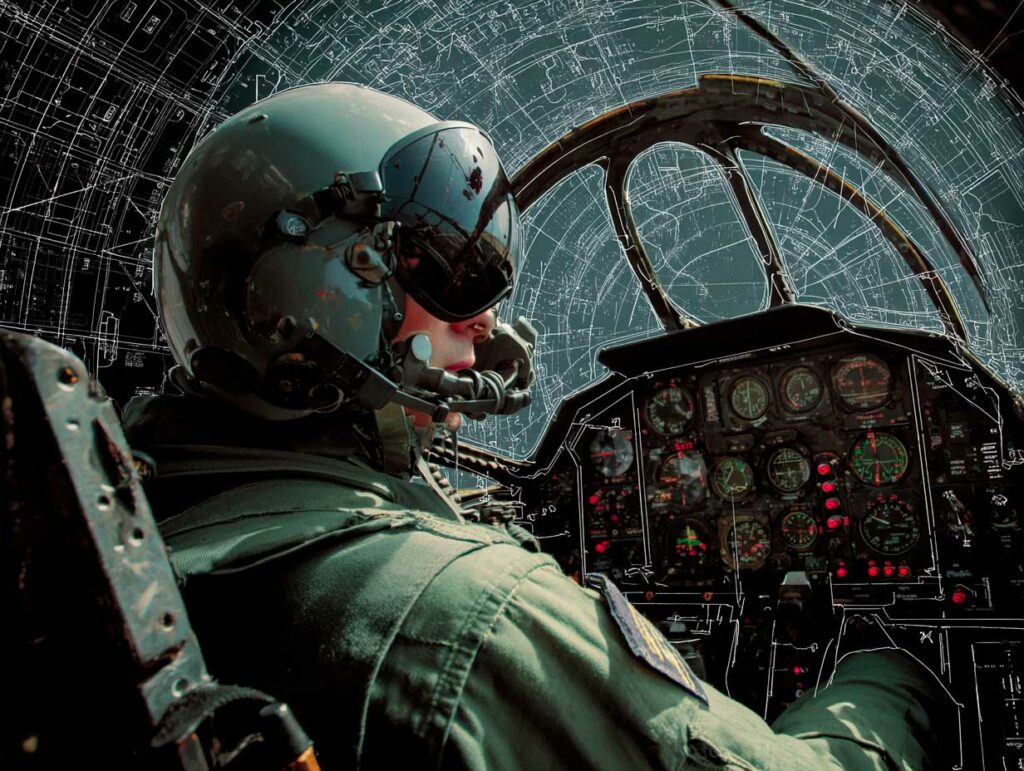
Technologies that enhance situational awareness, and their blind spots
Modern systems promise enhanced situational awareness. This is true, but only if humans remain at the center.
Data fusion, useful if it can say “I don’t know”
Data fusion aims to correlate radar, optronics, links, and electromagnetic signals to produce a single, more reliable track. On paper, this is a huge gain. The pilot sees “one object,” not ten contradictory clues.
But fusion has a risk: it masks uncertainty. A “clean” track can be false if the correlation is poor, if an adversary deceives the sensors, or if the data quality deteriorates. A good system must display confidence, or at least allow the pilot to access quality indicators. Otherwise, we create an AWAS that is comfortable but fragile.
The helmet-mounted display: faster situational awareness, but not necessarily more accurate
The helmet-mounted display allows information to be displayed while looking outside, and targets to be designated with the eyes. This reduces the amount of time spent looking down and speeds up engagement. It is a real advantage in dynamic phases.
The downside is simple: if the interface overloads the field of vision, the pilot loses external perception. One too many symbols, one misplaced alert, and you recreate tunnel vision, but “in the helmet.” The visor must therefore be adjustable, and training must include scenarios where the pilot agrees to simplify the display to stay oriented.
Data link, shared situational awareness, and network dependency
Link 16 illustrates the idea of shared situational awareness. The pilot receives tracks from other platforms. He sees further, wider, and earlier. This is not a gadget. It is a force multiplier, especially when patrolling and in coalition.
But network AW is a dependency. A track might be delayed, wrong, or duplicated. The link might be contested. So, the pilot has to learn to tell the difference between what they “see” from their sensors and what they “get” from the network. They also have to know how to keep fighting if the network goes down. Otherwise, AW becomes a crutch.
Training, where SA is really built
Sensors can be bought. SA cannot. It is built through training, repetition, and criticism.
The first pillar is standardization. A pilot must have automatic routines: scans, mental checklists, radio phrases, priorities. The more solid these routines are, the more the brain frees up capacity for tactical analysis. The second pillar is debriefing. SA is strengthened when we reconstruct the chronology: what was perceived, what was ignored, why, and at what point the scene changed. The third pillar is stress training. A pilot who has only experienced “clean” scenarios collapses when the sensors lie and the radio is saturated.
It must also be made clear that SA is collective. In a formation, the leader does not see everything. The wingman is not a passenger. He is a human sensor, a verifier, a safeguard. Effective formations exploit this complementarity, with explicit roles: who scans what, who speaks when, who validates which threat.
The limits of “all technology” and lessons to be learned
It is tempting to believe that the next generation of aircraft will make situational awareness “automatic.” This is a mistake. Technology shifts the problem. It sometimes solves it. It also creates new ones.
The more we automate, the more we risk surprises when automation fails. The more we connect, the more we risk dependence on the network. The more we merge, the more we risk false certainty. In a contested environment, the enemy will seek precisely to break AW: deceive sensors, saturate alerts, force quick decisions based on bad assumptions.
The real conclusion is therefore less comfortable, but more useful. SA is a discipline. It is based on mental hygiene: checking, cross-checking, maintaining an exit strategy, and accepting to break a commitment when the uncertainty becomes too great. It is also based on a culture of error: identifying the moments when we have told ourselves the wrong story, then correcting the habits that lead to it.
The pilot who wins is not the one who “knows everything.” It is the one who knows early enough what matters and acts without lying to himself about what he does not know.
Sources
- Mica R. Endsley, “Situation Awareness Analysis and Measurement” (PDF chapter), excerpt citing Jones & Endsley (1996) and the three levels of SA.
- Aviation New Zealand, “Situational awareness (SA) – guidance” (PDF), overview of levels and human factors.
- OODA loop, summary note on John Boyd and the Observe-Orient-Decide-Act cycle.
- Bundeswehr, “What are military data links?” (Link 16 and encrypted real-time exchange).
- BAE Systems, “Link 16 Terminals” (industrial presentation, real-time tactical data exchange).
- U.S. Air Combat Command, “Airmen enhance F-15E capabilities with helmet-mounted cueing system” (JHMCS principle and head-up targeting).
- Elbit Systems of America, “JHMCS II Helmet Mounted Display” (HMD and SA improvement).
War Wings Daily is an independant magazine.