From the canceled F-111B to the VFX, here is the technical history of the development of the Grumman F-14 Tomcat, its key choices, cost overruns, and versions.
Summary
The Grumman F-14 Tomcat was not born out of an engineer’s dream, but out of a brutal operational need. After the failure of the carrier-based F-111B, the US Navy launched the VFX program in 1968 to regain true long-range fleet air defense. The specifications called for a two-seat, twin-engine fighter capable of reaching Mach 2.2, carrying powerful radar and heavy missiles, while remaining compatible with aircraft carriers. The first flight took place on December 21, 1970, but the program suffered early losses in testing and schedule delays. The Tomcat became a “system” platform, centered on the radar-missile combination, at the cost of high complexity and a controversial initial engine, the TF30. Its development tells a simple truth: on aircraft carriers, pure performance is not enough. It must also survive reality, maintenance, budget, and evolving threats.
The context of a navy that refuses to lose its reach
In the mid-1960s, the US Navy saw a clear danger: Soviet bombers and anti-ship missiles meant that interception had to take place far, far away, before the threat could approach a carrier strike group. This was the logic behind fleet air defense, with a radar and missile combination capable of detecting, tracking, and engaging at long range.
The problem was that the program supposed to fulfill this mission, the F-111B, got bogged down and was eventually abandoned. The Navy found itself with a potential capability gap and a political constraint: it had to prove that it could obtain a credible carrier-based interceptor without repeating previous mistakes.
In this climate, Grumman proposed a concept in November 1967 that set the wheels in motion. The US Navy obtained authorization to launch a contract definition in June 1968. Then came the decisive step: in February 1969, the development contract was awarded to Grumman. From the outset, the ambition was clear: this would not be a simple aircraft, but a complete weapons system designed for the sea.
Specifications that pushed for a “system” aircraft
The VFX tender required a specific architecture: two crew members in tandem, two engines, high speed (Mach 2.2), a 20 mm internal cannon, and above all, the ability to carry heavy air defense missiles. The logic is simple: if the aircraft has to fire from a distance, it must be able to see far, and therefore carry a large radar, electronics, and substantial weaponry.
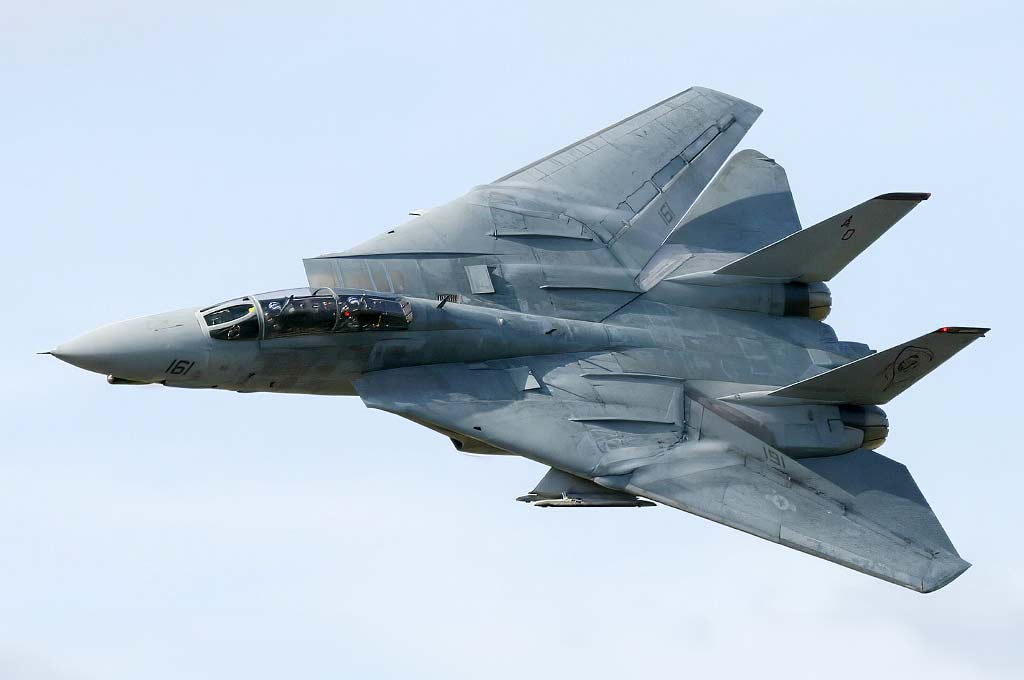
This is where the Tomcat takes its real shape. To combine a airframe capable of high speeds with the ability to land on aircraft carriers, Grumman adopted a variable-geometry wing. It was a rational choice on paper: large surface area and lift at low speeds, increased sweep at high speeds. But it was also a costly, heavy, and mechanically demanding choice. The Tomcat gained aerodynamic versatility, but at the cost of more maintenance and lasting structural complexity.
Another key point: the radar and the missile define the aircraft. The AN/AWG-9 is not an “added” piece of equipment, it is a raison d’être. The AWG-9 / AIM-54 Phoenix combination became the hallmark of the program: multi-target capability, interception logic, and beyond-visual-range strike in a naval setting.
Tests that quickly remind us of the price of risk
The first flight took place on December 21, 1970. Very quickly, the program paid the price for its learning curve: a prototype was lost shortly thereafter, and the GAO noted that the crash of the first aircraft caused schedule delays and extended testing. This episode sums up the Tomcat well: the aircraft aimed for the top of the technological spectrum, and each incident resulted in lost months and added costs.
What matters is the domino effect. In a shipboard program, a loss in testing affects more than just the aircraft. It affects aircraft carrier qualification, weapons system validation, training, and production batches already underway.
The GAO also highlights another uncomfortable fact: the US Navy orders aircraft even though not all test results are known yet. This is a common occurrence in times of strategic tension: industrial risk is accepted in order to avoid operational risk.
The TF30 engine, a compromise that will leave its mark
The most controversial aspect of the initial development can be summed up in one acronym: TF30. This turbofan engine powers the F-14A, but it has inherited constraints and limitations that have become apparent with use. Technical sources describe efforts to improve reliability, with version upgrades and modifications aimed at reducing incidents.
Here, we must be frank: the Tomcat suffered from this choice. Not because the aircraft was “bad,” but because its promise was based on power reserves and engine robustness compatible with carrier-based use, including dynamic maneuvers and low RPM during critical phases. When the engine becomes a limiting factor, operational confidence is affected.
This topic also explains part of the subsequent evolution. The Tomcat is changing not only because the threat is changing, but because the aircraft must become safer, more reliable, and more consistent with its actual weight and mission profiles.
Costs, quantities, and budgetary reality
The development of the F-14 came at a time when program costs were skyrocketing as soon as the aircraft became a “system.” The GAO documented an increase in estimated development costs and highlighted debates about performance measurement, cost visibility, and how the program was being managed. It also notes a major reduction in planned quantities, from approximately 710 aircraft to 301 in a re-planning phase. This is a useful reminder: even an iconic aircraft is subject to budgetary constraints.
Looking at production as a whole, one figure stands out: 712 F-14s were built between 1969 and 1991. That’s a lot, but it’s not infinite. The Tomcat remains an expensive aircraft to produce and maintain, especially with a variable wing, heavy avionics, and demanding interceptor logic. It was designed for tactical advantage, not economy.
Developments that correct rather than reinvent
The F-14 has not “changed its soul.” It has been corrected, hardened, and modernized.
The switch to GE engines and the F-14B version
Starting in 1987, the US Navy introduced aircraft with F110-GE-400 engines. This development responded to a simple requirement: more useful thrust, a better margin in operations, and increased reliability. The literature also indicates that the standard, initially called the F-14A+, would be redesigned as the F-14B in 1991, with a mix of new airframes and conversions.
This is not a minor detail. Changing the engine on a carrier-based platform alters the balance between theoretical performance and actual performance available on the deck, in high heat, under load, or during go-arounds. This is often where an aircraft’s credibility is at stake.
Radar modernization and the F-14D logic
The last major milestone was the F-14D Super Tomcat version, delivered from 1991 onwards. It incorporated more modern avionics and an APG-71 radar to replace the original system.
An industry report summarizes a useful timeline: AWG-9 development began in 1968, production started in 1973, then F-14D radar testing began in 1988, with ramp-up in 1989–1990.
Here again, we must be blunt: the F-14D arrived late. It represented a solid technical response, but in a context where budgetary constraints and the arrival of other platforms reduced the political window of opportunity. The Tomcat reached a very high level of technological maturity at a time when the world was shifting to other priorities and the US Navy was redefining its fleet.
The Iranian case reveals an aircraft that is difficult to replace
One aspect that is often overlooked in a “development history” is the export customer, as it influences production, logistics, and technology security. The F-14 has a unique case: Iran. Aircraft were delivered there before the 1979 revolution, and the country remains associated with the long-term operation of this platform.
This point reminds us of one thing: when an aircraft is built around a radar-missile system, it becomes as much a strategic object as an aeronautical object. This has consequences for parts, upgrades, and the protection of know-how.
A non-nostalgic assessment of a very “1970s” development
The development of the F-14 Tomcat reveals a truth that is rarely stated clearly. The Tomcat is an operational success in its initial segment, but it is also a product of its time: a response to a specific threat, achieved through a heavy, complex, and expensive technical solution.
Its legacy is not only aesthetic or cultural. It is methodological. The program demonstrates that a carrier-based fighter is a constant compromise between performance, weight, safety, maintenance, and mission sortie rate. The F-14 often won on the tactical level. It sometimes lost on the level of simplicity. And that is exactly what makes its development history interesting: we see the constant tension between the technical ideal and the reality of a flight deck.
Sources
GAO – “The F-14 Aircraft” (PDF report, 1971)
Naval History and Heritage Command – F-14A Tomcat (museum fact sheet)
US Navy (Navy Live / Naval History) – “On the 50th Anniversary of First Flight…”
Grumman F-14 Tomcat (summary sheet) – Wikipedia (dates and quantities, cross-checked)
Forecast International – “AWG-9/APG-71(V)” (PDF report, radar timeline)
MAPS Air Museum – F-14 sheet (general program data and versions)
Back to the Grumman F-14 Tomcat page.