From the F-14A to the F-14D, the Tomcat changed in character: engines, radars, data links, and missions. Each variant explained using concrete data.
Summary
The Grumman F-14 Tomcat is often reduced to a silhouette and a movie. This shortcut hides what really matters: the aircraft changed profoundly over the course of its main variants. The F-14A was the original fleet defender, built around the AWG-9 radar and the AIM-54 Phoenix, but it had a real flaw: the Pratt & Whitney TF30 engines imposed limitations on maneuverability and created safety and maintenance problems. The F-14B was not a “minor upgrade.” It was the Tomcat finally equipped with a military-grade engine, the General Electric F110, which transformed acceleration, climb, and low-speed safety while retaining much of the architecture of the A model. The F-14D was the most ambitious step: new radar (APG-71), more advanced digital avionics, and a modernized cockpit, but it arrived late and in limited numbers. To understand the Tomcat variants, one must consider budgets, risks, and operational constraints, not nostalgia.
The F-14A, a brilliant but constrained naval interceptor
The F-14A is the benchmark against which all Tomcats are judged. It first flew on December 21, 1970, and entered service with the U.S. Navy in the mid-1970s. Its primary purpose was fleet air defense: detecting threats at an early stage, tracking multiple targets, and engaging them at long range before they could threaten a carrier strike group. This concept was embodied by the Hughes AWG-9 radar, which could track up to 24 targets and guide engagements against six of them at a time in “track-while-scan” mode. The antenna itself was large for its time, with a width of approximately 0.91 m (36 inches), and was paired with the AIM-54 Phoenix missile for long-range interceptions. The Phoenix class’s engagement range is often cited as “over 90 miles,” or approximately 145 km (90 miles). These figures explain why the Tomcat was not designed primarily as a light fighter. It was designed to control airspace far from the ship.
But the F-14A presented a contradiction: a world-class sensor and missile concept combined with engines that were not suited to a highly agile fighter. The Pratt & Whitney TF30-P-412A family offered solid peak performance on paper, but fleet experience was marked by reliability issues and compressor stalls, particularly during high angle of attack maneuvers and rapid throttle transitions. Simply put: pilots had to fly around the engine. This is not a minor detail. It influenced training, tactics, and accident risk. The Tomcat’s reputation for being demanding at the limits of its capabilities is not just romantic lore; it was partly an engineering and integration problem.
The F-14A, “blocks,” and sub-versions that really matter
Calling everything “F-14A” hides a long chain of incremental changes. Production blocks (often in increments of five) brought visible and invisible differences: vents, fairings, radios, sensors, and later, mission systems. In practical terms, this means that two F-14A airframes from different blocks can feel like different aircraft in terms of cockpit layout, maintainability, and upgrade potential. This is important because many of the later strike and reconnaissance enhancements were grafted onto the A model jets. The airframe had room for growth, but the engine remained the limiting factor until the B model appeared.
The F-14B, the variant that corrects the “original sin”
The most important thing to say up front is this: the F-14B is not just a cosmetic redesign. It is the Tomcat finally getting the powerplant it always needed. The story begins with the F-14A+ program, a temporary engine upgrade that replaced the TF30s with General Electric F110-GE-400 engines while retaining much of the previous basic avionics. In May 1991, the F-14A+ became the F-14B.
The F110 provided a significant increase in thrust (approximately 120 kN with afterburner, depending on conditions and power settings). This resulted in better acceleration, better climb, and, most importantly, easier maneuverability during carrier operations and at high angles of attack. The often overlooked operational advantage is not “speed.”
It is safety and usable performance: more room for maneuver in case of problems at low altitude and less need to treat throttles like explosive detonators. In a nutshell: the B made the Tomcat a fighter rather than a powerful detection platform that could occasionally bite.
The F-14B, a pragmatic modernization under pressure
The F-14B also arrived at a time when naval aviation was moving toward true multi-role requirements. The Tomcat began to expand into precision strikes and “Bombcat” employment, not because the Navy suddenly liked turning an interceptor into a bomber, but because operational reality and force structure demanded it. The improved engine in the B model facilitated this evolution: carrying pods, weapons, and extra fuel is much less of a burden when thrust margins are greater.
The numbers are also important. The Model B fleet was built from a mix of new production and conversions of older Model A airframes. This hybrid approach reflects the real constraints underlying most Tomcat variants: budgets and deadlines, not wish lists.
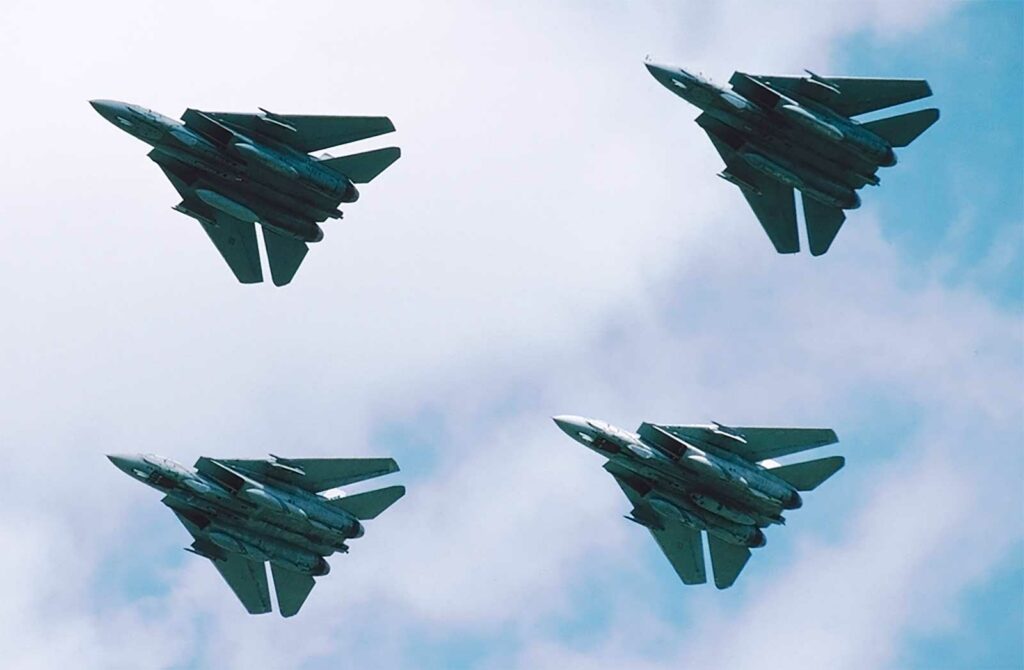
The F-14D: technological ambition… and political reality
While the B model fixed the engine, the F-14D attempted to modernize almost everything else in one step. It combined the F110 engines with more advanced digital avionics, a glass cockpit, and a new radar: the AN/APG-71, an evolution of the AWG-9 base. The D model also incorporated improvements such as the digital flight control system, which significantly improved maneuverability in difficult conditions.
Here’s the uncomfortable truth: the promises of the D model were thwarted by late Cold War and post-Cold War procurement politics, test results, and competing priorities. Production was scaled back, and the fleet never received enough D models to make it the dominant Tomcat standard. The figures commonly cited are 37 newly built F-14Ds and 18 conversions. That’s a small number for a “final standard” of a major fleet fighter.
The F-14D, the most advanced but least widespread variant
This limited service entry also explains why discussions about “the best Tomcat” can be misleading. Yes, the D is the most capable in terms of systems. But a capability that exists only in small numbers, and late in the game, does not reshape an entire air wing the way an abundant variant does. The B, in many operational accounts, is the most important variant because it distributes engine correction across a significant portion of the force.
There is another point that is often overlooked: the risks associated with software and integration were real at that time. Government reports from the early 1990s documented serious reliability issues with the F-14D’s software in relation to the operational requirements of the time. This does not mean that the aircraft was a failure. It means that the D arrived in a procurement environment that was less tolerant of costly maturation cycles.
“Mission” variants, the other story of the Tomcat
Beyond the alphabetical suffixes, Tomcat variants also exist in configurations tailored to specific missions.
Reconnaissance, from TARPS to digital transmission
The Tactical Airborne Reconnaissance Pod System (TARPS) transformed the Tomcats into valuable reconnaissance assets. Subsequent upgrades moved from the constraints of the film era to digital systems, notably with configurations often described as TARPS-DI and TARPS-CD in the late 1990s, offering increasingly digital processing and the ability to transmit images more efficiently. This was a subtle but decisive change: it altered the speed with which intelligence was transmitted from the aircraft to decision-makers.
Ground attack, a transformation dictated by operations
The evolution of strikes is sometimes viewed as an identity crisis. In reality, it was a rational adaptation. A two-pilot aircraft with long range, payload potential, and mature navigation/attack upgrades can add value in precision strike and support roles, especially when equipped with targeting pods and modern guided weapons.
The Tomcat did not become a specialized bomber. It became a flexible platform in a fleet that needed flexibility.
What the variants say about design and compromise
The history of the F-14 variants is not just a list of letters. It is a case study in compromise in aerospace.
First, the F-14A shows how a revolutionary weapons system can be held back by a subsystem that never quite fits. Next, the F-14B shows that sometimes the “right” modernization is the simplest: fix the propulsion, unlock the aircraft. Finally, the F-14D shows that the most advanced option can fail simply because it comes at the wrong time, with an unsuitable cost profile and too much integration risk concentrated in a single step.
Finally, the mission variants show something more fundamental: the Marines don’t keep aircraft because they look good on posters. They keep them because they can still solve problems at sea: intercept today, reconnoiter tomorrow, strike the day after tomorrow.
Sources
Naval History and Heritage Command – F-14A Tomcat:
Naval History and Heritage Command – F-14D Tomcat:
GAO – F-14D aircraft software is unreliable
Aviation Stack Exchange – Discussion on the TF30 vs. F110 compressor stall problem
Airfighters – Grumman F-14D Tomcat Data and history
Wikipedia – Grumman F-14 Tomcat (variants, blocks, TARPS notes)
Sandboxx – Article on TF30 issues
Back to the Grumman F-14 Tomcat page.