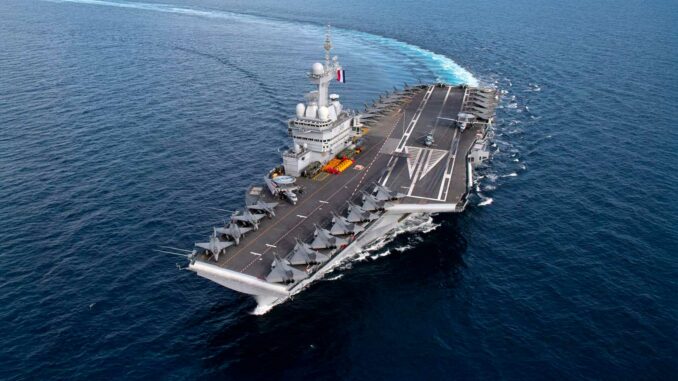
A new French aircraft carrier is being launched to replace the Charles de Gaulle. Challenges, current limitations, budget, drones, and manufacturers: the real debate.
In summary
France currently has only one aircraft carrier: the Charles de Gaulle. When it undergoes major maintenance, the capacity for air strikes from the sea disappears, and this is not a minor strategic detail. The PA-NG program, confirmed at the highest level at the end of 2025, aims to replace the current ship around 2038 with a larger, more durable vessel that is better suited to modern threats. The project is also a major industrial undertaking, with knock-on effects for shipbuilding and the military nuclear industry. Its announced cost is around €10 billion, which requires some tough choices to be made: construction pace, technological ambitions, and the never-resolved question of a second aircraft carrier. Finally, the arrival of drones does not render aircraft carriers obsolete; it changes the nature of their air groups and how they survive in a sky saturated with sensors and missiles.
The need to replace the Charles de Gaulle without telling stories
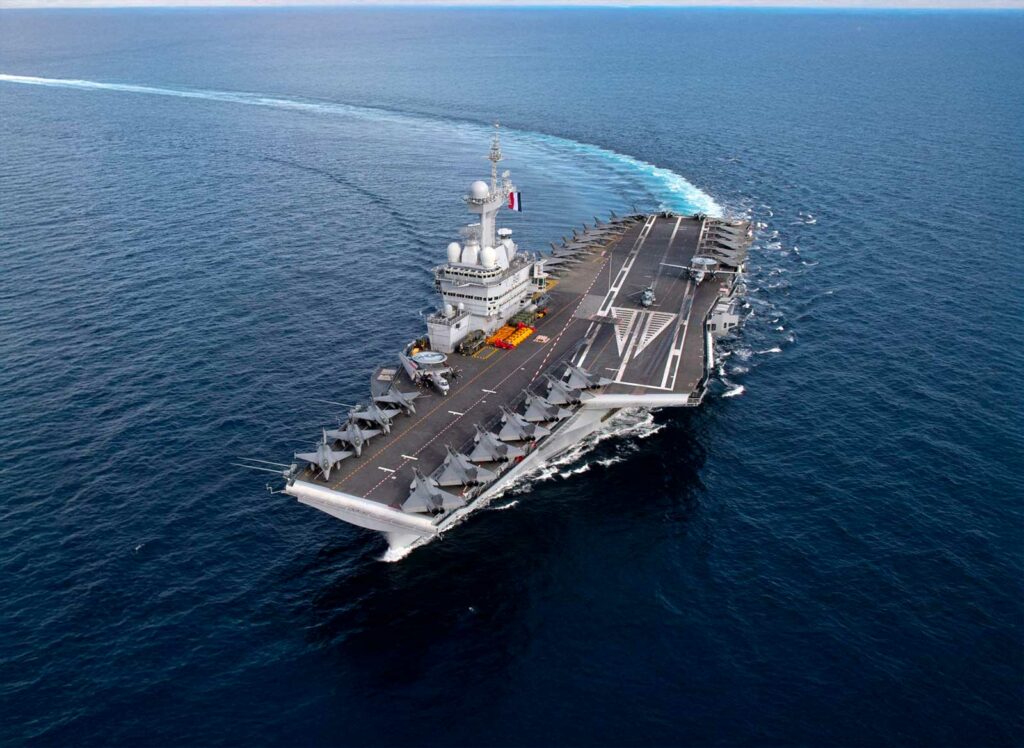
The Charles de Gaulle is not a symbol. It is a tool. Commissioned in 2001, it has a capability that is rare in Europe: launching fighter jets by catapult, day or night, far from national territory. The problem is simple. A ship of this type is aging. Its combat systems, radars, networks, accommodation capacities, and above all its availability cannot be “patched up” indefinitely.
The choice of replacement is therefore not a whim. It is a decision of strategic continuity. In December 2025, Emmanuel Macron confirmed the launch of the construction of the new-generation aircraft carrier (PA-NG, often referred to as PANG), with entry into service targeted for around 2038. This date coincides with the expected end of life of the Charles de Gaulle. Postponing the decision means running the risk of a lasting gap in capacity. Filling this gap at a later date would be more expensive and would result in a less coherent ship.
The practical limitations of the Charles de Gaulle, beyond the slogans
Availability constraints: a structural weakness
An aircraft carrier is a mechanical and electronic monster. It must periodically shut down for long periods of time. The Charles de Gaulle undergoes periods of heavy maintenance, historically referred to as IPER (then “major technical shutdown” in recent terminology). We are talking about more than a year of work during major deadlines, with heavy operations, including those related to nuclear propulsion.
As a result, France cannot guarantee a permanent aircraft carrier presence at sea. And this unavailability is no surprise. It is built into the model. This is where the problem lies: when the ship is in dry dock, France has no equivalent national solution.
A size and power designed for the Rafale, not necessarily for the post-2040 era
The Charles de Gaulle displaces around 42,000 tons and measures approximately 261 meters. The future PA-NG is aiming for another category: 78,000 tons and approximately 310 meters. This leap is not “to make it bigger.” It is explained by space, available electrical power, weapons flows, workshops, stocks, aeronautical maintenance, and the ability to upgrade the air group.
A modern aircraft carrier is as much a floating power plant as it is a runway. However, requirements are exploding: more power-hungry radars, electronic warfare, data links, command capabilities, and tomorrow’s new weapons. Keeping a platform that is too constrained means denying oneself room for evolution.
The pace of catapult launches and configuration limitations
The Charles de Gaulle has a CATOBAR (catapult and arresting wire) format, which is rare outside the United States. But its configuration requires operational compromises, and its sortie generation capacity remains that of a medium-sized ship. In a high-intensity conflict, mass matters.
Not to “fight the war alone,” but to maintain a sustained tempo with a full carrier strike group around it.
The raw facts: how many aircraft carriers France has, and what that implies
France has only one aircraft carrier in service: the Charles de Gaulle. Period.
This has a mechanical consequence: during major technical shutdowns, the capacity for air combat from the sea disappears. The French Navy maintains helicopters on board other vessels, but it is not the same thing. An aircraft carrier provides fighter, strike, intelligence, and air command capabilities, with a group of aircraft and crews trained continuously in carrier operations.
What happens when the aircraft carrier is undergoing maintenance
When the aircraft carrier is unavailable, France has to make imperfect choices:
- Switch training and certain missions back to land-based bases.
- Rely on agreements with allies for certain operations, if the political and operational context allows it.
- Accept that there are areas where the national “naval aviation” option is not available.
This is a strategic blind spot. It is not visible in peacetime. It comes at a high price when you need to act quickly, far away, without depending on overflight authorizations or welcoming bases.
The role of an aircraft carrier in the 21st century, without naval romanticism
An aircraft carrier is not used to “redo 1942.” It is used to project air combat where there is not necessarily an airport available, and to do so with a sovereign chain of command.
Its main functions are very relevant today:
- Conventional deterrence: showing that we can strike and endure.
- First entry: opening a theater, protecting sea lanes, supporting the evacuation of nationals.
- Flexibility: moving from presence to coercion without deploying thousands of men on the ground.
- Armed diplomacy: the sea allows for a reversible posture. We can move closer, move further away, and adjust without “occupying.”
The truth is that naval competition is returning. And not just against terrorist groups. We are talking about states capable of long-range missiles, submarines, space surveillance, and cyberattacks. An aircraft carrier is not invulnerable. It has never been invulnerable. Its value depends on its escort, its discretion, its countermeasures, and its pace of action.
The impact of drones: a transformation rather than a replacement
It’s easy to say that “drones will replace aircraft carriers.” In reality, drones expand the usefulness of aircraft carriers, but they also increase the threats.
On the opportunity side:
- Onboard intelligence drones: greater endurance, further range, more frequent use.
- Attack drones: certain mission profiles can be automated or semi-automated.
- Swarms and saturation: in the future, an aircraft carrier could launch mixed waves of piloted aircraft and drones to dilute the risk.
On the threat side:
- Cheap enemy drones: constant surveillance, opportunistic attacks.
- More sensors: harder to hide.
- Defense saturation: need for more responsive anti-aircraft and anti-drone systems, potentially more powerful lasers or jammers.
The PA-NG is designed for this world. It must be able to integrate drones, but also survive their proliferation. This requires electrical margins, networks, electronic warfare capabilities, and credible close-in defense.
The PA-NG format: what we know and what it says about France’s choice
Public information points to a ship that is significantly larger than the Charles de Gaulle: approximately 310 meters long and with a displacement of close to 78,000 tons. The announced target is commissioning in 2038.
The planned air group will consist of around 30 Rafale Marine aircraft, with a larger total capacity for carrier-based aircraft. The ship is to remain CATOBAR-based, with American-made EMALS electromagnetic catapults. This is as much a political as a technical decision. Political, because it creates a dependency on a critical component. Technical, because EMALS offers advantages in terms of maintenance and adaptability to different types of aircraft, including heavier or more sensitive ones.
Finally, the choice of nuclear propulsion is not a totem. It is a question of endurance and electrical power. It allows the ship to last longer, limits its dependence on refueling, and powers energy-intensive systems. But it also requires rare skills, specific industrial chains, and heavy maintenance periods.
Budget and financing: where the debate must be mature
The announced public cost is around €10 billion. Let’s be clear: this figure is not “the price of a ship.” It often includes design, industrialization, certain major equipment, and program elements. Depending on the scope, it does not always include all aircraft, all ammunition, all port infrastructure, or the escort.
Financing an aircraft carrier is not a matter of pulling €10 billion out of a drawer. It means spreading the expenditure over fifteen years, sometimes more, with peaks. The risk is the crowding-out effect: if spending drifts, it eats into other priorities. But the Navy is not just about aircraft carriers. Without frigates, submarines, and supply ships, an aircraft carrier becomes a luxury target.
There are therefore three conditions for success:
- Strict framing of operational needs, to avoid the accumulation of “everything, right now.”
- Realistic budget phasing, compatible with other programs.
- Management of technological dependencies, particularly on catapults, networks, and certain sensors.
The thorny question remains: with only one aircraft carrier, France will still have to accept years “without.” Building a PA-NG does not solve the problem of numbers. It replaces. It does not double. Those who call for two aircraft carriers are asking a logical question. Those who respond that it is “financially impossible” are imposing a real constraint. The honest position is to recognize that a single aircraft carrier is an intermittent power.
The French manufacturers who will carry out the project, and those who will influence the bill
A program of this size mobilizes an ecosystem. The names that come up are consistent with French expertise:
- Naval Group for architecture, systems integration, part of the construction, and propulsion.
- Chantiers de l’Atlantique in Saint-Nazaire for major hull work and assembly.
- TechnicAtome and players in the nuclear industry for the design and integration of the boilers.
- Dassault Aviation for onboard aviation, currently Rafale Marine and tomorrow the evolution of the air group.
- Thales and Safran for major components in sensors, navigation, communications, and electronic warfare, depending on the batches.
- MBDA for part of the anti-aircraft defense and missile integration, depending on the choices made.
Alongside the “big players,” there is above all an industrial reality: hundreds of medium-sized companies and SMEs in the fields of metalworking, cabling, automation, cybersecurity, maintenance, and software. This is another reason why the schedule and budgetary stability are important. An erratic program destroys skills instead of consolidating them.
The strategic ridge line: a tool of power or an overly expensive target
An aircraft carrier is a concentration of value. It therefore attracts criticism. “Too expensive,” “too vulnerable,” “too dependent.” These objections are not ridiculous. They are incomplete.
Yes, an aircraft carrier is vulnerable. But the alternative is not “zero risk.” The alternative is often dependence on foreign bases, political exposure, and a slower response capability. In a world where crises follow one another in quick succession, slowness is costly.
The PA-NG is not a prestige object. It is a choice of operational sovereignty. The real question is this: does France want to retain the ability to decide and act at sea with its combat aviation, even when no one rolls out the red carpet for it on land? If the answer is yes, then the PA-NG makes sense. If the answer is no, then we must accept that and accept what it means when a major crisis arises.
Sources
Reuters, “France to build new aircraft carrier, Macron tells troops based in Gulf,” December 21, 2025.
Associated Press, “France will build a new aircraft carrier as it increases defense spending,” December 21, 2025.
Mer et Marine, “France confirms construction of its new-generation aircraft carrier (PA-NG),” December 21, 2025.
Ministry of the Armed Forces (defense.gouv.fr), French Navy page “Aircraft carriers” (accessed in December 2025).
Senate, information report on the availability and maintenance of aircraft carriers (accessed in December 2025).
Le Monde, “The successor to the Charles-de-Gaulle aircraft carrier, a giant construction project…”, April 7, 2024.
War Wings Daily is an independant magazine.