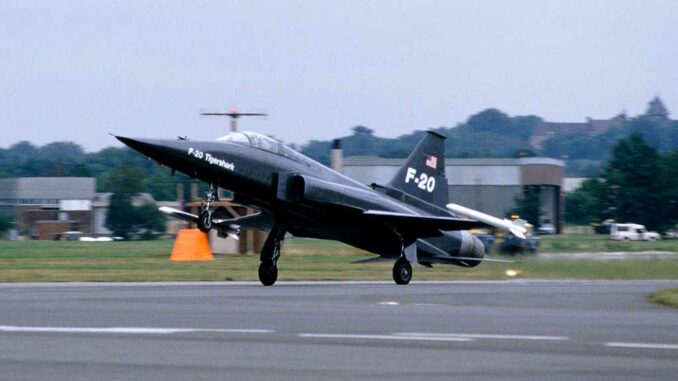
Promising and supported by Chuck Yeager, the F-20 Tigershark crashed twice during demonstrations. A look back at a crash that changed everything.
Summary
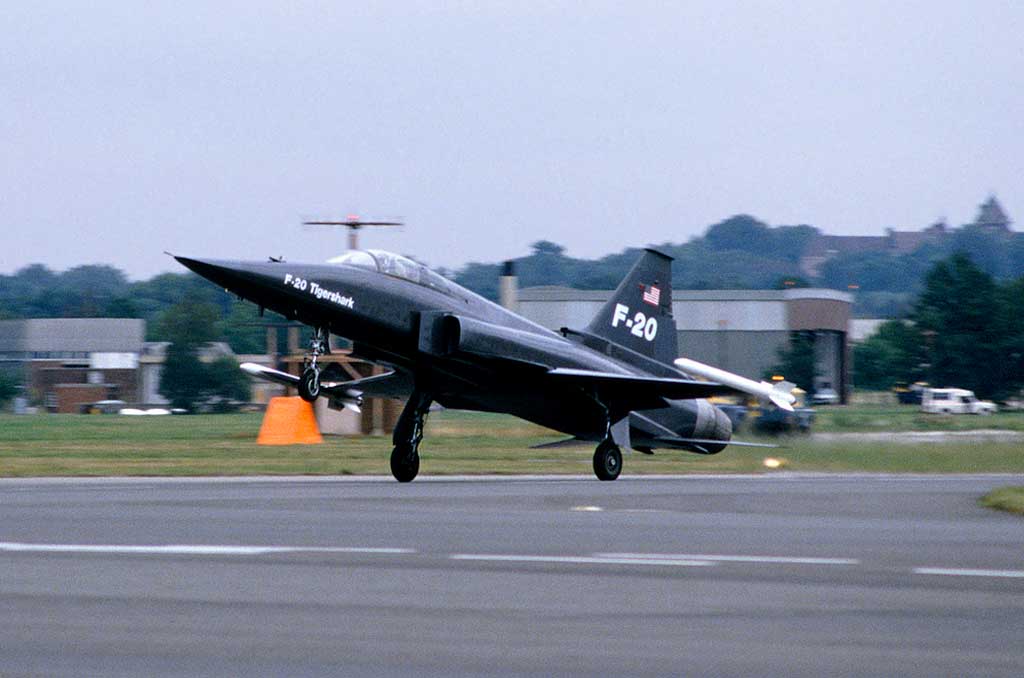
The Northrop F-20 Tigershark was presented as the ideal fighter jet of the 1980s: fast, modern, easy to operate, and designed for export. Publicly supported by Chuck Yeager, a legendary figure in American aviation, the aircraft was intended to be a credible alternative to heavy and expensive fighter jets. However, despite its solid performance and coherent design, the program collapsed abruptly. Two fatal accidents, one in 1984 in South Korea and another in 1985 in Canada, during demonstration flights, destroyed the confidence of potential buyers. These crashes, which received widespread media coverage, created the perception of a dangerous aircraft, even though the technical causes were more complex. The Tigershark was never ordered. Its story remains that of a technically viable aircraft, but one that was politically isolated and symbolically doomed by a series of tragic events.
The promise of a modern and affordable fighter
The F-20 Tigershark was born in a unique context. In the late 1970s, the United States sought to control the export of its most advanced fighter jets. Northrop identified an opportunity: to offer a high-performance fighter jet, but without overly sensitive technology, capable of appealing to allies excluded from the F-15 or F-16.
The Tigershark was based on a simple idea: a powerful engine, modern avionics, and simplified maintenance. With a single General Electric F404 turbojet engine, it could reach approximately Mach 2 and climb rapidly. Its radar, more advanced than that of the early F-5s, allowed the use of modern missiles.
On paper, the aircraft ticks all the boxes. It is light, responsive, and above all economical. Northrop promises lower operating costs than its competitors. For many countries, this is a decisive argument.
Chuck Yeager’s central role in the program’s narrative
To lend credibility to the project, Northrop relies on an extraordinary figure. Chuck Yeager, the first man to break the sound barrier, became the spokesperson for the Tigershark. His involvement went beyond simple communication. He flew the aircraft, defended it publicly, and emphasized its qualities as a pilot.
In the 1980s, Yeager was more than just a former test pilot. He was a moral authority in the world of aviation. When he said that the F-20 was safe and efficient, his opinion carried weight. This association helped forge the image of an “honest” aircraft, designed by pilots for pilots.
But this proximity also created immense expectations. The Tigershark had no room for error. Every public flight becomes an exam.
A technically sound but politically fragile aircraft
The F-20 suffers from a major handicap: it arrives too late. The F-16, initially designed as a light fighter, is finally authorized for export. The United States favors this program, supported by mass production and a vast logistics network.
The Tigershark found itself isolated. No launch customers. Every demonstration had to be convincing, with no safety net. In this context, the slightest incident took on disproportionate significance.
The 1984 crash in South Korea
The first tragedy occurred in October 1984 during a demonstration flight in South Korea. The prototype was performing a dynamic presentation in front of military officials. After a high-impact maneuver, the aircraft suddenly lost altitude and crashed. The pilot was killed.
The first images were seen around the world. The shock was immediate. For outside observers, the message was simple: a new aircraft had crashed during an official demonstration.
Technical causes and their perception
Investigations point to the pilot losing consciousness due to a high G-force maneuver combined with insufficient altitude to recover. The aircraft itself did not have any major structural defects.
But these nuances are lost on the public.
For potential buyers, a fighter jet crashing in front of officials inspires mistrust. Confidence, which is essential in an export program, is undermined.
The 1985 crash in Canada, the final blow
Less than a year later, in May 1985, a second accident occurred during an air show in Canada. The scenario was tragically similar. During the climb phase after a maneuver, the pilot lost control and the plane crashed. Once again, the pilot was killed.
This repetition proved fatal. Two fatal crashes during public demonstrations, on two continents, in less than twelve months. Even though the causes were linked to extreme flight profiles, the Tigershark’s image was permanently tarnished.
The media and psychological effect
At air shows and in defense ministries, the reasoning is brutal. An aircraft that crashes twice in front of potential buyers becomes a political risk. No decision-maker wants to explain to the public why they bought “the plane that falls.”
From that moment on, the Tigershark was no longer evaluated on its performance, but on its reputation.
Northrop’s reaction and the limits of communication
Northrop tried to regain control. The manufacturer emphasized the technical conclusions, highlighted the absence of major airframe failures, and pointed out that the demonstration profiles were deliberately aggressive.
Chuck Yeager continued to defend the aircraft. He claimed that the F-20 was sound and that the accidents were due to human error. But even his aura was no longer enough. Doubt had taken hold.
Loss of confidence among potential buyers
Several countries had shown interest in the Tigershark. After 1985, that interest evaporated. Discussions were postponed, then abandoned. The F-16, already widely used, appeared to be a safer choice, supported by the US Air Force.
The Tigershark found itself in a classic deadlock: no customers, therefore no production, therefore no continuous improvement, therefore even fewer customers. The crashes accelerated an already fragile process.
A failure that goes beyond technology alone
It would be simplistic to reduce the failure of the F-20 to its accidents. The program suffered from a lack of political support, internal American competition, and an unfavorable schedule. But the two crashes played a decisive role. They crystallized all the fears.
In military aviation, perception matters as much as reality. An aircraft may be safe, but if it is perceived as dangerous, it is doomed.
The Tigershark, a legend without a career
In the end, only three prototypes of the F-20 ever flew. None were sold. The aircraft never saw combat, nor even operational service. Yet many pilots and engineers continue to regard it as an excellent design.
The Tigershark has become a tragic legend, that of an aircraft that had almost everything it needed to succeed, except the right to make mistakes. Its crashes are not just accidents. They tell the story of the fragility of weapons programs, where a handful of events can wipe out years of work.
Even today, the F-20 remains a textbook case. It reminds us that in military aviation, technology, politics, and symbolism are inseparable. And that sometimes, two dark nights are enough to wipe out an aircraft destined for a very different fate.
Sources
- Northrop internal reports on the F-20 program
- Federal Aviation Administration archives on demonstration accidents
- Testimonials and interviews with Chuck Yeager on the F-20
- Historical analyses of American fighter programs in the 1980s
- Specialized publications on military aviation history
War Wings Daily is an independant magazine.