From the naval F-4B to the canonized F-4E, a detailed analysis of the variants of the McDonnell Douglas F-4 Phantom II and the technical choices that shaped its career.
In summary
The variants of the McDonnell Douglas F-4 Phantom II tell a story of constant adaptation. Originally designed as a fast, heavily armed naval interceptor, the F-4 evolved under the pressure of operational realities, changing doctrines, and the specific needs of each user army. Each version responded to a specific issue: naval aviation constraints, US Air Force requirements, lessons learned from air combat in Vietnam, or specialization in reconnaissance and air defense suppression. Behind a silhouette that remained largely unchanged, the differences between variants were profound: radars, engines, avionics, weaponry, structure, and missions. This gradual evolution explains the exceptional longevity of the aircraft, with more than 5,000 units produced and service in more than 11 major air forces. Studying the variants of the F-4 Phantom II means understanding how the same aircraft remained relevant for more than four decades.
The first naval variants designed for carrier-based interception
The F-4B, a pure interceptor for the US Navy
The first operational variant of the Phantom II was the F-4B, which entered service in the early 1960s. It was developed to meet the specific requirements of the US Navy, in a context where the main threat was the Soviet long-range bomber. The specifications favored speed, radar range, and the ability to carry heavy missiles.
The F-4B was equipped with AN/APQ-72 radar and AIM-7 Sparrow missiles. The absence of an internal cannon reflected a strong doctrinal conviction: close air combat was considered obsolete. The aircraft had a maximum takeoff weight of nearly 28,000 kg (62,000 lb), a high figure for a carrier-based fighter. Its maximum speed exceeds Mach 2.1 at high altitude.
This first variant laid the foundations for the entire F-4 family, but quickly revealed its limitations, particularly in terms of avionics reliability and low-speed performance during landings.
The F-4N, a modernization imposed by wear and tear
Faced with accelerated airframe wear and evolving threats, the US Navy launched a program to modernize the F-4B, giving rise to the F-4N. This version retained the basic airframe but received improved avionics and more reliable J79-GE-10 engines.
The F-4N illustrates a pragmatic approach: extending the life of an expensive aircraft without starting from scratch. It allowed the Navy to maintain a credible interception capability until the arrival of the F-14 Tomcat.
Variants transitioning to the US Air Force
The F-4C, rapid adaptation to USAF requirements
The F-4C marked the Phantom II’s entry into the US Air Force. This version was derived directly from the F-4B, but was adapted for land-based operations. The landing gear was modified to operate on conventional runways, and the avionics were adjusted to USAF standards.
The F-4C retained the absence of an internal cannon, a choice that would prove problematic during the first engagements in Vietnam. Pilots found themselves confronted with more agile MiGs in close-range combat, where missiles proved to be of limited effectiveness.
The operational consequences were immediate. Air-to-air missile success rates were less than 15% in the early stages of the conflict, calling into question the initial assumptions of the program.
The F-4D, a partial response to initial shortcomings
The F-4D introduced an improved radar, the AN/APQ-109, and better missile integration. However, it still lacked an internal cannon. To compensate for this weakness, external SUU-16 and SUU-23 pods equipped with the M61 Vulcan cannon were used.
This solution remains imperfect. The pod penalizes aerodynamics and firing accuracy is inferior to that of an integrated cannon. The F-4D thus embodies a transitional phase, where corrections are made without completely calling into question the initial design.
The F-4E, the variant of operational maturity
The integration of the cannon and its doctrinal consequences
The F-4E represents the most significant turning point in the evolution of the McDonnell Douglas F-4 Phantom II variants. For the first time, a 20 mm M61 Vulcan cannon was integrated into the nose of the aircraft. This choice marked a clear recognition that close combat remained an unavoidable reality.
The F-4E also received structural and avionics upgrades. Its AN/APQ-120 radar offered improved target tracking capabilities. The weight increased slightly, but the overall balance of the aircraft was improved.
This variant became the most widely produced of the entire family, with more than 1,300 units built. It was widely exported and served as the basis for many subsequent upgrades, particularly in Europe and the Middle East.
Increased effectiveness in actual combat
The operational results of the F-4E are unequivocal. Air victory rates increased significantly from 1972 onwards, thanks in particular to better crew training and the combined use of missiles and cannons.
The F-4E demonstrated that true versatility depends as much on equipment as on doctrine. It became a true multi-role aircraft, capable of interception, ground attack, and close air support.
Specialized variants, reflecting new missions
RF-4 reconnaissance versions
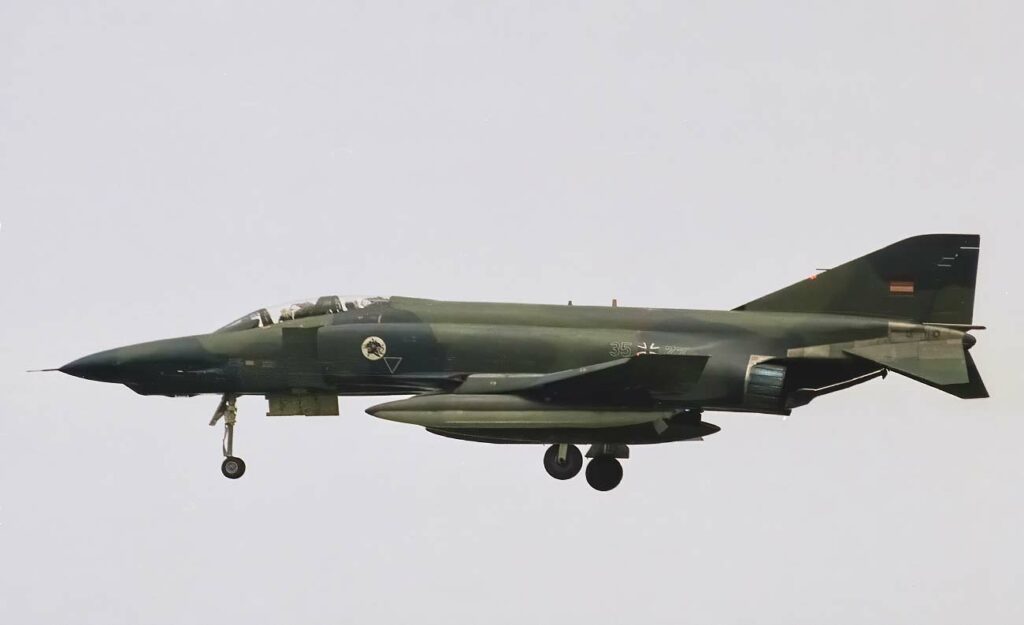
The RF-4B, RF-4C, and RF-4E were developed to meet a growing need for tactical and strategic reconnaissance. The nose was lengthened and modified to accommodate photographic and infrared sensors.
These versions sacrificed weaponry in favor of intelligence gathering. They played a central role in Vietnam, but also during the Cold War in Europe, where surveillance of Warsaw Pact forces was ongoing.
The RF-4s illustrate the Phantom’s ability to be adapted to missions far removed from its original role.
The F-4G Wild Weasel, hunting enemy radars
The F-4G Wild Weasel is undoubtedly the most specialized variant of the family. Dedicated to suppressing enemy air defenses, it is equipped with sensors to locate enemy radar emissions.
Armed with AGM-88 HARM anti-radar missiles, the F-4G became a key player in modern air operations. During the Gulf War in 1991, it played a decisive role in neutralizing Iraqi surface-to-air systems.
This variant demonstrates that the F-4 is no longer just a fighter, but a strategic tool at the heart of complex air operations.
The industrial and strategic consequences of this diversification
The proliferation of F-4 Phantom II variants had major industrial consequences. It kept production lines active for more than twenty years and enabled the company to respond to a variety of export markets.
Strategically, this diversity offered rare flexibility. A single aircraft, available in adapted versions, can cover the entire spectrum of air missions. This logic would profoundly influence subsequent programs, from the F-15 to the F-18.
The variants of the F-4 also show the limitations of an overly rigid initial design. Each improvement was often the result of a brutal return to reality, sometimes at the cost of significant human and material losses.
A legacy that goes beyond mere technology
The long career of the F-4 Phantom II is due less to absolute technological superiority than to its ability to evolve. Each variant reflects an era, a doctrine, and a compromise between cost, time, and efficiency.
The F-4 was never perfect. It was often heavy, demanding, and expensive to maintain. But with each new version, it learned to correct its own weaknesses. It is precisely this plasticity that explains why it remains, even today, an essential reference in the history of modern combat aviation.
Sources
US Air Force Historical Studies
US Navy Naval Aviation History publications
Jane’s All the World’s Aircraft
National Museum of the United States Air Force archives
McDonnell Douglas internal program histories
Back to the McDonnell Douglas F-4 Phantom II page.