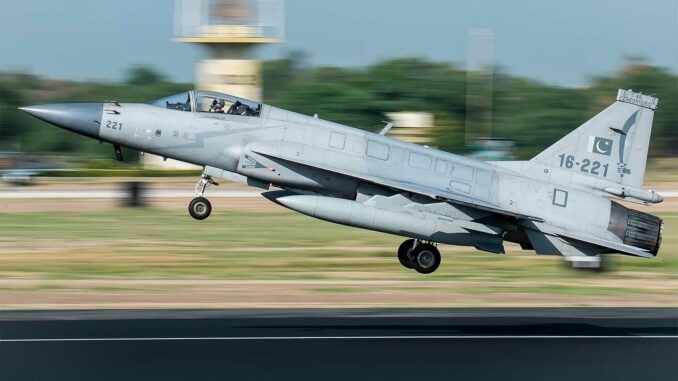
Islamabad signs a major military agreement with Libya. JF-17 aircraft, land and naval equipment: analysis of a strategic shift.
Summary
Pakistan has reportedly concluded an arms deal worth an estimated $4 billion with the Libyan National Army (LNA). The contract, which remains partially opaque, covers air, land, and naval equipment, with the possible sale of JF-17 Thunder and Super Mushak training aircraft as its centerpiece. For Islamabad, this agreement goes far beyond the commercial dimension alone. It is part of a deliberate strategy to boost its defense industry in emerging markets, particularly in Africa and the Middle East. For Libya, faced with a heterogeneous and aging military fleet, this represents a cost-controlled leap in capability, outside the traditional Western channels. However, this deal raises many questions: Libya’s budgetary credibility, delivery times, political risks, and Pakistan’s positioning in a sensitive geopolitical environment. Behind the figures, a new map of the global arms trade is emerging.
An agreement announced as major but still partially opaque
The news spread quickly in defense circles: Pakistan had reportedly reached an agreement with the Libyan National Army for an arms package valued at approximately $4 billion. The volume is considerable for a country like Libya, and significant for a Pakistani industry still in the process of consolidating its exports.
At this stage, no detailed contractual documents have been made public. The precise details remain unclear. Sources refer to a framework agreement, with successive tranches conditional on financing and political timelines. This structure is typical of arms contracts concluded with fragile or divided states.
This vagueness fuels speculation, but it is consistent with practices observed in this type of market.
Libya and the need to rebuild its military
Libya remains marked by more than a decade of military fragmentation. The forces aligned with the LNA have disparate equipment, inherited from the Soviet era, captured in war, or delivered on an ad hoc basis. The lack of standardization complicates maintenance, training, and operational planning.
In this context, the appeal of a “turnkey” solution is obvious. Pakistan offers relatively modern, proven platforms that are, above all, less expensive than their Western equivalents. For Libya, the challenge is not to achieve a cutting-edge level of technology, but to have a coherent, available, and sustainable tool.
This need explains the appeal of aircraft such as the JF-17 or the Super Mushak.
The JF-17, the cornerstone of Pakistan’s offering
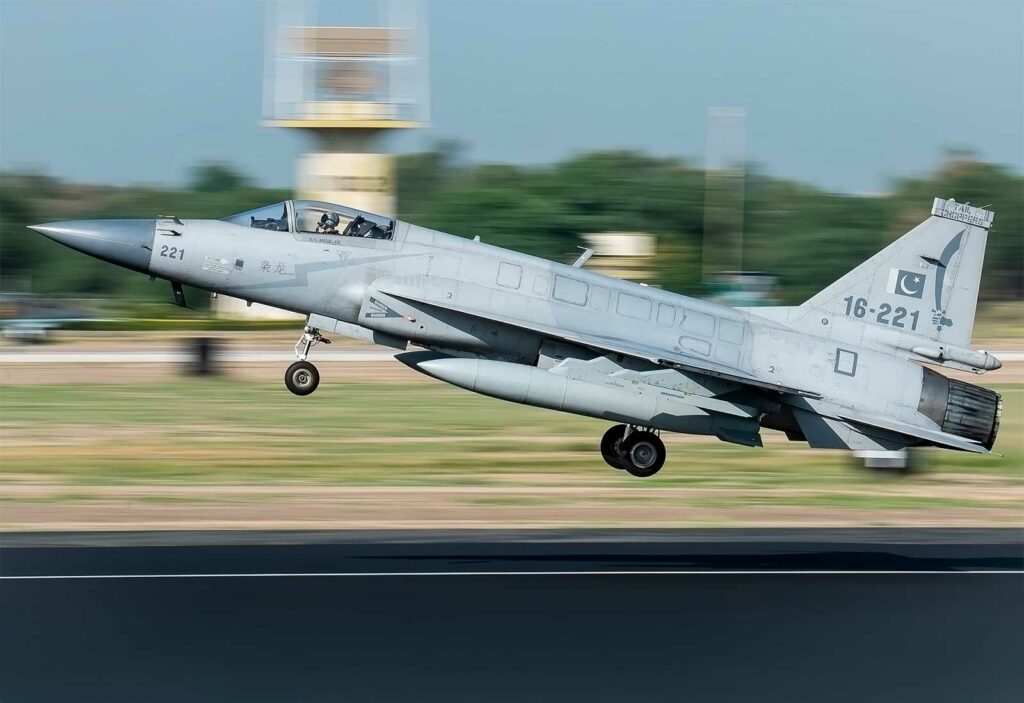
The JF-17 Thunder, developed jointly by Pakistan and China, is at the heart of Islamabad’s export strategy. A single-engine, multi-role aircraft, it is positioned in an intermediate segment: more capable than a light aircraft, but much less expensive than a latest-generation Western fighter.
Depending on the version, its unit cost is generally estimated at between $25 million and $35 million, excluding weapons and support. This positioning appeals to countries with limited budgets that nevertheless want credible combat capabilities.
For Libya, the JF-17 would offer a clear break from its current aging platforms, while remaining compatible with its limited infrastructure.
The Super Mushak and the rebuilding of training
The other key element mentioned is the Super Mushak, a basic training aircraft widely used by the Pakistani Air Force and exported to several countries. Although less publicized than the JF-17, it nevertheless plays a central role.
Training pilots is an absolute prerequisite. Without a coherent training chain, no combat aircraft can be operated sustainably. The Super Mushak makes it possible to rebuild a low-cost initial training base with simple logistics.
In a country like Libya, where the continuity of training has been severely disrupted, this type of platform is strategic.
An air, land, and sea package to maximize value
The agreement in question would not be limited to aviation. Sources speak of a comprehensive package, including land and naval equipment. This approach is characteristic of Pakistan’s strategy.
Rather than selling an isolated system, Islamabad seeks to offer integrated solutions: armored vehicles, artillery, patrol boats, radars, and command systems. This logic increases the value of the contract and strengthens the customer’s dependence on the supplier, particularly for support and training.
In the Libyan case, this approach may appeal to officials seeking rapid capacity coherence.
The Libyan budget and the question of actual financing
A $4 billion contract raises an obvious question: can Libya really finance such an effort? The country has significant oil resources, but their exploitation and redistribution remain politically sensitive.
It is likely that the agreement is based on staggered payments, or even mechanisms backed by energy revenues. Conditional tranches would allow deliveries to be adapted to the political and financial situation.
This type of arrangement is common in contracts with states with unstable governance. It reduces the risk for the seller, while offering flexibility to the customer.
Delivery times: a key issue
In industrial terms, Pakistan is capable of delivering platforms such as the Super Mushak relatively quickly. For the JF-17, delivery times are more constrained, but remain compatible with a gradual ramp-up.
The first deliveries could take place within 24 to 36 months, depending on the configuration chosen and the availability of production lines. However, full operational capacity will depend on training, maintenance, and security stability on the ground in Libya.
In other words, delivering aircraft will not be enough. The human factor will be decisive.
Pakistan’s arms export strategy
This agreement is part of a broader strategy. Pakistan is seeking to establish itself as a “mid-range” arms exporter, competing with Western and Russian manufacturers, which are currently constrained by sanctions or political requirements.
Islamabad is banking on several advantages: competitive costs, relative political neutrality, and real operational experience. Its equipment is not theoretical. It is used and tested by its own forces.
Africa and the Middle East are priority markets, where needs are high and budgets are tight.
An alternative to traditional suppliers
For many countries, choosing Pakistan is also a political choice. Buying Pakistani means avoiding certain Western constraints without becoming entirely dependent on Russia or China.
This intermediate position gives Islamabad diplomatic leeway. It allows it to sell where others hesitate or withdraw.
The Libyan case perfectly illustrates this window of opportunity.
The political and legal risks of the contract
This deal is not without risks. The situation in Libya remains unstable. The international recognition of certain military authorities is contested. Embargoes and international resolutions strictly regulate arms deliveries.
Pakistan will have to navigate carefully to avoid negative diplomatic repercussions. Any delay, suspension, or political challenge could undermine the agreement.
These risks are an integral part of the calculation. They also explain the progressive structure of the contract.
A strong signal for the Pakistani defense industry
If this agreement goes ahead, it will mark a quantum leap for the Pakistani defense industry. In terms of value, it would exceed most of the contracts previously concluded by Islamabad.
It would strengthen Pakistan’s credibility as a global supplier, capable of offering complete solutions, rather than just one-off equipment.
In the medium term, this type of success could pave the way for other African or Middle Eastern markets, where demand remains strong.
A fragile but revealing balance
The Pakistan-Libya contract illustrates a fundamental trend. The global arms market is fragmenting. Intermediate players are gaining ground, taking advantage of the constraints weighing on the major traditional exporters.
For Libya, this choice is pragmatic. For Pakistan, it is strategic. Only time will tell whether this agreement will withstand political and security uncertainties. But one thing is already clear: Islamabad is no longer content to be a regional player. It now aspires to play in the global supplier arena, where the lines are shifting rapidly.
Sources
– Public information and industrial leaks on Pakistan-Libya negotiations
– Industrial data on the JF-17 Thunder and Super Mushak
– Strategic analyses on Pakistani arms exports
– Studies on the reconstruction of Libyan military capabilities
– Economic observations on defense budgets in North Africa
War Wings Daily is an independant magazine.