
JADC2 aims to connect sensors and effectors from all forces in real time. A resilient network, powered by AI, to make decisions and strike faster.
In summary
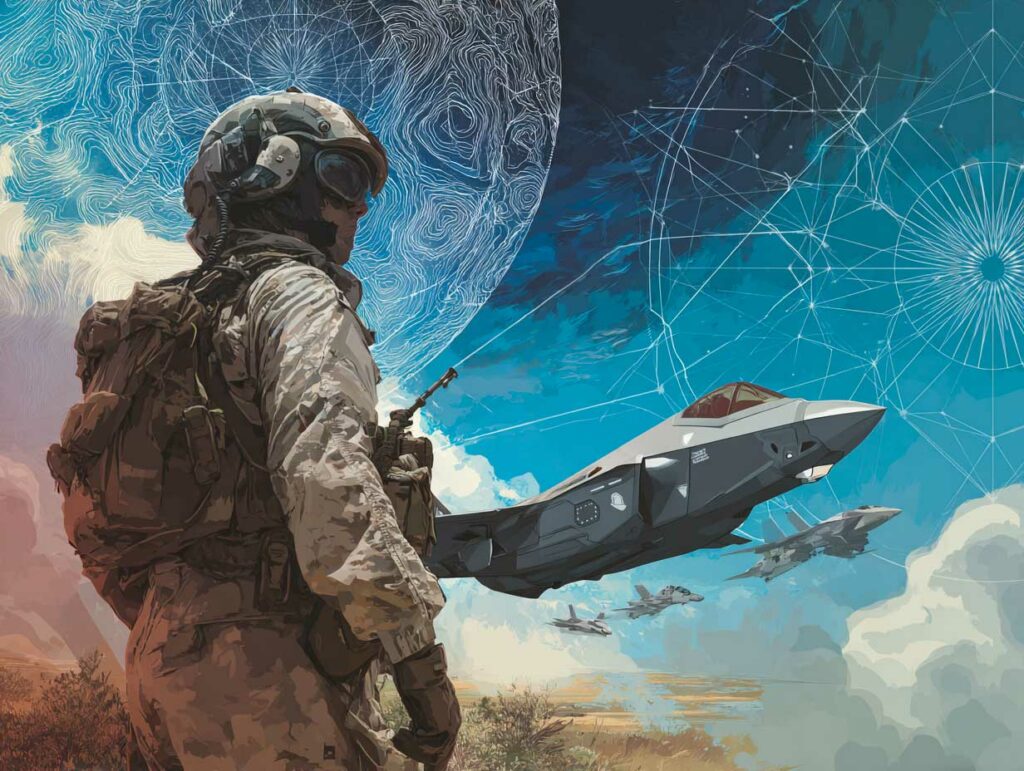
Joint All-Domain Command and Control (JADC2) is based on a simple and radical idea: in future conflicts, superiority will no longer come from an isolated platform, but from the ability to connect all sensors to all effectors, regardless of the environment. A satellite, ground-based radar, or drone must be able to transmit information in real time to the unit best placed to act, whether it be a fighter jet, a ship, or a surface-to-air battery. This logic requires a distributed, resilient network capable of operating under jamming, supported by artificial intelligence to filter and prioritize data. JADC2 is therefore not a single program, but a doctrinal, technical, and industrial transformation. It aims to reduce the time between detection and engagement to a few seconds, while accepting that the network will be under constant attack. The challenge is no longer just to see and shoot, but to circulate useful information, even when the enemy is trying to cut every link.
The conceptual break with joint command
For decades, each branch of the military developed its own networks. The systems were effective within their own perimeter, but slow to communicate with each other. In a contested environment, this segmentation becomes a strategic handicap. JADC2 starts from the opposite principle: the network is the weapon, and the platforms are merely nodes.
The goal is to create a common interface capable of aggregating data streams from the Army, Navy, Air Force, Space Force, and Marines. This interface does not replace chains of command. It feeds them. It provides a shared, hierarchical, usable, and above all, actionable picture in real time.
This approach responds to an operational reality: the speed of threats is increasing, while jamming, electronic warfare, and cyber attacks are degrading traditional communications. A centralized system is fragile. A distributed network can reconfigure itself.
The key principle of sensor-effector networking
At the heart of JADC2 is the direct connection between detection and action. If a space sensor detects a suspicious launch or trajectory, the information should not have to follow a slow vertical chain. It should be automatically available to the unit that is closest and best placed to act.
In this logic, the same event can be handled by several options: a ground-based surface-to-air missile, a fighter on patrol, or a destroyer equipped with an anti-missile system. The choice depends on time, range, availability, and threat level. AI is used here to prioritize, not to decide in place of humans.
This fluidity requires common standards. Without compatible data formats and shared protocols, the network becomes a collection of silos. That is why JADC2 emphasizes interoperability from the design stage.
Data as the raw material of combat
In modern conflict, the volume of data is massive. Infrared sensors, multi-band radars, satellite images, tactical links: everything produces signals. The risk is not a lack of information, but saturation.
JADC2 addresses this problem with a distributed architecture, often described as a combat cloud. Data is processed as close as possible to its source, filtered, and then shared in the form of actionable decisions. This approach reduces latency and limits dependence on a single center.
The figures illustrate the challenge. A modern fighter jet can generate several terabytes of data per hour of mission time. Without automation, no command center can absorb such a flow. Artificial intelligence becomes a multiplier, capable of detecting correlations and alerting immediately.
Secure mesh networks as a technical foundation
One of the major challenges is resilience. Adversaries are investing heavily in GPS jamming, satellite disruption, and cyberattacks. JADC2 cannot therefore depend on a single link.
The solution lies in secure mesh networks. Each node can relay information. If a satellite is neutralized, a drone, ship, or ground relay can take over. This redundancy does not eliminate degradation, but it prevents total collapse.
Security is just as critical. An open but vulnerable network becomes a gateway for the adversary. JADC2 architectures therefore incorporate strong authentication, dynamic segmentation, and continuous monitoring mechanisms. The priority is clear: continue to exchange information, even under attack.
The structuring role of artificial intelligence
Contrary to some misconceptions, JADC2 does not seek to automate firing. Its main use of AI is to manage complexity. AI sorts, classifies, correlates, and makes suggestions. Humans validate.
In a multi-domain environment, a single event can involve air, sea, land, and space. Without algorithmic assistance, coordination becomes too slow. AI reduces the decision-making cycle, sometimes from several minutes to a few seconds.
This acceleration has strategic value. It allows strikes to be carried out before the adversary can disperse or protect themselves. It also imposes discipline: algorithms that are explainable, tested, and adapted to strict rules of engagement.
Concrete examples of joint use
Demonstrations conducted in recent years show this logic in action. A space sensor detects an aerial threat. The data is immediately shared with a naval unit equipped with an anti-missile system, while a fighter jet receives the same information to adjust its posture.
In another scenario, a ground-based radar detects a moving target. The information is transmitted to an armed drone, while an artillery unit prepares an alternative option. This multi-domain cooperation reduces dependence on a single type of platform.
These examples illustrate a key point: JADC2 is not reserved for high-intensity conflicts. It also improves crisis management, force protection, and deterrence through responsiveness.
Current limitations and structural obstacles
Despite its promise, JADC2 remains a work in progress. The difficulties are as much human as they are technical. Each military has its own habits, legacy systems, and budget priorities. Harmonizing these cultures takes time.
Cost is another factor. Deploying resilient networks, modernizing sensors, and training personnel will cost billions of euros over time. There is a constant trade-off between innovation and maintaining existing equipment.
Finally, dependence on digital technology raises a strategic question: the more central the network is, the more it becomes a target. JADC2 must therefore accept a reality: it will never be invulnerable. Its value lies in its ability to take hits without collapsing.
The spatial dimension, the cornerstone of the system
Space plays a central role in JADC2. Satellites provide a global view, which is essential for early detection and long-distance coordination. But they are also vulnerable to anti-satellite actions.
This is why the trend is towards smaller, more numerous, and more redundant constellations. This approach reduces the strategic risk associated with the loss of a single satellite. It is in line with the dispersion logic specific to JADC2.
Spatial data is no longer a luxury. It is becoming a permanent flow, integrated with other domains, and treated as such.
Medium-term strategic implications
JADC2 changes the balance of power. An army capable of quickly connecting its sensors and effectors can compensate for local numerical inferiority. It can also deter by showing that no action will remain isolated.
This transformation has a ripple effect. Allies must be compatible to operate together. Interoperability is becoming a political as well as a military criterion. Conversely, adversaries seek to disrupt the network rather than destroy each platform.
The message is clear: the battlefield is becoming informational, and control of the network determines freedom of action.
A war of systems, not platforms
It would be a mistake to view JADC2 as a computer program. It is a vision of warfare. A vision where value is no longer concentrated in an aircraft, a ship, or a missile, but in the ability to make them work together.
The forces that successfully make this transition will have a decisive advantage: they will be able to make decisions faster, strike more accurately, and adapt under pressure. The others will retain high-performance equipment, but it will be isolated.
In future conflicts, the question will not only be “who has the best missile,” but “who controls the network when everything is jammed.” This is where JADC2 reveals its true scope: transforming complexity into an advantage and making connectivity a tool for superiority.
Sources
- U.S. Department of Defense, doctrine documents on Joint All-Domain Command and Control
- Congressional Research Service, reports on JADC2 and joint interoperability
- U.S. Air Force, communications on the Advanced Battle Management System
- U.S. Army, publications on Project Convergence
- U.S. Navy, work on distributed tactical networks and joint integration
War Wings Daily is an independant magazine.