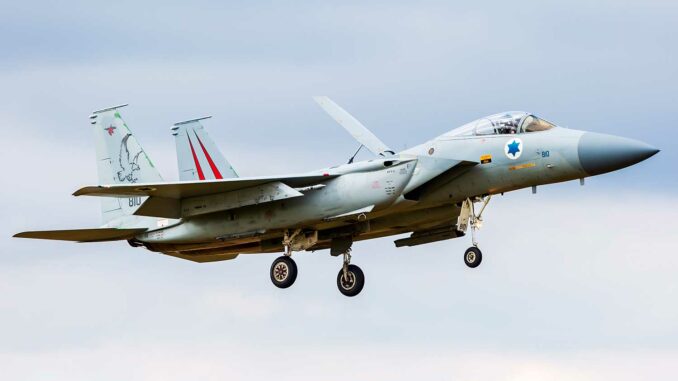
Washington launches production of F-15IA for Israel: operational requirements, schedule, financing, and the real industrial gain for Boeing.
Summary
The Pentagon has awarded Boeing a major contract to equip the Israeli Air Force with new F-15IA aircraft. The agreement covers an initial tranche of 25 aircraft, with an option for 25 more, and an industrial schedule that runs until 2035. Behind the announcement is a simple logic: Israel wants to strengthen its heavy, enduring, and adaptable strike capability, complementing the F-35I, in an environment where strategic depth is as important as stealth. The F-15IA, derived from the Advanced Eagle, offers high payload capacity and sustainable avionics modernization, while leaving room for Israeli integrations. For Boeing, this contract consolidates the F-15 line in St. Louis, secures volumes, and provides long-term visibility in a segment where the company needs stable success.
The US contract and what it really covers
The Pentagon’s announcement is not a simple “off-the-shelf” order. It represents a complete program: design, integration, instrumentation, testing, production, and delivery. The amount announced corresponds to a contract ceiling and a long work trajectory. This is a long-term industrial commitment, with milestones, options, and staggered financing.
The core of the decision can be summarized in four key points that structure the entire deal: an $8.58 billion contract, 25 F-15IA aircraft, an option for 25 additional aircraft, and Foreign Military Sales. This last point is key. This is not a “traditional” direct purchase by Israel from Boeing. It is a sale supervised by the US government, which secures the process, the authorizations, and part of the financial flows.
Another concrete indicator: at the time of the award, an initial budget was immediately committed by the United States. This means that the program is moving from talk to action, with money available to launch industrial and engineering tasks.
Israel’s operational logic, without detours
Israel is not looking for “just another” aircraft. It is looking for capability. And this capability responds to three realities that are often misunderstood in Europe.
The first reality is endurance and mass. In a region where distances and threats are multiple, a heavy fighter remains useful. The F-35I provides stealth and significant intelligence value. But a stealth aircraft is not automatically the most cost-effective tool for all missions. When it is necessary to carry a lot of weapons, maintain endurance, carry a variety of sensors, and retain a margin for modernization, a heavy fighter becomes the logical choice again.
The second reality is resilience. The Israeli Air Force wants to avoid dependence on a single technological “pillar.” A balanced fleet reduces operational risk: unavailability, maintenance constraints, limitations on use, or excessive tempo. The idea is not to replace the F-35I. It is to add combat and strike capabilities to it.
The third reality is the long term. Aircraft are ordered when a crisis is escalating, but they arrive when the crisis has changed shape. Israel thinks in terms of ten- to fifteen-year cycles. An aircraft purchased now must remain relevant after 2030. This is exactly what Boeing is selling with the Advanced Eagle: a proven airframe, but with modernized architecture and, above all, the ability to upgrade.
Choosing the F-15IA over the alternatives
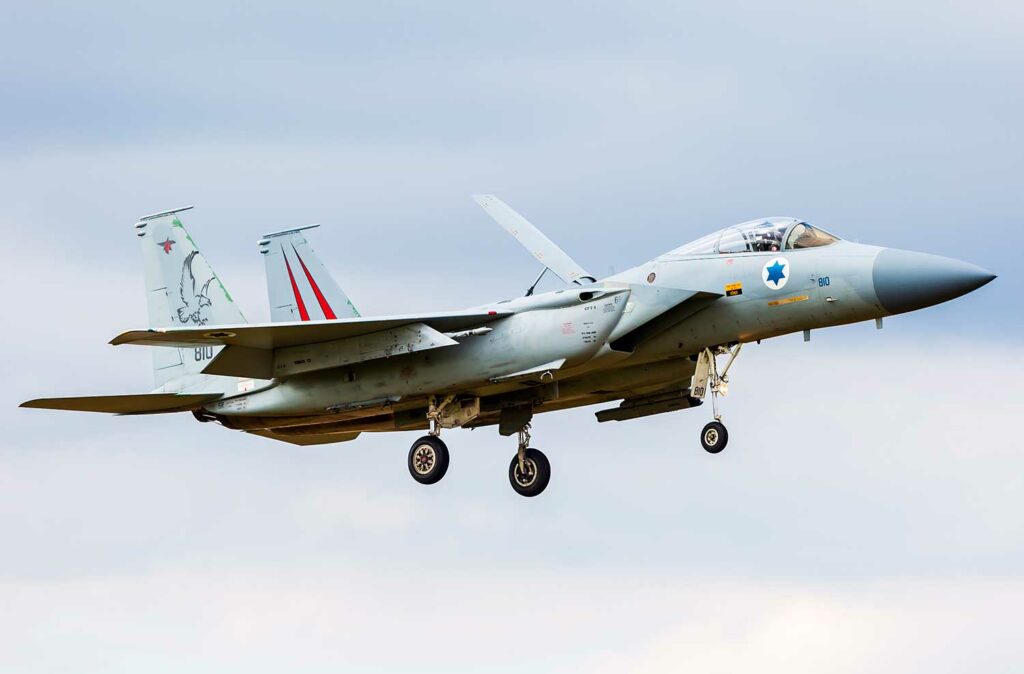
The F-15IA is not an “old F-15 repainted.” It is a modern version, derived from the Advanced Eagle standard. The important point is not the name. It is what the aircraft can do in practice.
First, the aircraft can accommodate modern avionics and sensors, with a design built to last. The official potential sales dossier mentioned an AESA radar and recent mission modules, which puts the aircraft back in the running against current threats.
Second, the aircraft is chosen for its payload capacity and flexibility.
Boeing highlights a simple and telling statistic: 13,300 kg (29,500 lb) payload. This means that for a comparable mission, the aircraft can carry more weapons, fuel, and pods. In real life, this margin is used to adapt the configuration without sacrificing everything: range, payload, or sensors.
Finally, the often decisive factor for Israel is national integration. The F-15IA is designed to accommodate Israeli technologies, weapons, and specific systems. This is a matter of operational sovereignty. Israel wants to be able to modify, adapt, and integrate without waiting indefinitely for a foreign roadmap.
Budget, financing, and the difference between “advertised price” and “full cost”
The discrepancy between the amounts quoted in the press and those seen in other announcements creates confusion. We need to be clear.
The Pentagon is talking about a long-term contract ceiling, including engineering and production phases. At the same time, previous communications from the Israeli side mentioned a lower amount for the acquisition of 25 aircraft, with a focus more on “purchase” than “complete program.” These discrepancies do not mean that anyone is lying. They reflect different scopes: aircraft alone, aircraft + support, or complete program with integration, testing, and contractual elements.
What is certain is that this type of purchase is part of an exceptional budgetary dynamic. In 2025, the Ministry of Defense’s budget was announced at a record level of around 110 billion shekels. In this context, Israel can absorb a heavy aviation program while financing other priorities.
There is also a structural factor: US aid. The reference framework remains the military assistance MOU, often summarized as $3.8 billion in US aid per year. This does not automatically pay for “everything,” but it facilitates the financial architecture and secures a portion of US purchases.
The military advantage for Israel is very concrete
The F-15IA provides a pragmatic response: more payload, more configuration autonomy, and modernization that stands the test of time.
In air-to-air combat, a modern heavy fighter remains a missile truck, with greater payload and energy capacity than a light fighter. In air-to-ground combat, the logic is even clearer: the aircraft is designed to carry, strike, return, and repeat. When the pace is high, the ability to generate sorties and carry a lot becomes an asset.
The fleet effect must also be considered. Israel already operates adapted versions of the F-15. Continuing with a familiar family reduces the risks of transition: training, infrastructure, maintenance habits, and operational culture. This does not make the program easy, but it avoids a complete break with the past.
Finally, the aircraft is part of a staggered delivery schedule. Public information suggests that deliveries will begin in the early 2030s, with a window that then extends. One point is central to following the issue: deliveries 2031-2035.
The industrial gain for Boeing, beyond the press release
For Boeing, this contract is a breath of fresh air for the industry and a commercial signal.
First, it secures activity on an iconic production line: the St. Louis assembly line. In combat aviation, visibility is almost as valuable as margin. A program that runs until 2035 stabilizes employment, suppliers, and the ability to negotiate batches.
Second, it is a structuring “export” success. Fighter sales are not just about the number of aircraft. They entail support, parts, modernization, and sometimes options exercised later. The option for 25 additional aircraft is therefore a lever, not a detail.
Finally, it sends a message to the market: the modernized F-15 is not a survivor. It is a living product, capable of coexisting with the 5th generation. Boeing is selling complementarity: stealth on the one hand, mass and flexibility on the other. It is a simple proposition, and one that appeals to many armies.
Political sticking points and program risks
We must also look at what the announcement does not say.
Politically, FMS to Israel is scrutinized and contested by some in the American public. This noise can complicate the administrative timetable, even if the overall strategic orientation remains favorable.
Industrially, an “à la carte” integration program is always a risk: the more you want to customize, the more you increase testing, validation, and sometimes delays. Israel will want to integrate national systems. This is a strategic advantage, but it rarely comes “free” in terms of planning.
Finally, the question of the actual cost per aircraft will remain a subject of debate until the options, support packages, and scope of integration are finalized. The figure that matters, in the end, is not the contractual ceiling. It is the total cost of ownership: availability, maintenance, modernization, ammunition, and operational tempo.
What this order says about the future of Israeli air power
The choice of the F-15IA is a gamble of lucidity. Israel is not betting everything on a single technology. It is consolidating a force architecture where the F-35I opens doors, and where a modern heavy fighter provides mass and versatility.
It is also a reminder that air superiority is no longer just a matter of “stealth versus stealth.” It depends on firepower, connectivity, endurance, and the freedom to integrate one’s own solutions. Based on these criteria, a modernized F-15 still has a place, especially in a theater where high-intensity scenarios are not theoretical.
For Boeing, the message is just as clear. The company has secured a long-term, high-profile contract with political backing at the highest level. At a time when the US defense industry is looking for robust, deliverable programs, this type of order is not just a sale: it is an anchor.
Sources
- Reuters, “Pentagon announces $8.6 billion Boeing contract for F-15 jets for Israel,” December 29, 2025.
- U.S. Department of Defense, “Contracts For Dec. 29, 2025” (contract notice, F-15 Israel Program).
- FlightGlobal, “US government authorizes Foreign Military Sales agreement for up to 50 Boeing F-15IA fighters for Israeli air force,” December 30, 2025.
- Defense Security Cooperation Agency, “Israel – F-15IA and F-15I+ Aircraft” (Transmittal No. 24-01), August 13, 2024.
- Israel Ministry of Defense, “Israel MOD Acquires 25 Advanced F-15 Aircraft for $5.2 Billion,” July 11, 2024.
- Knesset, “Budget Bill for 2025 approved in final readings,” March 25, 2025.
- White House Archives, “Fact Sheet: Memorandum of Understanding Reached with Israel,” September 14, 2016.
- Boeing, “F-15EX Eagle” (capabilities and payload).
War Wings Daily is an independant magazine.