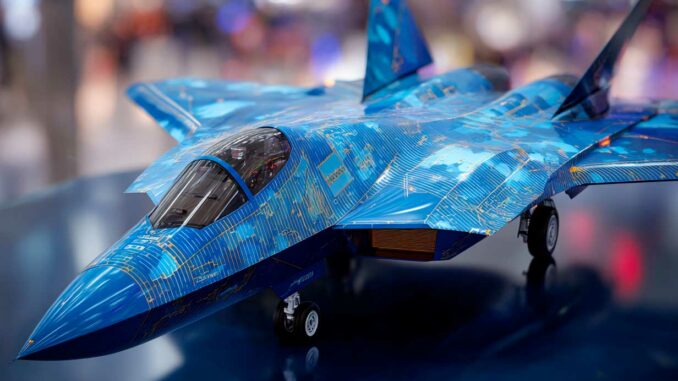
NGF, Remote Carrier drones, combat cloud: SCAF aims for European air superiority. Technologies, budgets, dependencies, and timelines.
In summary
SCAF is not “the replacement for the Rafale.” It is a comprehensive architecture designed to win air combat that is becoming collective, saturated, and ultra-connected. At its heart is a manned aircraft, the NGF, which must pilot and coordinate drones, sensors, and effectors. Around it, drones, known as Remote Carriers, serve as scouts, jammers, decoys, or weapon carriers. The whole system relies on the combat cloud, which merges data, prioritizes targets, and distributes orders in near real time. The challenge is both technological and political: to build European air superiority without excessive dependence on external players, while sharing costs and industry between Paris, Berlin, and Madrid. Phase 1B, estimated at €3.2 billion, launched the demonstrators. But the total bill could exceed €100 billion, and industrial friction weighs as heavily as technical complexity.
SCAF, a program that goes beyond the idea of a simple aircraft
When we talk about “sixth generation,” the image that comes to mind is that of a stealthier, more powerful, and smarter fighter jet. That’s an oversimplification. The Future Air Combat System is designed as a “system of systems”: a constellation of aircraft, drones, sensors, and command centers linked by networks and shared mission computing.
The basic idea is straightforward: a single aircraft, even an excellent one, no longer has the mass or resilience needed to face a modern adversary. Long-range ground-to-air defenses, multi-band radars, electronic warfare, swarms of drones, and airspace saturation require a division of roles. The SCAF therefore aims to pool detection, decision-making, and action between platforms. This is the very principle of collaborative air combat.
This approach also enables an explicit political objective: strategic autonomy. If Europe wants to decide and act without permission, it must master the critical building blocks: communications, encryption, software architectures, sensors, propulsion, weapons, and industrial chains.
The NGF pillar: a manned fighter designed to be the conductor
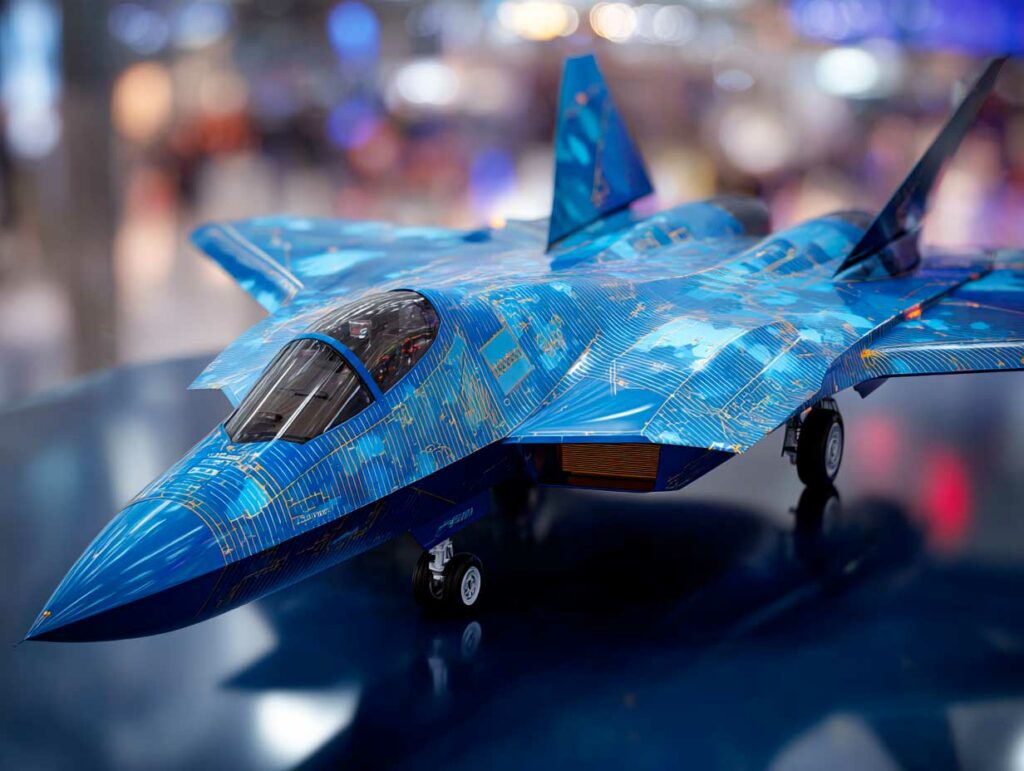
The NGF (New Generation Fighter) is not the project’s “star aircraft,” but it remains the most demanding platform. It must combine survivability, operational range, payload, and the ability to command drones, while remaining flyable in degraded situations.
Two elements change the logic:
- The NGF is designed to manage a complete “package”: drones, jammers, decoys, communication relays, and possibly remote effectors.
- Its advantage comes not only from its aerodynamic performance, but also from its ability to use on-board artificial intelligence to sort information, suggest tactical options, and reduce the pilot’s cognitive load.
Let’s be clear: AI does not replace the pilot. It serves to speed up the decision-making cycle, filter out false signals, and make the aircraft operable in an environment where data links can be jammed, degraded, or misled.
Remote Carriers: drones designed to saturate, deceive, and strike
Remote Carriers are not a gimmick. They address a real problem: an adversary with modern integrated defenses can force a fighter to remain at a distance or expend costly missiles on secondary threats.
These escort drones must cover several categories, from consumable to long-endurance. The target spectrum is broad:
- “Attritable” drones serving as decoys, relays, or advanced sensors.
- Heavier drones capable of carrying payloads: electronic warfare, reconnaissance, or weapons.
- Swarm effects, with coordination between drones to saturate radar, open a corridor, or force the adversary to reveal their positions.
The desired gain is twofold. First, to multiply the vectors and complicate interception. Second, to preserve manned platforms: it is easier to accept the loss of a drone than an aircraft and its pilot. It is a logic of mass and resilience, adapted to the rise of threats.
The combat cloud, the real backbone of the program
The most structuring element is the combat cloud. This is where the SCAF differs from a conventional “new aircraft.” The cloud is not “the internet in a cockpit.” It is a distributed command and data processing architecture designed to:
- Merge multi-sensor feeds (radar, IRST, electronic warfare, satellites, intelligence).
- Produce a common and consistent tactical picture despite conflicting data.
- Prioritize targets and assign tasks to the best available platform.
- Maintain effectiveness in contested environments: jamming, cyberattacks, GPS denial, loss of network nodes.
This is a politically sensitive issue. If the cloud depends on software bricks, components, or standards that are not controlled, the promise of sovereignty collapses. The SCAF cannot afford a high-performance but captive “cloud.” This is where digital sovereignty and cybersecurity become operational requirements, not slogans.
Stealth and electronic warfare, an inseparable pair
We often talk about stealth as a coating and a shape. In reality, future survivability is a mix. It combines reduced radar signature, controlled infrared signatures, emissions management, active decoys, jamming, and network-centric tactics.
The SCAF therefore aims for “systemic” stealth: the manned platform, drones, and links must be consistent. A discreet aircraft connected to talkative and detectable drones loses its advantage. Conversely, drones capable of jamming, deceiving, and striking shift the risk away from the NGF.
This is also an area where Europe must make industrial choices: materials, computers, antennas, testing methods, and production lines. These are heavy investments, and difficult to share without intellectual property conflicts.
Possible dependencies, a blind spot if not addressed head-on
Talking about “strategic autonomy” without mapping dependencies is hypocritical. Like any complex system, the European air combat program will depend on global markets: electronic components, semiconductors, certain raw materials, software tools, and manufacturing lines.
The typical risks are well known:
- Critical dependencies on components subject to export control regimes.
- Dependencies on essential industrial software (design, verification, and simulation tools).
- Supply chain vulnerabilities: delays, scarcity, cost increases, or political disruption.
The SCAF is attempting to respond to this through design choices and industrial governance. But we must be clear-headed: total sovereignty is out of reach. The realistic goal is to reduce dependencies that could block operational use, maintenance, or system evolution.
Program funding: less technical than it seems
Funding is the crux of the matter, and it determines everything. The 1B demonstration phase has been budgeted at €3.2 billion and covers approximately three and a half years of work on demonstrators (aircraft, drones, and cloud). This is the entry ticket, not the final cost.
The figure that decision-makers often avoid stating clearly is the total order of magnitude. Several public assessments and leaks converge on a program exceeding €100 billion over decades, including development, industrialization, and commissioning. This places SCAF in the category of structuring programs, comparable to major deterrence cycles or major combat fleets.
This budgetary reality clashes with another: the sustainability of national trajectories. In France, the 2024–2030 Military Programming Law sets an overall framework of €413 billion. But execution, cost deferrals, and geopolitical uncertainties are stretching the margins. The SCAF will therefore have to justify its place in the face of other urgent needs: ammunition, ground-to-air defense, cyber, drones, space, and operational maintenance.
Industrial tensions: a problem of governance as much as ego
The most fragile point is clearly identified: industrial tensions between Dassault Aviation and Airbus. It is not just a matter of ego. It is a collision of industrial cultures and responsibilities. A combat aircraft requires a short decision-making chain, strong integration, and clear responsibility for the final performance. Conversely, a multinational program pushes for an “equitable” sharing of tasks, sometimes to the detriment of efficiency.
The friction centers on concrete issues: leadership on the NGF, division of labor, access to data, intellectual property, validation methods, and governance of combat software. On several occasions, these differences have slowed down the process. In 2025, German and French officials even raised the need for a political decision at the highest level to avoid deadlock, with some scenarios going so far as to imagine a refocusing on the cloud rather than the aircraft.
Let’s be clear: if governance remains unstable, technical complexity will amplify delays, not absorb them.
The development schedule, between 2040 ambitions and very real constraints
The published schedule targets entry into service around 2040, with flying demonstrators at the end of the 2020s. On paper, this makes sense: the current generation (Rafale, Eurofighter) can be modernized, but not indefinitely. The threats, however, are accelerating.
In practice, the schedule depends on three factors:
- Industrial stability: cooperation that changes the rules with every crisis will not last twenty years.
- The maturity of technologies: combat cloud, embedded AI, systemic stealth, motorization, sensors.
- Budgetary discipline: spreading out expenditure lengthens programs and often increases the final bill.
There is a risk that the gap between political promises and operational reality will widen, prompting some countries to buy “off the shelf” or to massively extend their existing fleets. This would be a serious blow to the idea of a truly sovereign European sixth-generation fighter.
Industrial spin-offs, a major challenge for European sovereignty
The SCAF is not just a military response. It is also an industrial gamble. It structures sectors: avionics, computers, sensors, engines, simulation, cybersecurity, materials, and system integration.
Industrial sharing within the SCAF is therefore a battleground, as it defines who will control key skills in 2040 and beyond. The question is simple: who will be able to design, produce, maintain, and upgrade a complete combat system without depending on a third party?
If the program succeeds, the benefits will be long-lasting: skilled jobs, exportable skills, and a knock-on effect on civilian sectors (critical software, materials, embedded AI). If the program fails or fragments, Europe risks losing some of its industrial autonomy and finding itself permanently dependent on non-European solutions.
European air superiority, a promise that must be earned
The SCAF is selling a promise: European air superiority in a world where airspace is contested, congested, and saturated. This promise is not automatic. It requires a rare consistency between strategy, industry, budget, and doctrine.
The biggest misunderstanding would be to believe that innovation alone is enough. What will make the difference is the ability to mass produce, maintain availability, secure supply chains, and update software faster than the adversary.
The SCAF is therefore not just an armament program. It is a test of maturity for European defense. The day Paris, Berlin, and Madrid agree to robust governance, clear responsibilities, and decisive arbitration, the program will pick up speed again. If these choices remain impossible, technology will not save the project. And Europe will discover, too late, that autonomy cannot be decreed: it is built, line of code after line of code, and euro after euro.
Sources
Reuters, November 17, 2025, “Berlin and Paris discuss scrapping plan to jointly build fighter jet, FT says”
Reuters, August 27, 2025, “Decision on Franco-German fighter jet to be taken by year-end, says Merz”
Airbus, press release and dossier “Europe’s Future Combat Air System: on the way to the first flight,“ December 16, 2022
Airbus / Dassault Aviation / Indra / Eumet, PDF ”FCAS demonstrator Phase 1B contract,“ December 16, 2022
Senate, report ”2040, the SCAF odyssey,” updated 2023
IFRI, study “The FCAS and MGCS Weapon Systems and Franco-German…”, 2023
Ministry of the Armed Forces, “LPM 2024-2030: €413 billion…”, 2023
Le Monde, August 30, 2025, “On defense, Franco-German projects in doubt”
War Wings Daily is an independant magazine.