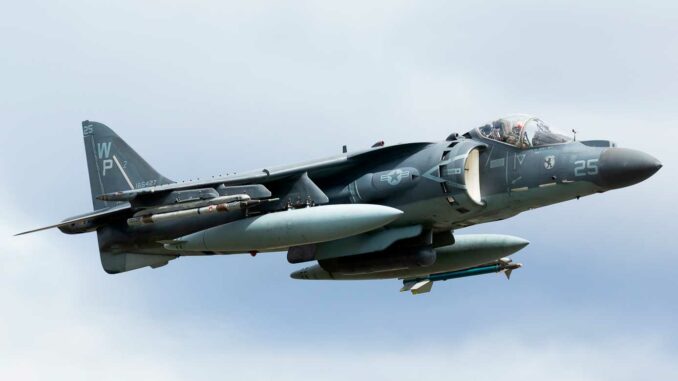
The US Marine Corps confirms the Harrier’s final retirement in 2026. End of a unique capability and transition to the F-35B.
Summary
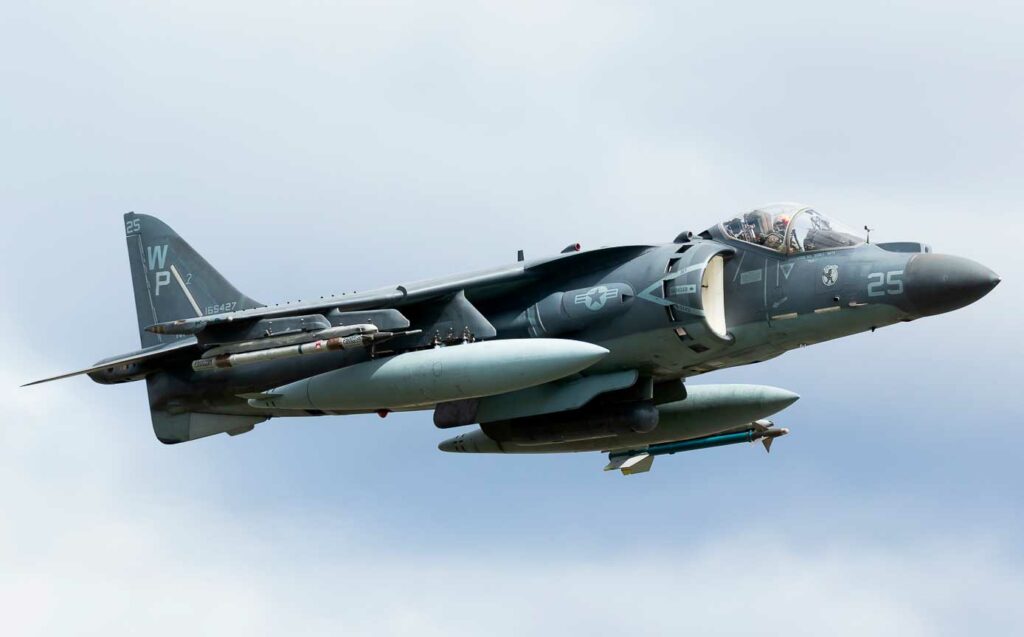
On January 2, 2026, the United States Marine Corps confirmed that the AV-8B Harrier II will officially reach its sundown in September 2026. Only one unit remains active today, Squadron VMA-223, the last repository of a capability that has marked American carrier-based and expeditionary combat aviation for more than four decades. This decision is not symbolic, but rather an operational, technical, and budgetary arbitration. The short takeoff and vertical landing aircraft, long indispensable for operations from rudimentary bases and amphibious ships, is reaching the end of its potential. Its successor is the F-35B, which is more versatile and better integrated with modern combat networks. The retirement of the Harrier marks the end of a unique operational philosophy and the Marine Corps’ entry into an entirely digital and stealthy era.
The official announcement of a now irreversible withdrawal
The timeline is no longer unclear. By confirming the date of September 2026 for the complete retirement of the AV-8B Harrier II, the Marine Corps is putting an end to years of gradual postponements. Since 2020, the fleet had already been in rapid decline. Several squadrons had been disbanded or converted, leaving only one operational squadron to ensure the transition.
The term sundown is not insignificant. It does not refer to simple retirement, but to the end of all operational, training, and deployment activities. The last aircraft will be removed from active service, with some going to museums and others serving as sources of spare parts or ground test platforms.
This announcement comes at a time of budgetary constraints. Maintaining an aging fleet was becoming increasingly costly, without offering operational gains comparable to those of newer platforms.
The Harrier, a historic pillar of expeditionary aviation
Introduced to the Marine Corps in the late 1980s, the AV-8B Harrier II profoundly transformed the way close air support was conceived. Its short takeoff and vertical landing capability allowed it to operate from runways as short as 300 m (1,000 ft), or even from reinforced roads or amphibious ship decks.
In asymmetric conflicts as well as conventional operations, this flexibility was decisive. The Harrier could be positioned close to ground forces, reducing response times and limiting dependence on major air bases.
With a maximum takeoff weight of approximately 14 tons (31,000 lb) and a payload of close to 4 tons (9,000 lb), the aircraft offered a rare compromise between firepower and flexibility of use. It was not designed for air superiority, but to strike quickly, close to the target, and then leave.
A fleet worn down by decades of service
While the Harrier has long provided essential service, its structural aging has become impossible to ignore. The majority of airframes still in service are over 30 years old, with thousands of flight hours accumulated in demanding environments.
The propulsion system, based on a single engine with swiveling nozzles, imposes severe thermal and mechanical constraints. Harrier maintenance is notoriously labor-intensive, with availability rates often below 60% in recent years.
Support costs have risen steadily. Each flight hour requires more technicians, rare parts, and structural checks. With performance remaining constant, the economic equation was no longer tenable in the face of more modern platforms.
Operational limitations in the face of current threats
The Harrier II remains a subsonic aircraft, lacking stealth and survivability capabilities suited to heavily defended environments.
In a context marked by the proliferation of modern surface-to-air systems, multi-band radars, and passive sensors, its use is becoming risky.
Its avionics, although modernized in successive stages, do not allow for native integration into current collaborative combat networks. Data fusion remains limited, as does the ability to fully exploit information from external sensors.
These weaknesses were not always a problem in permissive theaters. They become prohibitive when facing adversaries with credible anti-access capabilities.
The symbolic role of the last VMA-223 squadron
Maintaining a single active squadron is not only an operational function. It is also a symbolic and organizational choice. VMA-223 ensures the transfer of expertise, the final training of crews, and the gradual end of the Harrier’s life cycle.
This squadron plays a key role in managing the transition to the F-35B. The most experienced pilots and mechanics are involved in capitalizing on feedback, particularly on use from amphibious platforms and austere bases.
The planned disbandment of VMA-223 in 2026 will mark the end of a lineage dating back to World War II, which explains the special attention being paid to this final phase.
The F-35B as the obvious successor, but different
Replacing the Harrier with the F-35B is not just a matter of swapping airframes. It is a change in doctrine. The F-35B retains the short takeoff and vertical landing capability, but integrates it into a much broader architecture.
With its stealth capabilities, advanced sensors, and data fusion capabilities, the F-35B acts as both a sensor and a shooter. It can detect, analyze, and share information well beyond its own firing range.
However, this sophistication comes at a cost. The F-35B is more expensive to purchase and to fly. It requires more structured logistics and a robust digital infrastructure. The ruggedness of the Harrier, capable of operating in very harsh conditions, is partly lost.
Doctrinal consequences for the Marine Corps
The end of the Harrier is forcing the Marine Corps to rethink certain scenarios of use. Close air support from extremely basic sites is becoming more constrained. Dependence on networks, sensors, and electronic protection is increasing.
On the other hand, the Marine Corps is gaining informational reach and survivability in high-intensity conflicts. Expeditionary aviation is transforming into connected aviation, integrated into multi-domain combat.
This shift is consistent with U.S. strategic priorities, particularly in the Indo-Pacific, where the ability to operate in the face of complex anti-access systems is critical.
Turning the page without excessive nostalgia
The Harrier II occupies a special place in American military history. It demonstrated that tactical aviation could break free from traditional infrastructure and follow ground forces as closely as possible.
Its withdrawal is not an admission of failure, but a clear-eyed recognition of its limitations in a world where technology, connectivity, and survivability take precedence. The Marine Corps is not giving up on expeditionary warfare. It is redefining its contours.
When the last AV-8B leaves the runway in 2026, it will not be a simple farewell to an aircraft. It will be the end of a way of waging war from the air, replaced by another, more discreet, more integrated, and significantly more demanding one.
Sources
- United States Marine Corps – official communication dated January 2, 2026
- Department of Defense budget reports
- Historical technical data on the AV-8B Harrier II
- Marine Corps doctrinal publications on the transition to the F-35B
War Wings Daily is an independant magazine.