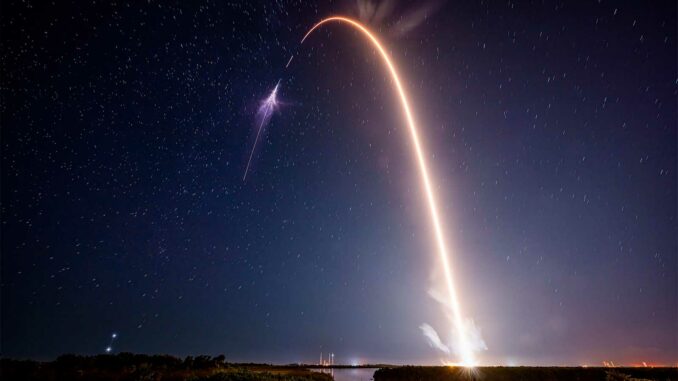
The Space Force has awarded SpaceX $739 million worth of launch contracts, confirming its central role in US military access to orbit.
Summary
In January 2026, the US Space Force awarded SpaceX a set of launch contracts totaling $739 million, covering nine national security missions for the Space Development Agency and the National Reconnaissance Office. These missions are part of the National Security Space Launch Phase 3 – Lane 1 program, intended for payloads considered to be of medium complexity. This decision illustrates a structural shift: SpaceX is no longer just one service provider among many, but a key player in the US space posture. Industrial reliability, launch cadence, cost control, and the ability to operate quickly explain this choice. Faced with Western competitors still constrained by limited launch rates and higher costs, SpaceX has established itself as the primary orbital projection tool for US military missions, strengthening its strategic weight well beyond the commercial sector alone.
The framework of the contract awarded by the Space Force
A major award under NSSL Phase 3 Lane 1
The contract announced by the U.S. Space Force covers nine launch missions, awarded under the NSSL Phase 3 program, specifically in the Lane 1 segment. This category covers national security payloads that do not require the most complex profiles, but nevertheless demand a high level of reliability and responsiveness.
The total amount of $739 million includes launch services, payload integration, ground operations, and specific constraints related to classified missions. Based on the number of missions, the average cost per launch is around $80 to $85 million, which is still below the historical standards for U.S. military programs.
Strategic customers: SDA and NRO
The missions mainly involve two key players in the US space architecture. The Space Development Agency, responsible for deploying low-orbit constellations for threat detection and tracking, and the National Reconnaissance Office, responsible for the most sensitive intelligence satellites.
This dual assignment underscores the confidence placed in SpaceX for critical missions, ranging from global surveillance to the resilience of command and intelligence capabilities.
Why SpaceX won most of the missions
Industrial superiority that has become structural
The first explanatory factor is SpaceX’s industrial capacity. In 2024 and 2025, the company carried out more than 90 launches per year, a pace unmatched in the Western world. This pace is based on an integrated organization, extensive standardization of the Falcon 9 and Falcon Heavy launch vehicles, and systematic reuse of the first stages.
For the Space Force, this capability translates into a clear operational advantage: the ability to plan launches in quick succession, quickly reschedule a mission, and guarantee near-continuous availability.
Proven reliability
Long perceived as a bold but risky player, SpaceX has reversed this image. Falcon 9 rockets now boast success rates of over 98%, including on classified missions. This reliability is essential for payloads whose unit value often exceeds several hundred million dollars.
For organizations such as the NRO, repeatability of performance has become as important as raw performance.
A decisive cost advantage
The budget factor remains central. Thanks to the reuse of stages and an internalized production chain, SpaceX offers prices significantly lower than those of its Western competitors. Even in a constrained military environment, the difference can reach tens of millions of dollars per launch.
In a context where the Space Force needs to rapidly deploy new constellations, this advantage makes it possible to increase the number of satellites launched on a constant budget, improving overall orbital resilience.
What the $739 million budget really represents
A political as well as an industrial signal
The announced amount is not exceptional in terms of the US military space budget, but it is highly symbolic. It confirms that SpaceX is now considered a trusted provider for national security, on a par with the traditional players.
It also marks a shift: the Space Force favors delivery capacity and speed of execution over systematic diversification of suppliers, as long as the overall resilience of the system is ensured.
A ripple effect on future batches
NSSL contracts operate in successive tranches. A successful award on Lane 1 automatically strengthens SpaceX’s position for future tenders, including more complex missions. Ultimately, this could further expand the company’s market share in military launches.
SpaceX’s central role in the US space program
A pillar of the proliferated constellation doctrine
The Space Force is increasingly relying on constellations of numerous satellites in low orbit to reduce vulnerability to anti-satellite attacks. This doctrine requires frequent and rapid launch capabilities.
SpaceX is currently the only Western player capable of sustaining such a pace without major disruption. This position makes it a critical link in the US space strategy.
Deep integration with military needs
Over the years, SpaceX has adapted its processes to military requirements: enhanced security procedures, dedicated infrastructure, and teams authorized to handle classified information. Launches from Vandenberg or Cape Canaveral are now integrated into the Space Force’s operational planning.
This functional proximity goes beyond the traditional customer-supplier relationship. It creates a strategic interdependence.
SpaceX versus its Western competitors
United Launch Alliance and the difficult transition
United Launch Alliance remains a key player in heavy military launches, but its transition to the Vulcan launch vehicle has been accompanied by delays and a still limited launch cadence. Costs remain higher, limiting its competitiveness on Lane 1 missions.
ULA retains a role in the most complex payloads, but its scope is narrowing in the face of SpaceX’s rise.
Europe and the lack of an immediate competitive solution
On the European side, institutional launchers suffer from low production rates and high costs. As things stand, they do not constitute a credible alternative for US military launches, even in a cooperative framework.
This situation accentuates the West’s dependence on SpaceX for rapid and massive access to orbit.
The real size of SpaceX and its operational weight
An extraordinary company in the space sector
SpaceX now employs several thousand people and operates at several major sites. It produces its own engines and launch vehicles and manages its launch infrastructure, giving it a rare vertical integration in the industry.
In terms of annual launches, SpaceX far exceeds all other Western players combined. This reality largely explains its attractiveness for military missions.
Rapid ramp-up capacity
Beyond this contract, SpaceX has a unique ability to rapidly increase its business volume. In the event of a major crisis requiring rapid redeployment of satellites, this capability becomes a decisive strategic asset for the United States.
Limitations and issues of dependence
Risk of industrial concentration
SpaceX’s dominance nevertheless raises a sensitive issue: that of excessive dependence on a single supplier. If a major technical incident were to temporarily immobilize the Falcon fleet, the impact on US space capabilities would be significant.
The Space Force is aware of this and seeks to maintain a minimum level of diversification, even if the industrial reality limits the options in the short term.
A delicate balance between efficiency and resilience
The choice of SpaceX illustrates a clear trade-off. In the short and medium term, operational efficiency takes precedence. In the longer term, the issue of industrial resilience will remain central, particularly in the face of rising anti-satellite threats and global strategic competition.
A contract that confirms a lasting shift
The award of $739 million in launches to SpaceX is not an isolated event. It confirms a shift that is already underway: US military access to space now relies heavily on a private player capable of operating on an unprecedented industrial scale.
This situation strengthens the strategic posture of the United States, but it also redefines the balance of power in the Western space sector. SpaceX is no longer just a commercial leader. It has become a central instrument of American space power, with all the responsibilities and questions that this implies for the future.
Sources
- SpaceNews, US Space Force announcement on NSSL Phase 3 contracts awarded to SpaceX
- Official U.S. Space Force press releases on national security launch programs
- Public data on SpaceX launch rates in 2024 and 2025
- Industry analyses of the NSSL Phase 3 program and competition among Western launch providers
War Wings Daily is an independant magazine.