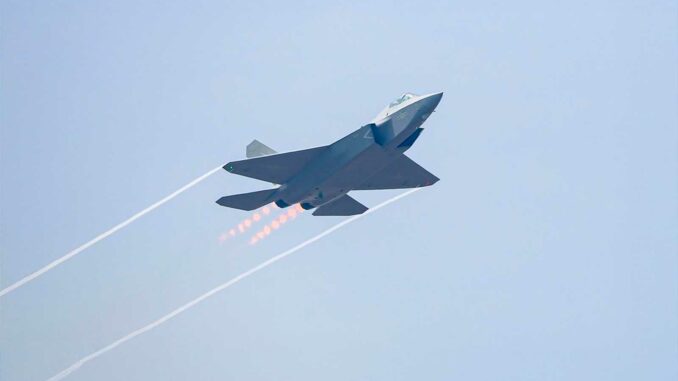
China is ramping up production of the J-35A, a medium-sized stealth fighter jet, with the aim of competing with the F-35 on the export market.
Summary
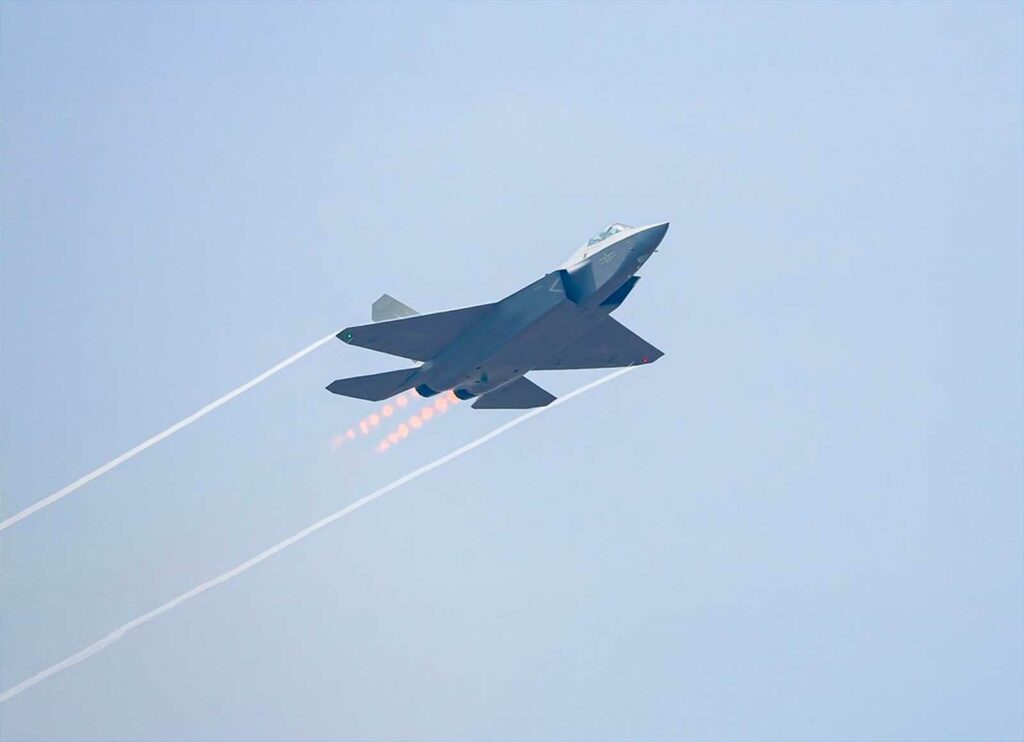
On January 12, several corroborating reports from Asian industrial and military sources indicated a marked acceleration in the production of the J-35A, also known by its export designation FC-31. Developed by Shenyang Aircraft Corporation, this medium-class stealth fighter is now reportedly being produced at a rate approaching that of the American F-35, a global benchmark in fifth-generation fighter aircraft. Beijing’s stated objective is clear: to establish itself as a dominant player in the stealth aircraft export market by offering a technologically credible, politically less restrictive, and financially more accessible alternative. If confirmed, this ramp-up in industrial production marks a turning point. It reflects the maturity of the J-35A program and China’s strategic ambition to leverage its domestic technological successes to gain military and diplomatic influence internationally.
The context of the announced industrial acceleration
A political as well as an industrial decision
The acceleration of the Shenyang J-35A production line is not solely an industrial choice. It is part of a broader state strategy aimed at strengthening China’s technological autonomy while consolidating its position in global arms markets. Unlike the initial phase of the FC-31 program, which was long perceived as hesitant, the J-35A version now enjoys strong institutional support.
China has learned from the development of the J-20. It has understood that the credibility of a modern fighter aircraft depends not only on its performance, but also on its mass production capacity, availability, and industrial sustainability.
A production rate close to Western standards
According to information available in early 2026, the target production rate for the J-35A would reach several dozen aircraft per year. While not yet reaching the annual peaks of the F-35, which has exceeded 150 units produced in some years, this ramp-up places the Chinese program in a category comparable to major international standards.
This change of scale is essential. It not only allows the Chinese forces to be equipped quickly, but also frees up sufficient volumes for export, which is a prerequisite for an aggressive trade policy.
The J-35A and FC-31, a mature program
A gradual but consistent technical evolution
The J-35A is the result of several iterations of the FC-31. Initially presented as a technology demonstrator, the program has evolved into a more sophisticated aircraft, incorporating optimized stealth architecture, more integrated sensors, and modernized avionics.
Although China has released little official data, observers agree on several points: a reworked airframe, reduced frontal radar signature, integration of internal weapon bays, and compatibility with new-generation sensors. The J-35A is clearly positioned as a medium stealth fighter, complementing the heavier J-20.
A platform designed for export from the outset
Unlike the J-20, which is reserved for Chinese forces, the FC-31 has always been designed with export in mind. This focus is reflected in its dimensions, estimated costs, and integration flexibility. Beijing is targeting countries that cannot access the F-35 for political, budgetary, or industrial reasons.
This logic is reminiscent of that once adopted by Russia with some of its fighters, but with one major difference: China is now capable of supporting large-scale industrial production.
Expected production volumes and their strategic significance
A gradual but structured ramp-up
Current estimates suggest annual production could exceed 40 to 50 aircraft in the medium term, if the pace stabilizes as announced. This volume would cover both domestic needs and initial export orders.
By way of comparison, few modern fighter programs outside the United States achieve such figures.
This capacity puts China in a favorable position to respond quickly to international demand, a decisive commercial argument.
A tool for commercial credibility
The ability to mass produce is a strong signal to potential customers. It guarantees reasonable delivery times, parts availability, and continuity of logistical support. In the fighter aircraft market, these criteria are as important as pure performance.
Clearly identified export targets
Countries excluded from the F-35 program
The J-35A’s primary target is countries that cannot access the F-35 due to political restrictions. This includes states subject to sanctions, non-aligned partners, or countries wishing to preserve strategic autonomy from the United States.
In this category, the J-35A appears to be the only credible stealth option available in the short to medium term.
Emerging markets with intermediate budgets
China is also targeting countries with significant defense budgets, but insufficient to absorb the full costs of the F-35. The estimated unit price of the J-35A would be lower than that of the F-35, even taking into account differences in configuration.
A typical contract, including aircraft, training, weapons, and support, could range from $4 to $6 billion for a medium-sized fleet, an attractive level for many air forces.
Asia, the Middle East, and Africa as priority areas
The target regions are clear. Southeast Asia, the Middle East, and parts of Africa are markets where China already has a strong diplomatic and industrial presence. The J-35A becomes a tool for projecting influence, beyond its strictly military dimension.
Expected budgets and economic impact
Contracts with high political value
Each sale of the J-35A goes beyond a simple commercial transaction. It is usually accompanied by training and maintenance agreements and sometimes partial technology transfers. These elements increase the overall value of the contracts and strengthen bilateral ties.
At the program level, a few major export sales would be enough to generate tens of billions of dollars over the aircraft’s lifetime.
Economies of scale favor Beijing
The ramp-up reduces unit costs. The more production increases, the more competitive the J-35A becomes. This logic of economies of scale strengthens China’s ability to adjust its prices in the face of Western or Russian competition.
Direct competition with the F-35
An inevitable but asymmetrical comparison
The F-35 Lightning II remains technologically superior in several aspects, including network integration and operational experience. However, the J-35A does not seek to beat the F-35 on all fronts. It targets a strategic niche: customers who are excluded from or reluctant to purchase the American model.
This competition is therefore less technological than geopolitical. China offers an alternative where the United States imposes strict conditions.
Growing influence on the regional balance
The introduction of the J-35A in certain regions could alter the local air balance. Even in limited numbers, a stealth fighter changes employment doctrines and forces neighbors to adapt their air defense systems.
The expected strategic influence for China
A lasting diplomatic lever
Each sale of the J-35A strengthens China’s influence in the long term. Pilot training, logistical dependence, software updates: these are all mechanisms that bind customers into a lasting relationship with Beijing.
This approach is part of a global strategy in which armament becomes a vector of strategic alignment, on a par with infrastructure and economic investment.
A signal to Western powers
The ramp-up of the J-35A sends a clear message. China is no longer content to catch up with Western standards. It seeks to shape the market and impose its own rules, particularly in segments where the West is hesitant or restricted.
A game-changing program without turning everything upside down
The J-35A is not yet a global equivalent of the F-35. It has neither the ecosystem nor the operational history. But the announced ramp-up is transforming its nature. It is moving from a promising project to a strategic industrial product, capable of influencing the choices of many countries.
The real question, therefore, is not whether the J-35A is superior or inferior to its Western competitors. It is to gauge how far China is willing to go to impose its model, and how many countries will be willing to take the plunge. In a fragmented world, China’s offer is now finding increasingly favorable ground.
Sources
- Asian trade press reports on the production of the J-35A
- Industry analyses of the FC-31 program and its development
- Open data on F-35 production rates
- Strategic studies on Chinese arms exports
- Observations by experts in combat aviation and defense markets
War Wings Daily is an independant magazine.