Between drones, cruise missiles, and ballistic missiles, Moscow is intensifying “mixed” raids to wear down Patriot and IRIS-T. Ukraine is taking the hits, the West is calculating.
Summary
Between January 13 and 20, 2026, Russia crossed a threshold in its air campaign against Ukraine. The figures speak for themselves: on January 13, an attack described as the most intense of the year so far combined around 18 missiles and 294 drones in a very short time frame. On January 20, Ukraine reported an even heavier barrage, with 18 ballistic missiles, 15 cruise missiles, and 339 drones, or more than 340 vectors in one night, with Kiev as the main target. This sequence confirms a now systematic doctrine: mixing fast (ballistic) vectors, difficult-to-detect (cruise) vectors, and a mass of inexpensive drones to fatigue defenses, deplete stocks, and find “holes” in the protective bubble. The aim is to exhaust Patriot and IRIS-T before Western reinforcements arrive, while putting Ukraine under psychological and energy pressure. In the short term, Russia is gaining momentum, learning and coercing. In the long term, it is betting on Western political wear and tear and industrial constraints on interceptors.
The figures that signal a step up
The week of January 13-20 is not an isolated episode. It is a structured escalation.
On the night of January 12-13, Ukraine suffered a wave described by several media outlets as the most sustained attack of early 2026, with approximately 18 missiles and 294 drones. The striking feature is the concentration in time: a “compressed” attack over a short period of time aims to overwhelm decision-making and coordination, not just radars.
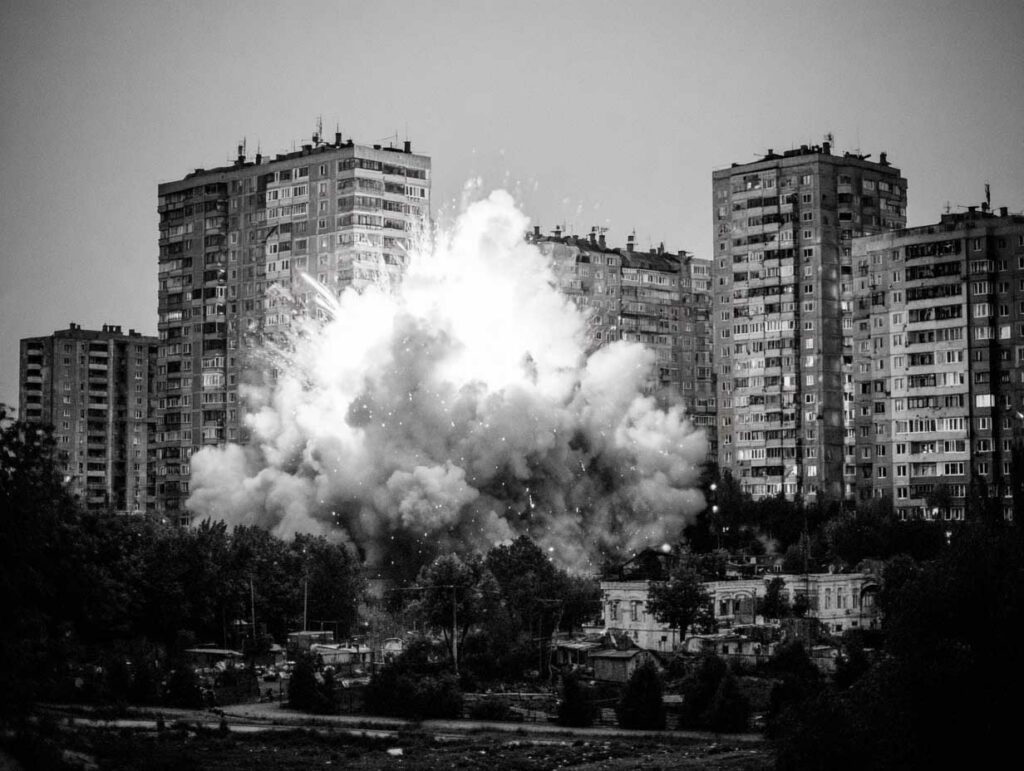
Then came the sequence of events on January 20. Ukrainian forces provided more precise details: 18 ballistic missiles, 15 cruise missiles, and 339 drones, for a total of more than 340 vectors engaged. The attack primarily targeted Kyiv, with visible effects on the energy and heating networks. The city council reported that more than 5,600 buildings were left without heating after the attack, in the midst of a severe cold spell. This is not simply “collateral damage.” It is an operational objective: to destabilize urban life.
What has changed here is not just the quantity, but the composition. This mix results in an attack with multiple speeds, multiple signatures, multiple altitudes, and multiple defense strategies.
Russia’s strategy focuses on attrition rather than a “decisive blow”
Since 2022, Moscow has been striking Ukraine with drones and missiles. The difference in 2026 lies in the method.
Russia appears to be applying a strategy of complex strikes aimed at three simultaneous objectives:
- degrading critical infrastructure (energy, distribution, heating, water),
- imposing disproportionate defensive expenditure,
- creating permanent operational stress on urban centers.
This approach resembles an attrition equation: if Ukraine fires too many interceptors at drones, it weakens its capacity to defend against missiles. If it conserves its interceptors, the drones strike more often, paving the way for more destructive weapons. In either case, Russia gains something.
It is also a learning strategy. Each massive raid allows Russia to test Ukrainian reactions, identify firing patterns, locate areas with less coverage, and adjust routes. The January 20 attack illustrates this principle: Ukrainian reports mention a Zircon and Iskander missiles, but also the use of Kh-101s, which diversifies flight profiles and makes interception more difficult.
The technical “cocktail” that breaks through layered defenses
Ukrainian defenses operate in layers: small arms and jamming against certain drones, medium-range systems for conventional air threats, and long-range systems for fast or dangerous missiles. The Russian mix breaks this logic, as it forces multiple layers to be engaged at the same time.
Drones as a mass erosion weapon
Shahed drones (and their derivatives) are the perfect weapon of attrition. They are less expensive than cruise missiles and force defenses to remain active for long periods of time. A swarm of drones also imposes human constraints: operators, monitoring, coordination, fatigue.
On January 20, the announced mass of drones was spectacular. Ukrainian authorities claimed to have shot down more than 300 drones, but several reached their targets. Even when “intercepted,” these drones had already fulfilled part of their mission: occupying radars, triggering fire, and forcing defenses to make trade-offs.
Cruise missiles as precision and circumvention weapons
Cruise missiles (including Kh-101) fly low, follow the terrain, and can approach from several angles. They are dangerous for infrastructure because they combine range, precision, and military payload. They force the defense to keep interceptors in reserve, which complicates the management of drones.
Ballistic missiles as a speed hammer
Ballistic missiles (Iskander-M, and sometimes missiles derived from surface-to-air systems) force the use of the rarest systems. They arrive quickly, with difficult trajectories, and reduce the decision window. They are the ones that “bring out” the most expensive ammunition.
This sequence is logical: drones to saturate, cruise missiles to bypass and strike effectively, ballistic missiles to force expenditure and break through when an opening appears.
The economic trap that directly targets Patriot and IRIS-T
The budgetary dimension is not secondary. It is probably one of the driving forces behind the tactic.
On January 20, Volodymyr Zelensky explained that Ukraine had used up nearly $100 million worth of interceptors in a single night. He also pointed out a brutal order of magnitude: a PAC-3 can cost around $3.7 million each. At this level, even a “successful” defense becomes a problem of sustainability.
The heart of the debate is about interceptors: how many can Ukraine fire, and how many can the West produce and deliver?
In the European segment, the IRIS-T is a good system, but it is limited by industrial production rates. An estimate cited in 2025 indicated that Diehl Defence was producing around 500 to 600 IRIS-T interceptors per year, with a target increase to 800–1,000 in 2026. Even if these figures increase, they remain insufficient in the face of repeated massive raids.
This is exactly what Russia is seeking to achieve: to turn modern air defense into an industrial and financial problem. And, ultimately, to force Kiev to make impossible choices: protect the big cities, protect infrastructure, or protect the front lines.
The direct consequences for Ukraine, beyond the visible damage
The most immediate consequence is the weakening of the power grid and associated networks (district heating, pumps, water). Winter strikes are a powerful psychological lever: they affect the population, disrupt the economy, and force the state to invest in repairs rather than military efforts.
The second consequence is tactical: Ukrainian air defenses must remain on constant alert, which wears down crews. The Russians know this. Defense is not just about missiles. It is a human and technical cycle.
The third consequence is strategic: if stocks dwindle, Ukraine must “let certain threats pass.” This does not mean immediate collapse.
It means a gradual decline in the probability of interception. And a gradual decline is enough for infrastructure to deteriorate over several weeks.
Finally, there is a political effect. Every night that Kyiv is plunged into cold and darkness becomes an argument in Western debates about the cost, duration, and priority of aid.
The immediate gains for Russia and what it is really seeking
Let’s be clear: these raids do not prove that Russia has won the war. They prove that it has found a way to make Ukraine’s defense costly and psychologically untenable.
The gains for Moscow are manifold:
- Material gains: a few hits are enough to disrupt a city.
- Psychological gains: the pressure on the population is constant.
- Industrial gains: Russia is testing its production lines and logistics.
- Doctrinal gains: it is adjusting its saturation tactics.
It is a war of attrition waged from the air. The goal is not to “destroy everything in one night.” The goal is to reduce Ukraine’s capacity to absorb the blows, night after night.
The international context that may favor Moscow, even without military victory
The diplomatic environment is as important as the terrain.
Russia is benefiting from three realities:
- Western industrial constraints on ammunition,
- political fatigue among certain electorates,
- uncertainty about the US trajectory, and therefore about the stability of aid.
If Ukraine receives more numerous and regular anti-aircraft reinforcements, the Russian model will reach its limits. But if deliveries remain irregular, then Moscow can maintain pressure and bet on time.
This is where the question of “Trump and Greenland” becomes interesting, but only hypothetically. A major crisis involving the United States in the Arctic or within NATO would cause a political and diplomatic shock. And this type of shock automatically offers Moscow an opportunity: to divert attention, fracture cohesion, and slow down aid decisions.
China, for its part, would observe a weakening of the Western message of unity and stability. It would see this as a useful precedent. India, more pragmatic, would seek to preserve its balance, while taking advantage of the margins for negotiation on energy and partnerships. In this scenario, Moscow would above all gain time, which is already an advantage.
The question that will matter: can Ukraine “industrialize” its defense?
The answer does not depend solely on Patriot or IRIS-T missiles. It depends on a logic of volume.
Ukraine must be able to shoot down drones at low cost, reserve expensive missiles for critical threats, and increase the number of sensors. This is the only way to break the Russian economic model.
This requires interceptor drones, cannons, simple guided munitions, and automated command. Several signs indicate that Kyiv is moving in this direction. But the speed of adaptation must exceed that of Moscow. Otherwise, saturation will remain profitable.
What is certain is that Russia did not invent this strategy for a “winter coup.” It is turning it into a method.
Sources
- Reuters, “Russia hits Kyiv with drones and missiles, cutting power, water supplies,” January 20, 2026
- Associated Press, “Russia batters Ukraine’s power grid again…,” January 20, 2026
- The Kyiv Independent, “Russia attacks Kyiv with ballistic missiles… 18 ballistic, 15 cruise missiles, 339 drones,” January 20, 2026
- Le Parisien, “Ukraine hit by around 20 missiles…”, January 13, 2026
- Euronews, “Russia launches major attack…”, January 13, 2026
- Challenges, “Ukraine suffered the most intense Russian air attack…”, January 13, 2026
- Business Insider, “Ukraine burned nearly $100 million worth of missiles… PAC-3 cost,” January 20, 2026
- IISS, “Ukraine’s ground-based air defense: evolution, resilience and pressure,” February 24, 2025
- Re:Russia, “Missile-Financial Balance… IRIS-T interceptor production,” July 17, 2025
War Wings Daily is an independant magazine.