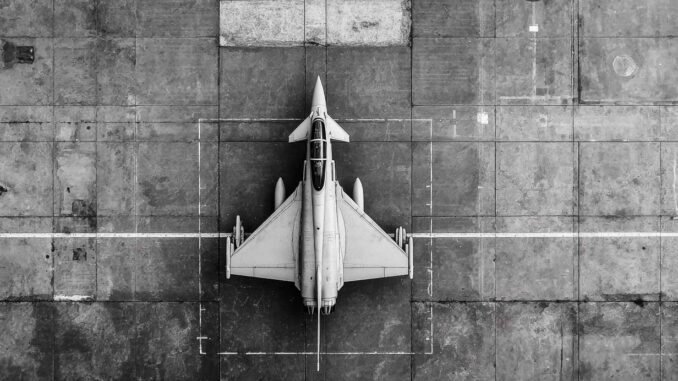
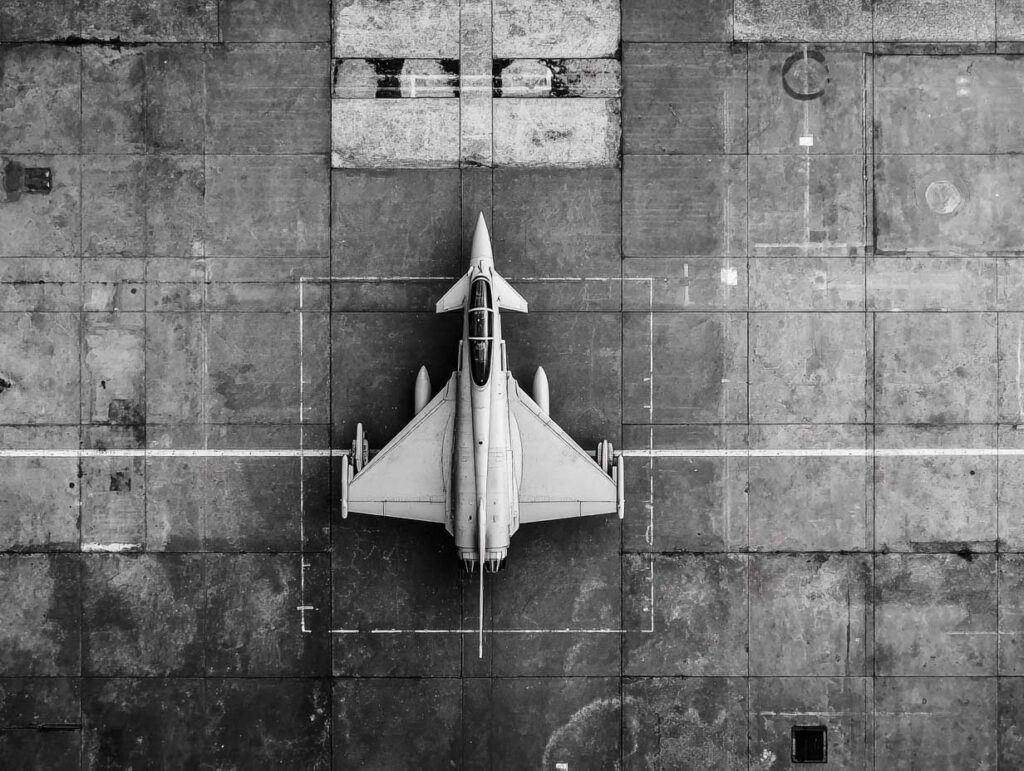
London launches production of 40 ECRS Mk2 radars for the Typhoon. An AESA and electronic warfare leap that weighs on deterrence and exports.
In summary
The United Kingdom has just taken a major step forward in the modernization of its air defense. On January 22, the Ministry of Defense awarded a £453.5 million contract to a consortium led by BAE Systems and Leonardo UK, with Parker Meggitt, for the complete production of 40 ECRS Mk2 radars for the RAF’s Typhoon fleet. The challenge is simple: to keep a fighter aircraft relevant in the face of faster, more numerous and better-protected threats. The ECRS Mk2 is not just a more powerful radar. It combines detection and advanced electronic warfare capabilities, with the ability to operate across the electromagnetic spectrum while tracking targets. It is this versatility that changes the tactical balance. Beyond combat, the contract secures more than 1,300 highly skilled jobs and strengthens a key industrial base in Scotland and England. The Typhoon, often described as “mature,” proves that it can still evolve significantly and remain a credible lever of power for London.
The British contract that locks in a long-awaited modernization
The figure is clear: £453.5 million. So is the political signal. The United Kingdom has officially launched series production of the ECRS Mk2 to equip its Typhoon fleet. Behind the announcement lies a weighty decision, prepared over several years and often postponed due to budgetary considerations.
The choice is not only technical. It is strategic. The RAF is keeping the Typhoon as the cornerstone of its air policing, early warning, and some of its first-entry missions. In this role, a more powerful and intelligent radar is not a “plus.” It is a condition for operational survival.
The contract covers 40 “standard production” radars and associated equipment. An important nuance is circulating in the industrial details: 38 radars would be intended for integration on Tranche 3 aircraft, with additional units for reserve, qualification, or support. This type of logic is classic. You don’t modernize a fleet without planning for spare parts and test benches.
Another point to note is that the first deliveries are not expected “tomorrow morning.” Authorities are talking about deliveries starting “later in the decade.” This is consistent with a complex radar program, which requires testing, flight validation, avionics integration, and industrialization.
The technological leap brought about by a new-generation AESA radar
To understand the impact, we need to move beyond the slogan “AESA = better.” An AESA radar is not just more modern than a mechanical radar. It changes the way we fight.
The difference between mechanical scanning and electronic scanning
The Typhoon’s historic Captor-M radar is based on a mechanical antenna. It “looks” at an area by physically orienting its beam. The principle works, but it has limitations: scanning speed, flexibility, and the ability to perform multiple tasks at the same time.
An AESA works differently. The beam is oriented electronically, without any physical movement of the antenna. The immediate result:
- Search is faster.
- Multi-target tracking is more robust.
- Resistance to jamming is improved.
- Air-to-air and air-to-ground modes can be chained more effectively.
This is not magic. It is powerful engineering, signal processing, and sophisticated spectrum management.
The logic of “multi-mission” at the same time
The strength of the ECRS Mk2 is precisely its stated ability to perform radar and electronic warfare simultaneously. This is where the Typhoon “changes category”: the aircraft can search, identify, track, and engage, while emitting effects on the spectrum.
This opens up more offensive scenarios. In modern warfare, survival does not depend solely on stealth. Survival also depends on the ability to disrupt the adversary, degrade their sensors, and create uncertainty.
Electronic warfare capabilities that transform the Typhoon into an attack system
The official line emphasizes one point: radar is not just for “seeing far.” It is also for taking action.
The central promise is integrated electronic attack. Radar then becomes a tool for putting pressure on the enemy, not just a sensor.
A capability clearly aimed at SEAD
In air force vocabulary, this is referred to as SEAD: neutralizing or reducing enemy air defenses. The ECRS Mk2 is presented as capable of locating transmitters, contributing to identification, and disrupting ground-to-air systems through powerful and adaptive emissions.
In other words, an equipped Typhoon can help “open a door” for other platforms, or for itself, by making the enemy’s response less reliable.
This idea is important to the RAF. The UK does not want to rely solely on a single family of aircraft to “make the entry.” It is looking for a consistent combat capability, in which the Typhoon remains useful when the skies become hostile.
Survivability through spectrum, not just speed
Electronic warfare is not a gimmick. Jamming, deception, and spectrum management often determine who fires first and who survives after the first exchange.
Recent conflicts have made this reality more visible: radars are hunted down, the spectrum is saturated, and platforms that cannot operate in electromagnetic fog become blind.
The ECRS Mk2 aims to reduce this vulnerability. It does not make an aircraft invincible. It makes the adversary less certain of its own tactical picture.
The direct consequences for the RAF and its daily missions
The RAF is not modernizing for a brochure. It is modernizing for its real missions: alert, deterrence, and projection.
A more robust air policing force in the face of complex threats
The Typhoon remains the UK’s primary alert aircraft. As such, a more powerful radar improves:
- the detection of fast-moving targets,
- earlier identification,
- more stable tracking in busy environments.
This is particularly useful in the face of ambiguous trajectories and “gray” behavior around NATO airspace. Better radar gives more room for decision-making, thus reducing the risk of error.
Enhanced capability against asymmetric threats
The British statement also refers to drones and saturation threats. Here, a more modern radar can help, but we must not sell a myth.
An AESA radar improves the detection of small targets in certain scenarios, but anti-drone warfare also depends on:
- rules of engagement,
- available ammunition,
- the ability to track multiple targets,
- ground-to-air coordination.
The ECRS Mk2 is an accelerator, not a single solution. It is part of a package that includes surveillance, ground-to-air systems, and command.
A Typhoon that remains credible in coalition
The UK rarely operates alone. The advantage of advanced radar is also interoperability. A modernized Typhoon can contribute to the common tactical situation, threat location, and coordination of multi-aircraft missions.
“Collaborative combat” is not limited to drones. It is also the ability of multiple platforms to share a coherent image and distribute roles.
The industrial effect: jobs, skills, and technological sovereignty
One of the areas most emphasized by London is employment: more than 1,300 highly skilled jobs secured, sometimes announced as more than 1,500 according to public communications.
This figure is not just for show. It reflects a reality: a modern AESA radar requires rare skills.
- RF design,
- power electronics,
- microwaves,
- real-time software,
- avionics integration,
- testing in complex electromagnetic environments.
The United Kingdom has an interest in keeping this expertise on its soil. Not only for the Typhoon, but also for future programs.
This contract also stabilizes strategic industrial sites, particularly in Scotland, while supporting a subcontracting chain. Modern defense is no longer just a matter of factories. It is a matter of ecosystems.
The role of Italy and Leonardo in a UK-led but European program
The BAE-Leonardo partnership deserves to be understood correctly. The leadership is British, but Leonardo is a key player in the radar, from the design to the manufacture of certain major components.
This industrial cooperation also reflects the history of the Typhoon: a European aircraft, but with standards that sometimes differ from country to country.
In fact, there are several ECRS variants:
- versions already delivered to certain export customers,
- versions planned for other partners,
- and this Mk2 version, more specific to British needs.
This fragmentation has a cost. But it also allows the product to be adapted to a doctrine. The United Kingdom wants a more offensive Typhoon in the spectrum, with clear added value in air defense suppression.
The impact on exports: why a radar can revive a “mature” aircraft
A fighter jet is not sold solely on its airframe. It is sold on its evolution trajectory. A customer buys a capability, but also a promise: to last 20 years, to receive upgrades, to remain supported.
With the ECRS Mk2, the Typhoon is giving itself a new lease of life. It can be presented as a more relevant aircraft in contested environments, with a versatility of radar and electronics that appeals to many armies.
There is another effect: a national standard sometimes pushes other customers to fall in line. Countries often want to avoid being alone with an exotic configuration. If the RAF puts the Mk2 into service, it can serve as a technical showcase, or even a political argument.
The question no one can avoid: cost-effectiveness
Let’s be blunt. £453.5 million for 40 radars is a serious investment. On a “per radar” basis, this seems high, even if the contract includes production, integration, support, and associated equipment.
The real metric lies elsewhere: how many Typhoons will actually be converted? What is the availability? How easy is it to maintain? What EW capability has actually been demonstrated in exercises?
If the Mk2 brings a real breakthrough in mission capability, the cost becomes rational. If integration becomes long and complicated, the program will be criticized, even if the technology is excellent.
The trajectory London is charting for the Typhoon until the 2030s
This modernization is part of a broader context: the Typhoon must remain a “sustainable” pillar while other programs ramp up. The United Kingdom is investing in several horizons.
The ECRS Mk2 acts as a technological bridge:
- it maintains high-intensity capability,
- it keeps an active industrial base,
- it prepares for future generations.
This is not the end of a cycle. It is an adaptation in the middle of a cycle, in a world where the electromagnetic spectrum is becoming as decisive as kinematics.
What this radar really tells us about European defense
The United Kingdom is modernizing the Typhoon for one simple reason: threats are increasing, and the long industrial lead time requires anticipation.
But this contract also says something else: European air power can no longer be limited to the platform. It must master the sensor, electronic warfare, software, and production.
If the ECRS Mk2 delivers on its promises, the British Typhoon will not just be “an aircraft that is still capable.” It will become a more dangerous tool, more complex to counter, and more useful in coalition. It may not be as spectacular as a new stealth airframe, but it is exactly the kind of modernization that quietly tips the balance of power in the right direction.
Sources
- Reuters — “UK to spend $608 million on radar upgrade for Typhoon fighter jet”
- Defense Equipment & Support (DE&S) — “State-of-the-art radar production contract secures 1,300 UK defense jobs”
- UK Government (GOV.UK) — “Half a billion investment to upgrade RAF Typhoons and secure 1,500 British jobs”
- BAE Systems — “New investment to deliver advanced radar for Royal Air Force Typhoon fleet”
- Leonardo UK — “UK government confirms £453m investment in radar for Royal Air Force Typhoon fleet”
- FlightGlobal — “UK signs ECRS Mk2 radar production deal for Royal Air Force’s Tranche 3 Typhoon upgrade”
- Eurofighter — “On Our Radar | Eurofighter Typhoon (ECRS Mk2 overview)”
- The Aviationist — “New RAF Typhoon ECRS Mk2 AESA Radar Upgrade Contract Awarded”
- Journal of Electronic Defense — “Typhoon Profile: ECRS Radars Introduce Electronic Attack Functionality”
- European Security & Defense — “Leonardo Delivers First ECRS Mk2 Radar to BAE Systems”
War Wings Daily is an independant magazine.