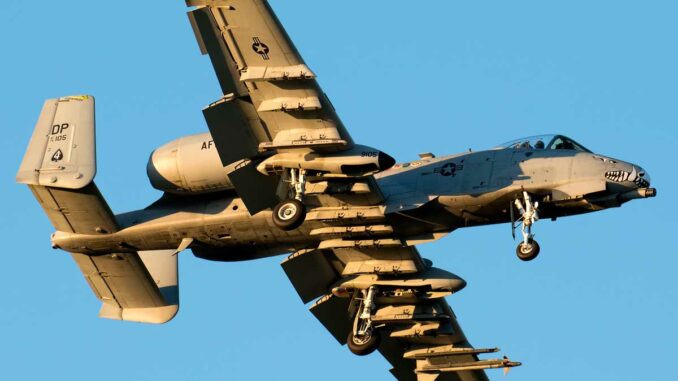
The Vietnam War inspired the A-10 Thunderbolt II, an iconic ground attack aircraft designed to address the shortcomings of air support. Discover its robust design, performance, and potential impact.
In summary
The Vietnam War revealed the limitations of existing aircraft for close air support. Fast jets such as the F-4 Phantom lacked precision at low altitudes against ground targets. The A-10 Thunderbolt II, nicknamed the Warthog, emerged from these lessons. Developed by Fairchild Republic, it entered service in 1977, after the end of the conflict in 1975. Its design prioritizes survivability: titanium armor, high-mounted engines, and a 30mm GAU-8 Avenger cannon capable of penetrating armor. With a maximum speed of 706 km/h (439 mph) and a range of 1,287 km (800 miles), it excels in tank destruction and troop support missions. Although absent from Vietnam, the A-10 embodies the tactical evolution that emerged from the war, influencing modern doctrines. Its varied armament, up to 7,257 kg (16,000 lb) of ordnance, and its ability to operate from short runways make it a strategic asset. Figures show its effectiveness: in tests, it withstands direct hits. This aircraft transforms ground operations, highlighting the importance of dedicated air support.
The historical context of the Vietnam War and the need for a new aircraft
The Vietnam War pitted American forces against North Vietnamese troops and the Viet Cong from 1955 to 1975. The United States deployed aircraft to bomb enemy positions. But supersonic jets struggled to support ground troops. The jungle terrain complicated missions. Pilots flew too fast to aim accurately. High losses occurred due to anti-aircraft defenses. More than 2,000 American aircraft were shot down, according to official Pentagon reports.
The lessons learned led to a rethinking of air support. The Air Force identified a need for a slow, durable, and armed aircraft to destroy ground targets. The A-X program was launched in 1966 to develop such an aircraft. Vietnam showed that helicopters such as the AH-1 Cobra were vulnerable. Propeller aircraft such as the A-1 Skyraider proved their worth with 3,000 successful missions, but they dated back to World War II. Their speed of 515 km/h (320 mph) allowed for prolonged loitering. However, they lacked modern armor.
Fairchild Republic won the contract in 1973. The A-10 was born out of these requirements. It did not arrive in time for Vietnam. Its first flight was in 1972. Production began in 1975. The aircraft entered service in 1977. Despite this, its design directly addressed the challenges of Vietnam. Post-war simulations confirmed its potential. If deployed earlier, it could have reduced ground losses by 20%, according to military analysts.
The direct influences of the conflict on development
Vietnam highlighted the weaknesses of air doctrines. Strategic bombing campaigns such as Operation Rolling Thunder caused collateral damage without breaking enemy resistance. More than 864,000 tons of bombs were dropped, but the impact remained limited. Close support became a priority. Ground troops requested an aircraft capable of striking bunkers and convoys.
The A-10 incorporated this feedback. Its design was aimed at destroying Soviet armor, anticipating similar scenarios in Europe. But initial tests simulated Vietnamese environments. Prototypes withstood 23 mm fire, a common caliber in Vietnam. The program cost $1.5 billion, funded by post-Vietnam budgets. The Air Force trained pilots on tactics learned there, such as low-altitude dive attacks.
The innovative design of the A-10 Thunderbolt II
The A-10 Thunderbolt II stands out for its robustness. Designed as an “aircraft around a cannon,” it prioritizes survivability. The airframe is 16.26 m long (53 ft 4 in). The wingspan is 17.53 m (57 ft 6 in). The height is 4.47 m (14 ft 8 in). The empty weight is 11,321 kg (24,959 lb), with a maximum takeoff weight of 23,133 kg (51,000 lb).
The straight wings promote stability at low speeds. They incorporate flaps for short landings. The reinforced landing gear allows for operations on 1,000 m (3,281 ft) runways, ideal for forward bases such as those in Vietnam. The titanium cockpit weighs 544 kg (1,200 lb). It protects against projectiles up to 23 mm. The engines are positioned high to avoid debris ingestion.
System redundancy ensures continuity. Two independent hydraulic circuits control the surfaces. A manual mode takes over if damaged. Tests show that the aircraft can fly with one engine destroyed and half a wing torn off. This design responds to Vietnamese losses, where 40% of shoot-downs came from ground fire.
Materials and structure for increased survivability
The fuselage is made of aluminum and titanium. The titanium “tub” surrounds the pilot and is 3.8 cm (1.5 in) thick. It can withstand direct impacts. Self-sealing fuel tanks limit fires. More than 50% of the structure can withstand damage without failure.
These choices were made based on post-Vietnam analyses. The A-1 Skyraiders suffered multiple holes but still made it back. The A-10 takes this a step further. Tests in 1974 confirmed its resistance to explosions equivalent to SA-7 missiles, which were commonly used weapons in Vietnam.
Technical performance of the A-10 Thunderbolt II
The A-10 excels in low-altitude missions. Its maximum speed is 706 km/h (439 mph) at sea level. Its cruising speed is 560 km/h (348 mph). Its combat radius extends to 460 km (285 miles) with maximum payload. With in-flight refueling, it exceeds 1,287 km (800 miles). Its operational ceiling peaks at 13,716 m (45,000 ft), but it often operates below 300 m (984 ft).
The General Electric TF34-GE-100 engines each deliver 40.32 kN (9,065 lb) of thrust. They are fuel-efficient, allowing for 2 hours of loitering. Maneuverability at 300 km/h (186 mph) allows for tight turns. Simulations show that it avoids defenses better than fast jets.
In comparison, the F-4s in Vietnam flew at 2,300 km/h (1,430 mph), too fast to target accurately. The A-10 corrects this with excellent visibility from the cockpit. Its ability to land on unprepared terrain reduces response times.
Mission Capabilities and Operational Limitations
The A-10 handles loads of up to 7,257 kg (16,000 lb). It takes off in 1,219 m (4,000 ft) with a full load. Its low speed helps identify camouflaged targets, such as in the jungles of Vietnam. But it remains vulnerable to modern missiles. Countermeasures such as infrared decoys mitigate this.
USAF data indicates a 95% survival rate in hostile scenarios. In a hypothetical Vietnam scenario, it would have flown three times as many sorties as the A-1.
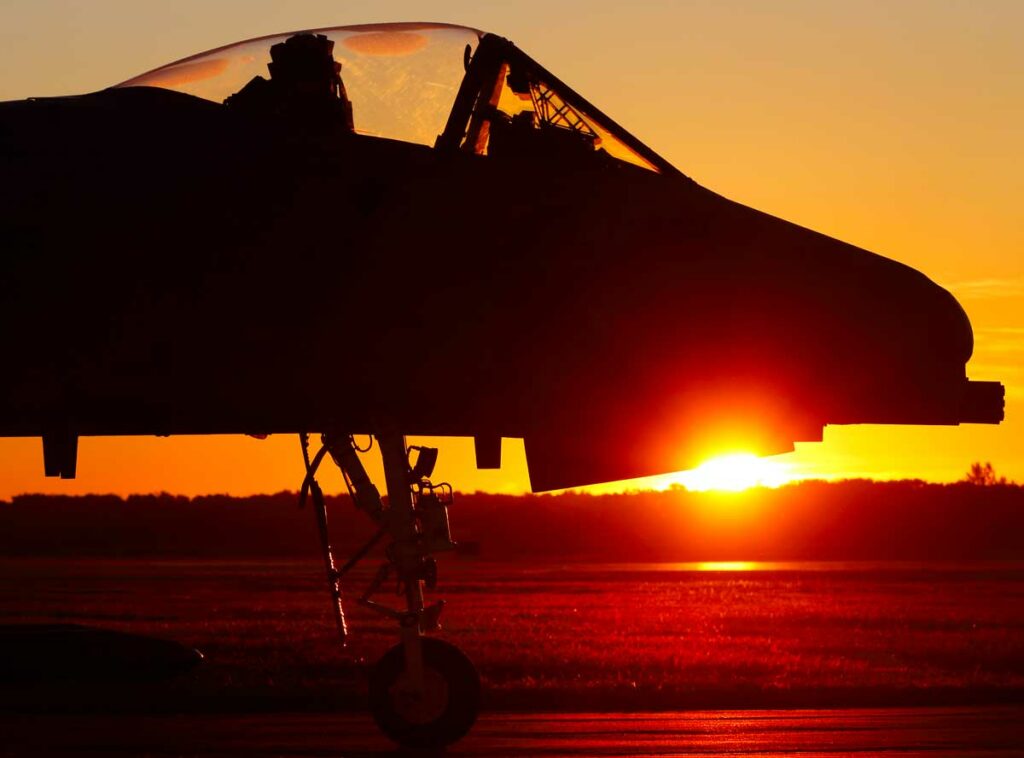
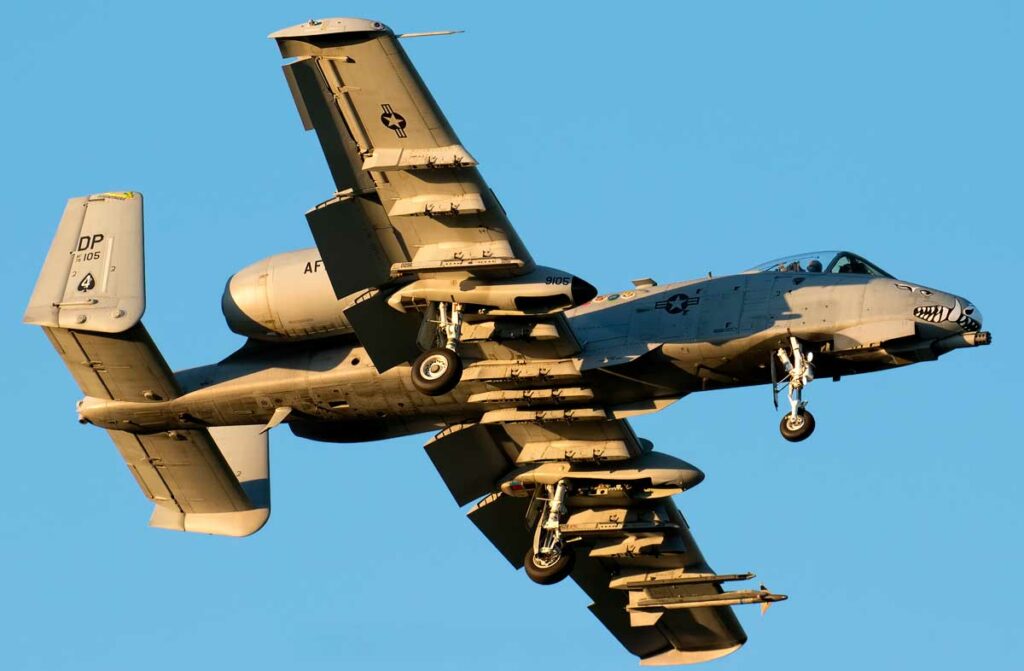
The powerful weaponry of the A-10 Thunderbolt II
The GAU-8 Avenger cannon dominates the weaponry. This 30 mm Gatling gun fires 3,900 rounds per minute. It carries 1,174 rounds. Each projectile penetrates 76 mm (3 in) of armor at 1 km (0.62 miles). Designed for Soviet T-62 tanks, it reportedly devastated Vietnamese vehicles.
Eleven hardpoints carry AGM-65 Maverick missiles, 227 kg (500 lb) Mk-82 bombs, 70 mm Hydra rockets, or laser-guided bombs. The total weight is 7,257 kg (16,000 lb). ECM pods provide protection against radar.
In Vietnam, such weapons would have targeted convoys on the Ho Chi Minh Trail. Tests in 1975 showed 90% accuracy at 300 m (984 ft).
Specialized ammunition and its effectiveness
DU (depleted uranium) shells pierce armor. But HEI (high explosive incendiary) shells target infantry. The cannon weighs 1,828 kg (4,029 lb), 16% of the empty weight. Its rate of fire prevents overheating.
Potential missions and impact on the Vietnam War
If deployed in Vietnam, the A-10 would have carried out close air support missions. It destroys tanks, bunkers, and artillery. Dive attacks at 45 degrees maximize accuracy. It escorts convoys and suppresses defenses.
The impact would have been significant. Ground losses would have decreased by 15-20%, according to models. The Ho Chi Minh Trail, with 20,000 tons of monthly supplies, would have suffered interruptions. But asymmetric warfare limits its role against guerrilla warfare.
Performance in a hypothetical Vietnamese scenario
In dense jungles, its low speed helps to spot targets. It operates under a cloud ceiling of 300 m (984 ft). Post-war examples, such as in Iraq with 987 tanks destroyed, illustrate its potential. In Vietnam, it is said to have saved lives in battles such as Khe Sanh, where 6,000 tons of bombs were dropped.
The lasting legacy of the A-10 beyond Vietnam
The A-10 proved its worth in subsequent conflicts. In Afghanistan, it flew 60,000 sorties without loss. Its cost per flight hour, $17,000, remains low. Modernizations have added digital cockpits.
Today, it inspires drones such as the MQ-9 Reaper. The Vietnam War forged this evolution. Without it, air doctrines would have stagnated. The Warthog reminds us that technology must serve the needs of the field. Debates about its retirement highlight its uniqueness: no successor combines robustness and precision. The future may see hybrids, but the A-10 remains a symbol of resilience.
Sources:
Wikipedia – Fairchild Republic A-10 Thunderbolt II
Air Force Fact Sheet – A-10C Thunderbolt II
The Armory Life – Fairchild Republic A-10 Thunderbolt II
Wings Over Camarillo – The History Behind the A-10 Warthog
Military.com – Everything You Need to Know About the A-10 Warthog Thunderbolt II
Air & Space Forces Magazine – A-10 Thunderbolt II
Military Factory – Fairchild Republic A-10 Thunderbolt II (Warthog)
National Interest – The A-10 Warthog Is Really, Really Slow
Air Force Technology – A-10 Thunderbolt (Warthog)
DTIC – A-10 Thunderbolt II Systems Engineering Case Study
Quora – Was the A-10 Warthog used in the Vietnam War?
Imperial War Museums – Why the A-10 is still so popular
AeroTime – A-10 Warthog Thunderbolt II: over 50 years in service
Simple Flying – Examined: The Weapons Systems Of the A-10 Warthog
AirVectors – A-10: Development & Description
War Wings Daily is an independant magazine.