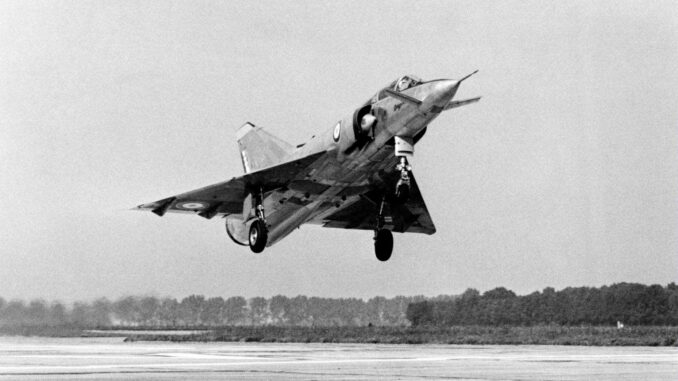
Long before the Rafale, the Mirage Milan tested retractable canards. A bold aerodynamic innovation, too complex for its time.
Summary
The Dassault Mirage Milan occupies a special place in the history of French military aviation. Designed in the late 1960s, this experimental prototype was never mass-produced. However, it introduced a radical aerodynamic solution: retractable canards, nicknamed “whiskers”, housed in the nose of the aircraft. Their purpose was not aesthetic, but functional: to improve pitch control and lift at low speeds without compromising the delta’s high-speed performance. By allowing the aircraft to pitch up without excessive use of elevons, the Milan explored a path that would later be fully exploited on the Rafale. However, the program ran into difficulties due to its high mechanical complexity and unfavorable industrial trade-offs. The Mirage Milan remains a little-known demonstrator today, but it is essential for understanding the genesis of modern canard aircraft designs.
The Mirage Milan in the context of delta-wing Mirages
At the end of the 1960s, Dassault Aviation capitalized on the success of its delta-wing aircraft. The Mirage III established itself as a fast and robust interceptor. The Mirage 5 is a simpler version, designed for ground attack. In this context, the Mirage Milan appears as an experimental evolution, intended to correct one of the structural flaws of the pure delta wing.
A delta wing offers excellent high-speed performance and good supersonic capability. However, it has limitations at low speeds. During approach and landing, the pilot must increase the angle of attack significantly to maintain lift. This configuration results in high drag and a loss of control surface effectiveness. The Milan was born precisely out of this operational constraint.
The aerodynamic limitations of the classic delta wing
On a delta wing without horizontal surfaces, pitch control relies mainly on elevons. To achieve a nose-up moment, these surfaces must be deflected upward. However, this deflection reduces the overall lift of the wing, as it disrupts the airflow and decreases the maximum lift coefficient.
At low speeds, this situation is detrimental. The aircraft must fly with a high angle of attack, which increases induced drag and reduces safety margins. On short runways or under heavy loads, performance deteriorates rapidly. Dassault engineers therefore sought a solution to generate pitch moment without sacrificing main lift.
The Mirage Milan’s “whiskers”: a conceptual breakthrough
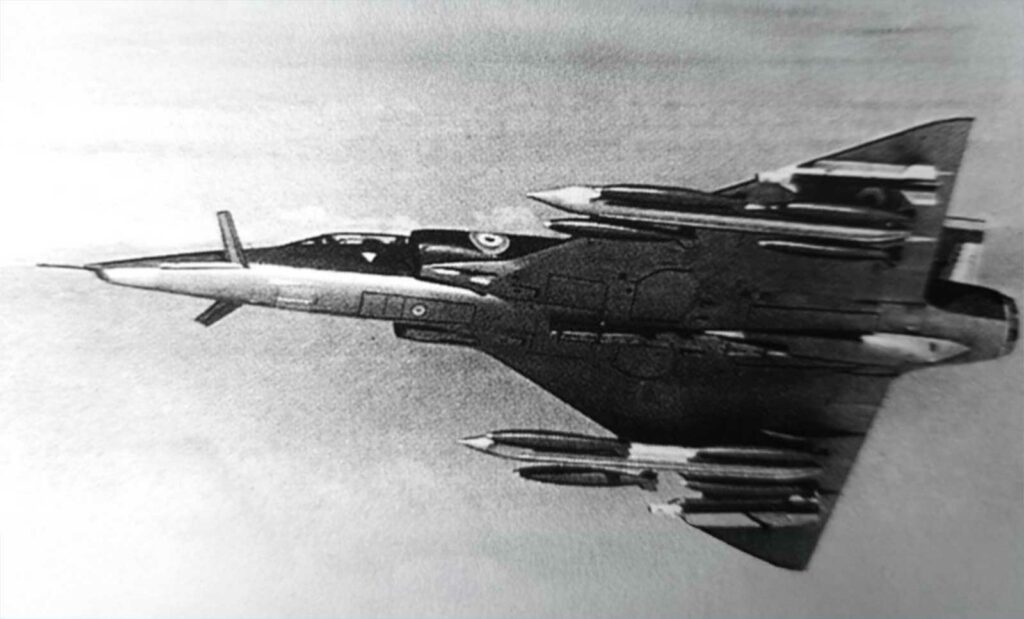
The solution they came up with was bold: add canard wings to the front of the aircraft. But not just any canard wings. On the Mirage Milan, these surfaces are retractable. At high cruising speeds, they disappear into the nose to maintain aerodynamic efficiency. At low speeds, they deploy and generate lift.
These wings, nicknamed “whiskers” because of their position and shape, generate natural pitch-up torque. The nose rises without the ailerons needing to be turned excessively. The delta wing thus regains more consistent lift.
The benefit is twofold: improved longitudinal stability and improved approach speeds. Tests show that the Milan can reduce its landing speed by several tens of kilometers per hour compared to a standard Mirage 5 of comparable weight.
The aerodynamic change induced by the deployment of the canards
From an aerodynamic point of view, the canards profoundly alter the distribution of forces. When extended, they create positive lift at the front, which shifts the center of lift forward. The resulting pitch moment reduces the need for compensation by the rear surfaces.
On a delta wing, this approach is particularly relevant. Instead of “breaking” the lift of the wing with sharply deflected elevons, the Milan maintains a cleaner flow. The result is better overall efficiency at low speeds.
This logic clearly foreshadows that of the Rafale. The difference is that, on the Rafale, the canards are fixed and integrated from the design stage.
The Milan, on the other hand, explores a transitional solution, compatible with a cell derived from the Mirage 5.
The mechanical complexity of a retractable canard
While the aerodynamic concept is elegant, its implementation is formidable. The Milan’s canards must fold into the nose, an area already constrained by radar, avionics, and pressurization.
Each wing is mounted on an articulated mechanism capable of withstanding significant aerodynamic loads. At low speeds, a canard of this type can withstand several tons of force. The system must therefore be rigid, reliable, and precise, while remaining compact enough to be retracted.
The difficulty is compounded by the pressurization of the nose cone. Integrating a moving surface into a pressurized area requires complex seals, strict tolerances, and frequent inspections. At the time, these constraints weighed heavily in the assessment of cost and maintainability.
Flight tests and lessons learned
The Mirage Milan made its first flight in 1967. Test campaigns confirmed the benefits of the device. Pilots noted improved stability during approach and a feeling of increased control at low speeds.
However, the tests also revealed some drawbacks. The mechanism was sensitive to stress and required rigorous maintenance. The operational gains, while real, did not entirely offset the penalties in terms of weight and complexity.
At a time when simplicity and robustness were major criteria for export, the Milan appeared too sophisticated for a market still dominated by immediate cost and reliability requirements.
A direct precursor to the Rafale, but without commercial success
The Mirage Milan did not go into series production. No customers signed up. However, its legacy is clear. Dassault’s engineers learned the main lesson: canards are effective, but they must be integrated from the outset, without a retraction mechanism.
Two decades later, the Rafale adopted fixed canard wings, optimized to work in conjunction with the delta wing. Thanks to electric flight controls, the natural instability of the assembly was controlled and exploited to improve maneuverability.
The Milan thus appears as a technological stepping stone. It demonstrates the validity of the concept, while highlighting its limitations when grafted onto an existing airframe.

The Mirage Milan in the history of Dassault innovation
This program illustrates a constant at Dassault: testing solutions in real-world conditions, even if they do not immediately lead to commercial success. The Milan is neither a total failure nor a forgotten prototype. It is a flying laboratory.
It also reminds us that aeronautical innovation progresses through trial and error and compromise. What is too complex at one point in time may become obvious twenty years later, when materials, computing, and flight control technologies have matured.
What the Mirage Milan says about the evolution of air combat
Today, canard configurations have become commonplace. They are no longer perceived as exotic, but as a logical response to the requirements of maneuverability and fine control. The Mirage Milan anticipated this evolution at a time when the pure delta wing still dominated European aeronautical thinking.
Looking back at this program, it is easier to understand why the Rafale did not appear by chance. It is the culmination of a series of experiments, of which the Milan is one of the most daring. The history of these retractable wings reminds us that innovation is not only measured by commercial success, but also by the mark it leaves on future designs.
Sources
– Dassault Aviation, historical archives of the Mirage programs
– Flight International, Mirage Milan technical files, 1967–1970
– Musée de l’Air et de l’Espace, Mirage Milan technical documentation
– Jean Cuny, Les avions Dassault, Éditions Larivière
– CEV flight test reports, Mirage experimental programs
War Wings Daily is an independant magazine.