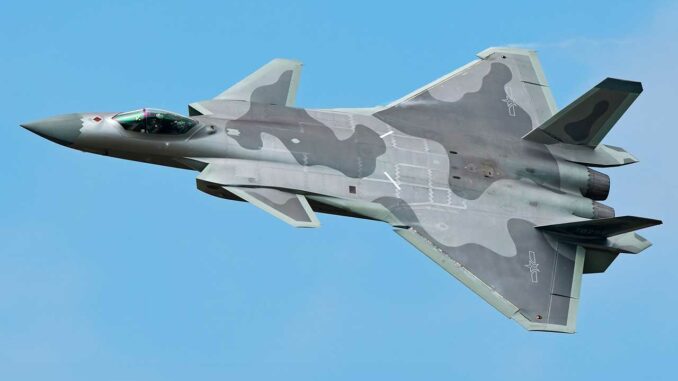
Similarities, hacking, stolen data: what we really know about the J-20, its supposed links to the F-22/F-35, and its differences.
In summary
The Chengdu J-20 has become the symbol of suspicions of industrial espionage targeting the US military aviation industry. The most persistent rumor links its appearance to computer intrusions attributed to Chinese actors against the F-35 ecosystem, first mentioned in 2007-2008, and to other legal cases such as the Su Bin case, involving files related to the F-22 and F-35. However, no public source demonstrates a direct link between the stolen data and the final design of the J-20. There are similarities, especially in terms of solutions that have become almost standard in stealth technology: edge alignment, internal fuel tanks, low-signature air intakes, and electro-optical sensors. The differences are just as significant: canards, larger size, and a design more geared towards long-range interception. The issue is not to decide based on conviction, but to understand how cyber espionage can accelerate a program without replacing engineering. And why this gray area continues to fuel international controversy.
The J-20 as an object of constant suspicion
The debate resurfaces every time the J-20 appears at a trade show or in an official video. This Chinese stealth fighter, designed by Chengdu Aircraft Corporation, is often presented as a showcase for technological advancement. It is also, almost automatically, associated with industrial espionage. The reason is simple: the timing and form of certain design choices have fueled the Western idea of a “shortcut” achieved through data theft.
One thing must be clear. Accusing a program of “copying” is not proof. It is a hypothesis, sometimes plausible, often unverifiable, and easily exploited. The useful question, therefore, is not to repeat a slogan, but to examine three layers: the proven facts of hacking, the similarities that can actually be observed, and the differences that prove that an aircraft remains a coherent system, not a collage of files.
The controversy over stolen data, between facts and inflated figures
Intrusions into the F-35 ecosystem and the notion of “terabytes”
The most widely cited story refers to a hack around 2007-2008 targeting the Joint Strike Fighter program, with “terabytes” of data exfiltrated. This idea has been in the press since 2009. It has been repeated and revived several times, particularly after media revelations in 2015 about documents attributed to the NSA, which referred to “many terabytes.” The important point is that serious open sources do indeed refer to volumes in the order of ‘several’ or “many” terabytes, without any definitive figure being made public.
This is where the figure “250 terabytes” appears, often repeated as a certainty. However, this specific volume is not solidly supported in the available documents. It behaves like a viral figure: it strikes, it is remembered, it is repeated. But, in the absence of published evidence, it remains a narrative marker rather than an established fact. The most honest approach is therefore to refer to the “terabytes” stolen in a generic sense, and to distinguish between what officials “suspected” and what has been documented.
The Su Bin case and the materiality of theft, this time judicial
The contrast is stark with the Su Bin case. Here, it is no longer a matter of rumor. There is an indictment, a trial, a plea, and then a conviction. The public evidence describes a targeting strategy, with exchanges, directories, selected files, and exploitation in China. Detailed accounts indicate measured volumes, much more modest than the spectacular figures associated with the F-35: for example, we are talking about approximately 65 GB on the C-17, and smaller amounts of data on the F-22, but that does not detract from the problem. A small volume can contain pieces that are very “dense” in value: drawings, tolerances, wiring architecture, test procedures, reliability feedback.
This point is often misunderstood. The useful flight is not necessarily the one that carries “everything.” It can be the one that answers a specific question: how a cargo door manages its play, how a leading edge is machined, how an antenna is integrated into a radome, or what maintenance constraints slow down a production line. In short, flight becomes a tool for optimization: avoiding dead ends.
Plausible mechanisms for espionage without resorting to fiction
It is tempting to imagine a simple scenario: plans are stolen, then a clone is manufactured. The reality is more prosaic.
First, cyber espionage operations often target subcontractors and partners, because the ecosystem is vast and uneven in terms of cybersecurity. Second, exfiltration can be gradual, spread out, and opportunistic. Finally, exploitation is rarely a matter of “copy and paste.” It is more like mapping: identifying architectures, understanding choices, and estimating what is missing.
Even if technical data has been obtained, it cannot replace industrial experience. It cannot manufacture an absorbent coating, qualify a resin, resolve aerodynamic instability, or produce reliable sensor fusion software. However, it can reduce the number of iterations, speed up decisions, and avoid costly mistakes. That is the most credible gain: time and money.
The similarities that fuel suspicion, and what they are really worth
Stealth and converging shapes
Modern stealth aircraft are subject to common constraints. They must reduce radar reflections by aligning edges, limiting cavities, hiding compressors, and controlling angles. In this world, convergence is common. When several engineers solve the same problem, they often end up choosing similar solutions.
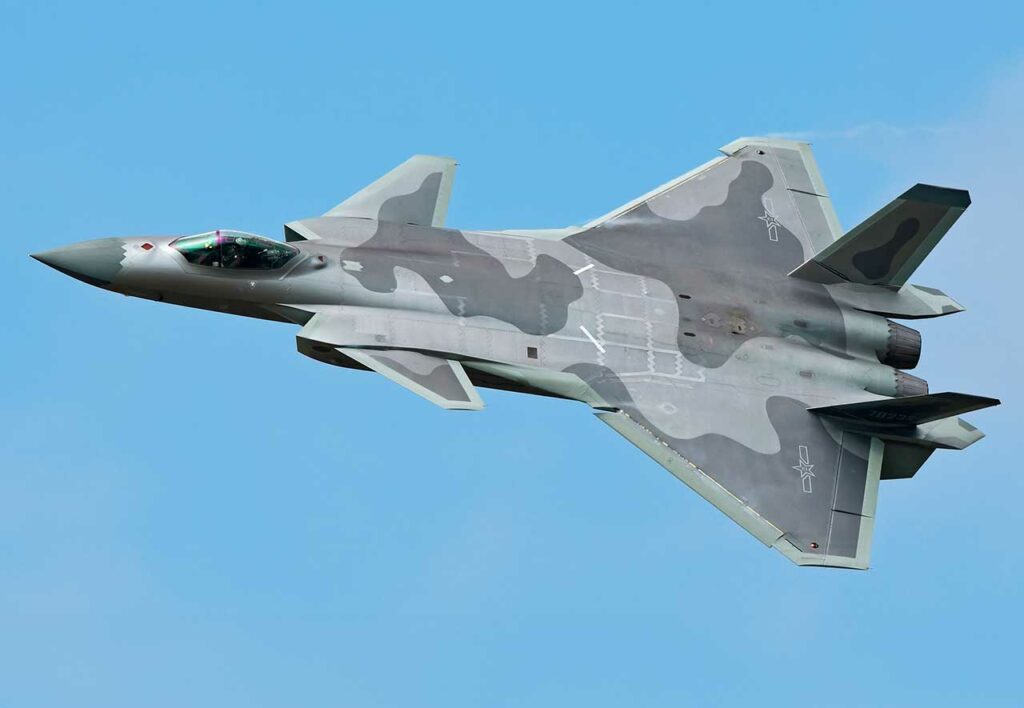
On the J-20, observers note elements associated with stealth: aligned edges, serrated doors, integrated bays, and sophisticated intake ducts. These are the “signatures” of a mature approach, also found on the F-22 and F-35. But this resemblance does not prove theft. Above all, it proves that China has adopted the design rules that the United States codified earlier.
Air intakes and the issue of DSI
One technical point that is often cited is the use of diverterless air intakes (DSI), which avoid certain separating structures and reduce signature and complexity. The F-35 has popularized this approach on a large scale. The J-20 also uses air intakes of this type. This is a visible similarity, and therefore “profitable” in media terms.
But, again, industrial logic is enough to explain the convergence. A DSI air intake is also a choice of maintenance, weight, and cost. And it is difficult to imagine that a power that has been investing in aerodynamics for decades could not have adopted this solution without a stolen plan.
Electro-optical sensors and the “déjà vu” effect
The nose of the J-20 has been photographed with a fairing that resembles a front sensor. Many have seen it as a cousin of the F-35’s EOTS system. However, image analysis has pointed out that the shape and depth differ, which may indicate a sensor of a different type or geometry. In a stealth fighter, the trend is to increase the number of integrated sensors, as an external pod degrades the signature.
It is therefore plausible that the J-20 has adopted a similar approach: integrating electro-optical sensors into the airframe rather than attaching them externally. This is a similarity in philosophy rather than evidence of copying.
Internal bays as a fifth-generation standard
Another point of contention: internal bays. The J-20, like the F-22 and F-35, carries part of its weaponry internally to preserve its signature. However, the Chinese configuration is different, with a central bay and side compartments for short-range missiles. The dimensions and arrangement also seem designed for long-range missiles, consistent with an interception doctrine.
Once again, this is a generational standard. When you want to be stealthy, you put your weapons inside. This is not a stolen secret. It is a consequence.
Differences that matter more than similarities
Canards, a choice that betrays another priority
The J-20 immediately stands out for its canards. The F-22 and F-35 do not have them. Canards can improve high-angle-of-attack control and certain performance characteristics, but they complicate the radar signature if integration is not perfectly mastered. Their presence suggests a different hierarchy of trade-offs, with a marked interest in maneuverability and control, at least in certain flight envelopes.
This is a strong indicator: if China had “copied” an F-22, it would have had good reason to avoid additional surfaces. The fact that it retained them indicates a unique design, influenced by its own requirements and constraints.
Size and role: an aircraft designed for distance
The J-20 is larger than an F-35, and its intended use is often described as being more oriented towards long-range air superiority and hunting high-value aircraft (refueling tankers, AWACS). Its twin-engine configuration, internal volumes, and potential capacity to carry long-range missiles illustrate this orientation. The F-35, on the other hand, is a multi-role aircraft, optimized for sensor fusion and first-day-of-war strikes. The F-22 is a pure superiority fighter, but designed in a different industrial and doctrinal era.
This is not a minor detail. An aircraft is a system. If you change its role, you change the airframe, the volumes, the cooling, the power generation, the weapons bay, and the software.
Engines and the shadow cast by propulsion
The J-20 has long been associated with Russian engines or transitional solutions, before the arrival of more modern Chinese engines. Open discussions mention developments towards new-generation engines, with challenges in terms of thrust, reliability, and infrared signature. This engine trajectory highlights a reality: even with stolen data, propulsion remains one of the most difficult areas to master. Tolerances, blades, single-crystal materials, and thermal performance are industrial barriers.
In other words, if espionage did occur, it did not “solve” the core of the problem. It may have helped, but it could not replace industrialization.
The “F-35 hack = J-20” link: why it is appealing but fragile
The argument works well in public debate because it tells a simple story. It has a culprit, a victim, supposed evidence, and a visible result in the sky. But it runs into a sticking point: direct evidence is lacking.
Two things can be established without too much risk. On the one hand, there have been intrusions and attempts, sometimes attributed to actors linked to China, targeting US aeronautical programs. On the other hand, China has produced a credible stealth fighter that has entered service and been modernized. Between the two, the causal link “therefore this is the source of the J-20” remains an extrapolation.
The most rigorous interpretation is as follows: cyber espionage may have provided benchmarks, constraints, ideas, and orders of magnitude. It may have accelerated certain decisions and avoided certain failures. But it does not, on its own, explain China’s ability to design, test, produce, and support a fleet of units.
The strategic context that amplifies the controversy
The strategic narrative and the battle for credibility
The issue is not only technical. It is political. Accusing the J-20 of being a copy minimizes its impact: “it’s not a technological leap, it’s theft.” Conversely, leaving doubt about the origin of the aircraft maintains pressure on budgets and defense posture.
In this game, the strategic narrative is almost as important as the aerodynamic details. Each side has an interest in shaping perceptions: China to prove that it has caught up, and the United States to highlight the cost of intellectual property theft and the need for tougher cyber security.
The supply chain as a battlefield
The question of “how” is not limited to hacking. It includes skills transfers, researcher mobility, the acquisition of production tools, the purchase of machinery, and misappropriated civil partnerships. China has invested heavily in aeronautics, microelectronics, AESA radars, and embedded systems. In this context, the supply chain becomes an accelerator, legal or illegal depending on the case.
Here too, we must be clear-headed. The line between inspiration, convergence, and copying is sometimes blurred. But this gray area does not exempt us from analysis: a modern fighter jet is an aggregate of thousands of components. Some may be inspired. The whole must function.
The most credible similarities: not the form, but the method
The most plausible similarities linked to leaks are not necessarily visible. They may relate to architectural choices: thermal management, bay layout, electrical redundancies, or avionics interfaces. These are areas where “internal” information can save time, because it reveals what has been difficult for the adversary.
Another point: software. Fifth-generation aircraft are digital platforms. Even if Chinese systems are not identical, documents on test chains, test profiles, or maintenance logic can help structure a program. This does not provide a recipe, but it does provide a map of the pitfalls.
The conclusions that must be drawn when we remove the slogans
The J-20 is neither a perfect clone nor a creation that “came out of nowhere.” It is a program that is part of a catch-up trajectory. Cyber espionage is a plausible accelerator, and there are documented cases showing that Chinese actors have targeted data related to the F-22 and F-35. But the equation “we stole X terabytes, so we created the J-20” is too simple and too convenient.
What is most disturbing, ultimately, is not whether one leading edge resembles another. It is the realization that China now has the capacity to develop a stealth fleet, improve its sensors, missiles, and doctrine. If the West wants a useful response, it lies less in nostalgia for lost secrecy than in a very concrete reality: protecting industrial ecosystems, tightening cybersecurity for subcontractors, and accepting that technological superiority is never a given, even when you were the first.
Sources
- Hackers breach defences of joint strike fighter jet programme, The Guardian, April 21, 2009.
- Pentagon says classified data on U.S. F-35 jet fighter program remains secure, Reuters, January 20, 2015.
- Theft of F-35 design data is helping U.S. adversaries, Pentagon, Reuters, June 19, 2013.
- The Cybersecurity Act: Recent Notable Cyberattacks, U.S. Senate (DPC) factsheet PDF (mention of the theft of “terabytes” related to the JSF).
- Chinese National Pleads Guilty to Conspiring to Hack into Computers (Su Bin case), U.S. Department of Justice, PDF, June 30, 2014.
- Chinese Businessman Pleads Guilty of Spying on F-35 and F-22, Defense News, March 24, 2016.
- How the US Forced China to Quit Stealing—Using a Chinese Spy, Wired, October 11, 2018 (details and file sizes).
- 2020 China Military Power Report, U.S. Department of Defense, September 1, 2020 (general characteristics of J-20/FC-31).
- High-Quality Shots Of Unpainted Chinese J-20 Stealth Fighter Offer New Capability Insights, The War Zone, July 31, 2018 (cautious reading of sensors).
- A Look at the J-20 AESA Radar, China Aerospace Studies Institute (CASI), July 28, 2025 (discussion of AESA maturation).
War Wings Daily is an independant magazine.