Chinese live-fire exercises around Taiwan: military objectives, a message to Taipei, and a test of the US response after a record arms sale.
Summary
The “Justice Mission 2025” exercises launched by Beijing around Taiwan combine naval maneuvers, air patrols, and missiles, with live fire and exclusion zones close to civilian routes. The signal is twofold: to demonstrate that a blockade and coordinated strikes are operationally ready, and to remind that any drift toward formal independence is a red line. The timing is calculated: the operation follows US approval of a record $11.1 billion arms package, presented as support for Taiwan’s asymmetric defense. Beijing is testing speed, joint coordination, and graduated coercion capabilities, while observing the reaction of Washington, Tokyo, and airlines. Taipei, for its part, is on alert, highlighting its means of retaliation and seeking to avoid economic panic. The risk: an incident, an escalation, or a miscalculation in an already saturated strait.
The outlines of a maneuver designed to encircle without invading
China has announced a new series of exercises around Taiwan, dubbed Justice Mission 2025, with a live-fire component and a scenario that resembles less a symbolic demonstration than a rehearsal of operational pressure. The announcement comes from the regional theater command, the Eastern Theater Command, which coordinates Chinese military activity on the eastern front. The forces involved cover the entire spectrum of the armed forces: army, navy, air force, and missile component, with a “system of systems” approach rather than a simple flyover.
Geography dictates the pace. The Taiwan Strait is approximately 130 km (80 mi) at its narrowest point. That is not very wide. In this space, Beijing’s interest is not to “invade” by surprise, but to show that it can saturate, close off, and control. The announced exercise areas extend around the island, including sectors to the north and southwest, and wider approaches to the east. The desired effect is that of a tactical ring: not necessarily permanently sealed, but threatening enough to complicate maritime and air traffic and remind everyone that normality depends on Beijing’s restraint.
Another telling detail is that the Chinese authorities have communicated temporary restrictions, with specific times and sectors, suggesting a combination of political signaling and risk management. This is a controlled demonstration, not an irreversible act. But make no mistake: the very repetition of these sequences creates a new normality, where military activity around Taiwan becomes a permanent “background noise,” at the risk of trivializing the escalation.
The forces involved and the joint logic behind the showcase
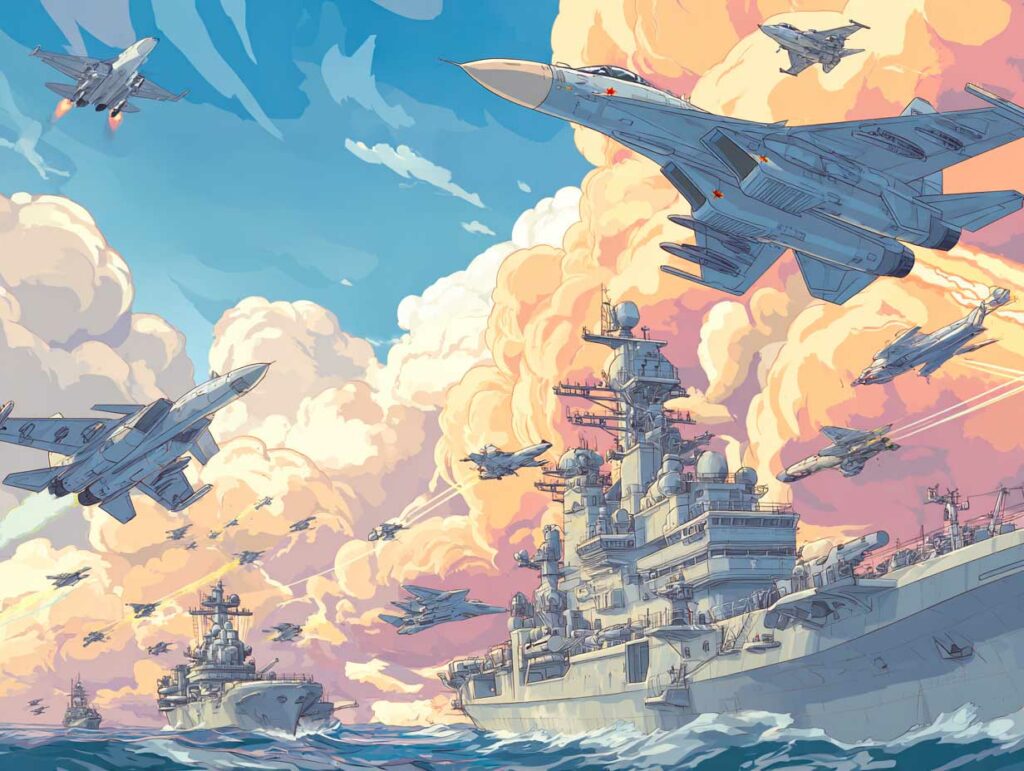
The most important point is the combination of components. The navy, with surface vessels, serves to materialize presence, simulate control of axes, and practice targeted blockade patterns. The air force adds the capacity for pressure, warning, reconnaissance, and simulated strikes at sea and on land. The army can be involved through coastal artillery, air defense, and amphibious preparation. And the missile component, via the Rocket Force, plays the role of strategic “stick”: the ability to strike far, fast, and in volume, which is at the heart of China’s anti-access/area denial (A2/AD) doctrine.
In a realistic scenario, Beijing would first seek to “see” before “hitting”: locate, track, classify, then threaten. The exercises described highlight sea-air combat patrols and training in gaining local superiority. This refers to a very concrete sequence: obtaining windows where Taiwanese defenses are forced to reveal themselves (radars, posture, reactions), while China collects data. Each Taiwanese alert becomes an intelligence opportunity.
The most sensitive part is the simulation of control of ports and access areas.
Even without actual firing on targets, training coordination (ships + aircraft + missiles + electronic warfare) is a rehearsal for the first phase of a crisis: cutting the island off from its supply lines. Taiwan depends on the sea for energy and part of its supplies. The real leverage is not only military, it is logistical.
Military objectives that go beyond communication
To say that these maneuvers are a “warning” is true, but incomplete. Militarily, the interest is in testing chains of command and timelines. An operation around Taiwan requires careful coordination, as the space is small, saturated, and monitored. Beijing wants to verify that it can generate tempo: launch, maintain, and then vary the intensity without becoming disorganized.
Second objective: to apply graduated pressure. Beijing is seeking a range of options between peace and all-out war. Live-fire exercises, exclusion zones, naval presence, inspections, and coast guard patrols can all serve as additional leverage without immediately escalating to open conflict. This is the essence of controlled escalation: pushing the adversary to make a costly choice (show up, mobilize, interrupt) while formally remaining “in exercise mode.”
The third objective is to make the threat of coordinated strikes credible. The implicit message is simple: if there is a crisis, the first few hours will count. Critical infrastructure (ports, air bases, depots, electrical hubs) are classic targets in coercion doctrine. Beijing wants to demonstrate that it can combine sea, air, and missiles, not just “scare tactics.”
Finally, there is an element of testing the international response. Each exercise serves as a benchmark: how many American statements, what level of allied naval activity, what instructions to airlines, how the markets behave. It is as much a political barometer as it is training.
The political interpretation of a calendar that is anything but innocent
Why now? First, because Washington has just approved a $11.1 billion U.S. arms package, billed as the largest ever announced for Taiwan. The details cited include typical “asymmetric” defense capabilities: HIMARS, artillery, anti-tank missiles, loitering munition drones, and associated parts or support. Beijing immediately denounced this as a violation of its sovereignty and also announced sanctions against US defense companies. In this sequence, the exercises serve as a visible response: they cost less politically than an act of force, but make a stronger statement than a simple diplomatic protest.
Beijing is addressing several audiences at once: Taiwan, the United States, but also its own public opinion and institutions. Showing a firm stance helps to lock in the internal narrative: “we are acting, we are deterring, we are in control.” This matters in a system where political credibility is linked to the ability to maintain a line on territorial integrity.
Finally, there is a logic of political window. Beijing is watching the American debates, the Japanese signals, and the political dynamics in Taipei. The more solid the support structure for Taiwan appears, the more China has an interest in testing the limits, to avoid being surprised later. The paradox is cruel: the stronger Taiwan becomes, the more Beijing can step up the pressure, not because invasion is imminent, but because coercion becomes, in its eyes, “necessary” to prevent lasting consolidation.
Taipei’s response: a balance between demonstration, caution, and risk management
On the Taiwanese side, the first obligation is to show that the state sees, follows, and reacts. Hence the alert, rapid response exercises, and communications intended to reassure. Taipei knows that too weak a reaction feeds the Chinese narrative, but that too nervous a reaction can produce the incident that Beijing does not need to trigger itself.
In terms of capabilities, Taiwan is highlighting its “anti-access” weapons and its ability to strike concentrations of forces. The most telling symbol is the HIMARS, often presented as a mobile tool that is difficult to neutralize and potentially capable of striking targets on the Chinese coast, depending on the ammunition. The exact ranges vary greatly: approximately 70 km (43 mi) with standard rockets, and up to approximately 300 km (186 mi) with certain missiles, when supplied and authorized. Taiwan’s message is clear: a blockade or amphibious preparation would also expose China to costs.
But Taipei is also constrained by economics. A prolonged crisis, even without firing, would disrupt trade routes, marine insurance, and industrial decisions. The authorities are therefore seeking to compartmentalize: showing military strength while avoiding panic. The fact that markets remain relatively stable during certain episodes is an indicator that Taiwanese society is getting used to living under pressure. This is a real resilience, but also a danger, as habituation can reduce the perception of risk.
The American reaction, the real target of the Chinese test
The very title, and the framing of “testing the response,” puts Washington at the center. Beijing wants to see whether the United States responds with visible military movements (ships, aircraft, surveillance), strong political statements, or cautious management to avoid escalation. Each option has a price: too much restraint can be read as doubt; too much demonstration can justify further Chinese escalation.
The weapons package is also a message. By focusing on mobile systems, ammunition, and distributed defense capabilities, Washington is encouraging Taiwan to make the Chinese military option more costly. This does not “guarantee” anything. But it does change the calculations: Beijing must factor in more friction, possible losses, and duration. This is precisely what China is seeking to counterbalance with exercises that simulate the rapid closure of the space around the island.
The Japanese variable also carries weight. Tokyo has repeatedly suggested that stability around Taiwan directly affects Japanese security, particularly in the southwest. For Beijing, the question is not only “Will the US intervene?”, but “In what allied framework, and at what pace?” Hence the interest in testing, in sequences, the coalition’s reflexes.
Plausible scenarios and the real danger of a repeated exercise
Militarily, the exercise can serve three credible scenarios. The first is the scenario of a gradual exclusion zone: increasing the number of “reserved” sectors, disrupting flows, and accustoming the region to a reinforced Chinese presence. The second is the scenario of targeted coercion: demonstrating the ability to strike a nerve center, without occupying the island, to force a political concession. The third is the partial blockade scenario: controlling certain routes and ports, not all of them, to provide a way out of the crisis while imposing an immediate cost.
The danger is less spectacular but more likely: the incident. The more the space is saturated with ships, aircraft, radars, jamming, and tense communications, the greater the risk of error.
An aircraft that gets too close, a collision, a misinterpreted shot, a radar illuminated, and the mechanics of escalation can be triggered even though no one “wanted” war that day.
Let’s be frank: Beijing is seeking to reduce Taiwan’s room for maneuver through continuous pressure. This is not mere theater. It is a strategy of attrition, designed to convince, over the years, that political resistance is too costly. The question for Taipei and its partners is not just to “hold” an exercise, but to hold a decade of signals, while avoiding the accident that would turn pressure into rupture.
Sources
Reuters, “China launches war games around Taiwan as island vows to defend democracy,” December 29, 2025.
Reuters, “US approves $11.1 billion arms package for Taiwan, largest ever,” December 18, 2025.
Financial Times, “China launches military drills around Taiwan,” December 29, 2025.
Associated Press, “Chinese military stages drills around Taiwan…”, December 29, 2025.
The Guardian, “China launches live-fire drills around Taiwan…”, December 29, 2025.
France 24, “China conducts large-scale Taiwan drills amid rising tensions”, December 29, 2025.
Focus Taiwan (CNA), “China’s live-fire drill around Taiwan ‘unilateral provocation’,” December 29, 2025.
South China Morning Post, “PLA holds drill near Taiwan… dubbed Justice Mission 2025,” December 29, 2025.
War Wings Daily is an independant magazine.