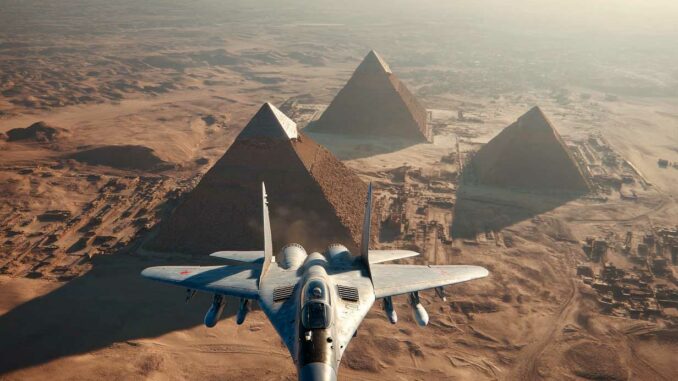
Cairo and Beijing have launched their first major joint air exercise. Aircraft involved, missions, strategic message, and regional effects.
Summary
On January 1, 2026, the Egyptian Air Force and the People’s Liberation Army Air Force began their first major joint air exercise. This event marks a visible turning point in the military relationship between Egypt and China, which until now has been mainly confined to the industrial and diplomatic spheres. The exercise, conducted from Egyptian bases, involves combat aircraft, support aircraft, and complex missions ranging from air superiority to air-ground coordination. Beyond training, the message is political and strategic. Cairo is diversifying its military partnerships, while Beijing is expanding its operational presence in the Middle East and North Africa. In an already tense region, this aerial rapprochement introduces a new credible player into the balance of power and directly challenges Egypt’s traditional partners, foremost among them the United States.
The launch of a symbolic and calculated exercise
The choice of January 1, 2026, is not insignificant. It is a clear signal, sent at the beginning of the year, showing that the military rapprochement between Cairo and Beijing is no longer theoretical. Until now, air interactions have been limited to official visits, static demonstrations, and occasional industrial cooperation. This time, it is a major joint air exercise, with real deployment of resources and comprehensive tactical scenarios.
For Egypt, agreeing to such an exercise means opening up its bases, procedures, and part of its doctrine to a non-Western partner. For China, it is an opportunity to demonstrate its ability to operate far from its territory, in a dense and politically sensitive air environment. The unprecedented nature of the exercise lies as much in its scale as in its operational nature.
The air assets deployed and their military scope
Chinese aircraft deployed
The People’s Liberation Army Air Force deployed recent-generation multirole fighters, mainly J-10Cs, accompanied by support aircraft. The J-10C, equipped with AESA radar and long-range air-to-air missiles, is now the backbone of China’s deployable fighter units. Its range exceeds 1,200 kilometers (approximately 750 miles) with external fuel tanks, which requires significant logistics for such a distant deployment.
The presence of Chinese transport and logistical support aircraft highlights a key point: Beijing is no longer seeking merely to showcase its fighters, but also its ability to support a full-scale air operation outside the Asia-Pacific region.
Egyptian resources deployed
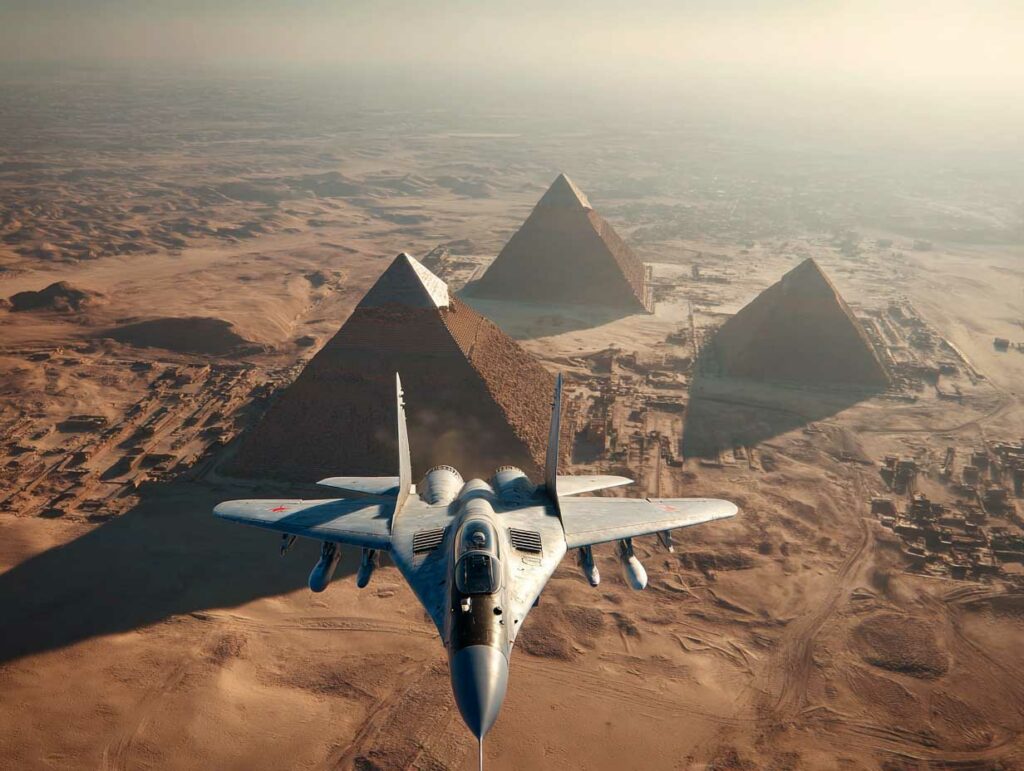
On the Egyptian side, the exercise mobilizes a deliberately heterogeneous fleet, reflecting Cairo’s acquisition strategy. French Rafale, Russian MiG-29M/M2, and American F-16 aircraft are participating in the scenarios. This diversity is not merely decorative. It allows the Egyptian Air Force to test its internal interoperability with a single external partner.
The Rafale, with its AESA radar and data fusion capabilities, plays a central role in tactical command missions. The MiG-29Ms, which are more basic but robust, are used in classic air superiority scenarios, while the F-16s provide support and escort missions.
Missions carried out and their level of complexity
Air-to-air scenarios
The first few days of the exercise are devoted to air combat missions. Simulated dogfights, medium-range interceptions, and coordination of mixed patrols are on the agenda. These scenarios allow crews to assess differences in doctrine, communication, and airspace management.
The exchanges are particularly instructive on the management of engagements beyond visual range, an area in which China is seeking to demonstrate the maturity of its sensors and missiles.
Air-to-ground and multi-domain missions
The exercise is not limited to the sky. Simulated air-to-ground missions are included, with target designation, coordinated strikes, and protection of fictitious ground forces. This dimension is essential for Egypt, which faces hybrid threats on several fronts, particularly in the Sinai region and on the Libyan and Sudanese borders.
China, for its part, is testing coordination between fighter jets and command platforms in a desert environment, which is very different from the usual Asian theaters.
Coordination and command
A central aspect of the exercise is command coordination. Language, radio procedures, rules of engagement, and decision-making hierarchies are all sensitive issues. Simply conducting complex missions without major incident is already an operational success for both forces.
Cairo’s strategic motivations
For Egypt, this rapprochement with China is part of a strategy of strategic diversification. Cairo has historically depended on the United States for some of its military equipment and support. However, this dependence is perceived as a political vulnerability, particularly in view of the conditions attached to human rights or certain diplomatic orientations.
By increasing its partnerships with France, Russia, and now China, Egypt is seeking to broaden its room for maneuver. A joint air exercise with Beijing sends a clear message: Cairo has credible alternatives and does not intend to allow itself to be locked into an exclusive relationship.
Chinese objectives in the Middle East and North Africa
For China, this exercise goes far beyond the bilateral framework. It is part of a broader strategy to project military influence, in line with its economic and political interests. Egypt occupies a key geographical position at the crossroads of Africa, the Middle East, and strategic maritime routes.
By conducting a large-scale joint air exercise, Beijing is demonstrating its ability to operate in a region traditionally dominated by Western forces. This is a strategic signal addressed as much to regional partners as to the United States and its allies.
Regional impact and expected reactions
This rapprochement has not gone unnoticed. For Gulf countries already engaged in military cooperation with China, the Egypt-China exercise confirms Beijing’s growing credibility as a security partner. Israel is watching the event closely, as it indirectly alters the regional air balance.
On the American side, the official reaction remains measured, but military circles are closely monitoring this development. A joint air exercise of this nature challenges the Western monopoly on air training and interoperability in the Middle East.
What this exercise reveals about the changing balance of power
The Egypt-China exercise is neither anecdotal nor purely symbolic. It reveals a gradual reshaping of military partnerships in a key region. Aviation, through its visibility and central role in modern conflicts, is an ideal vehicle for showcasing these changes.
If this exercise remains a one-off, its impact will be limited. On the other hand, if it becomes a recurring event, it could pave the way for deeper cooperation, including training, logistical support, and perhaps, in the long term, sales of Chinese fighter jets to Cairo.
For a few weeks, Egyptian skies became a strategic laboratory. The regional balance of power has not shifted, but a line has been crossed.
And it will now be difficult to erase.
Sources
– Official press releases from the Egyptian and Chinese Ministries of Defense, January 2026.
– Regional military analyses published by research centers specializing in Middle East security.
– Public technical data on the Egyptian and Chinese air fleets.
War Wings Daily is an independant magazine.