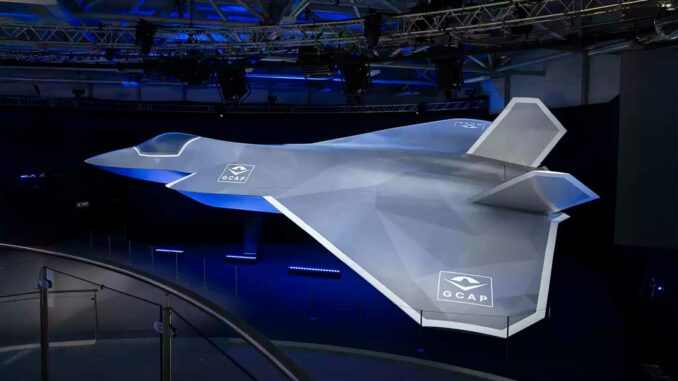
Tempest/GCAP raises concerns about costs. Can the UK stay the course without sacrificing the rest of its armed forces, or will it shift further toward the F-35?
In summary
The GCAP program (the fighter known as Tempest in the UK) aims to enter service around 2035, with Italy and Japan. The project is politically attractive because it protects a strategic industrial base and promises technological autonomy. But it is also structurally exposed to risks: changing requirements, industrial sharing between three countries, high-tech cost inflation, and an ambitious schedule. British institutions recognize the risk: parliamentary committees point out that multinational programs often run over time and budget. At the same time, London is increasing its dependence on the F-35 with an order already placed (48 aircraft) and a new trajectory including an F-35A component, linked to the Alliance’s deterrence posture. The real dilemma is therefore not “Tempest or F-35,” but how to finance an upgrade without stifling the rest of the capabilities.
The Tempest/GCAP program and the promise of a generational leap
The United Kingdom wants to remain in the club of nations capable of designing a complete combat aircraft. Tempest/GCAP is not just aiming for a new aircraft, but a “system of systems”: sensors, data links, electronic warfare, weapons, collaborative combat with drones, and digital architecture for rapid evolution. On paper, this is consistent with a Royal Air Force that needs to stay one step ahead of denser and more contested threats.
The schedule is aggressive: the stated goal is to enter service around 2035. This is the window when the Typhoon begins to approach its structural limits and when adversaries are fielding more radars, long-range missiles, and passive detection capabilities. The industrial gamble is clear: to save and modernize a European air combat industry, while adding Japan for technological critical mass and market depth.
The political logic of a three-way cooperation
The UK-Italy-Japan partnership is unusual, but not absurd. Italy brings industrial continuity (Leonardo) and an operational base close to British needs. Japan brings technological ambition and investment capacity, but also its own strategic priorities in the Indo-Pacific. In theory, this allows for the sharing of fixed development costs, the securing of skills, and increased production volumes.
In practice, this is where the risk lies: three states, three armies, three procurement cultures, and constant compromises on “minimum requirements” and “ideal requirements.” However, budgetary overruns often arise from these late compromises, when the aircraft design is already finalized and each modification is very expensive.
The budgetary risk and the experts’ warning signal
The debate in the UK is not “is GCAP important?”, but “can the country afford GCAP without breaking something else?” The House of Commons Defense Committee is explicit: multinational programs have a history of delays and cost overruns, and GCAP will have to “break the mold” if it wants to stay on schedule and within budget. This is not a formula: it is a warning.
In terms of funding, the figures are staggering. The Ministry of Defense has already committed around £2 billion since 2021 and has budgeted more than £12 billion over ten years for GCAP. This is not the total cost of the program, but it gives an idea of the scale of the effort even before the full development and industrialization phase. In other words, what London is investing today is mainly to reduce technological risk and “prepare” the decision, not to produce aircraft.
The real danger: the displacement of other capabilities
The problem is not spending a lot on a structuring program.
The problem is doing so in an environment where budgetary tensions are already visible: ammunition stocks, ground-to-air air defense, fleet availability, infrastructure, personnel, and nuclear modernization. When a fighter aircraft program goes off track, it does not “correct” itself nicely: it absorbs the budget for decades, because stopping along the way means losing the investment and skills.
The other danger is more insidious: reducing volumes. If GCAP costs more than expected, the temptation is to buy fewer aircraft, which increases the unit cost, undermines operational availability, and transforms the fleet into a “prestige capability” rather than a mass tool.
Comparison with the F-35: quick purchase, long-term dependence
The F-35 represents the present option. The aircraft exists, it is interoperable, and it allows immediate entry into allied combat architectures. The United Kingdom has already contracted for 48 F-35Bs. Public figures also show the scale of the bill: the UK audit authority reports approximately £9.35 billion spent on the F-35 program by the end of March 2025 (equipment and support), and estimates that including other items (personnel, infrastructure, training, prior costs), at least £1.5 billion must be added. In addition, the MoD maintains a whole-life estimate of £18.76 billion for 48 aircraft until 2048, excluding operating costs.
This brings us to a key point: comparing the “Tempest budget” and the “F-35 budget” only makes sense if we are comparing identical scopes. The F-35 is often presented with a purchase price, while Tempest is an R&D effort followed by acquisition. Both are expensive, but not at the same time, nor for the same reasons.
The shift to the F-35A changes the nature of the debate
In 2025, London announced its intention to purchase at least 12 F-35As and join the Alliance’s “Dual Capable Aircraft” nuclear mission. In effect, this strengthens the F-35’s place in the British posture, beyond the F-35B‘s carrier-based role. The result: even if Tempest exists tomorrow, the UK will already have a structural dependence on the supply chain, software updates, and the rules for upgrading an American aircraft.
Let’s be frank: a large F-35 fleet brings real military power, but it reduces sovereign maneuverability. This is not a theory: every modern aircraft is a software system, with industrial dependencies and certifications. The question then becomes: how much operational sovereignty does London want to retain when the situation becomes more difficult and American priorities are not necessarily the same?
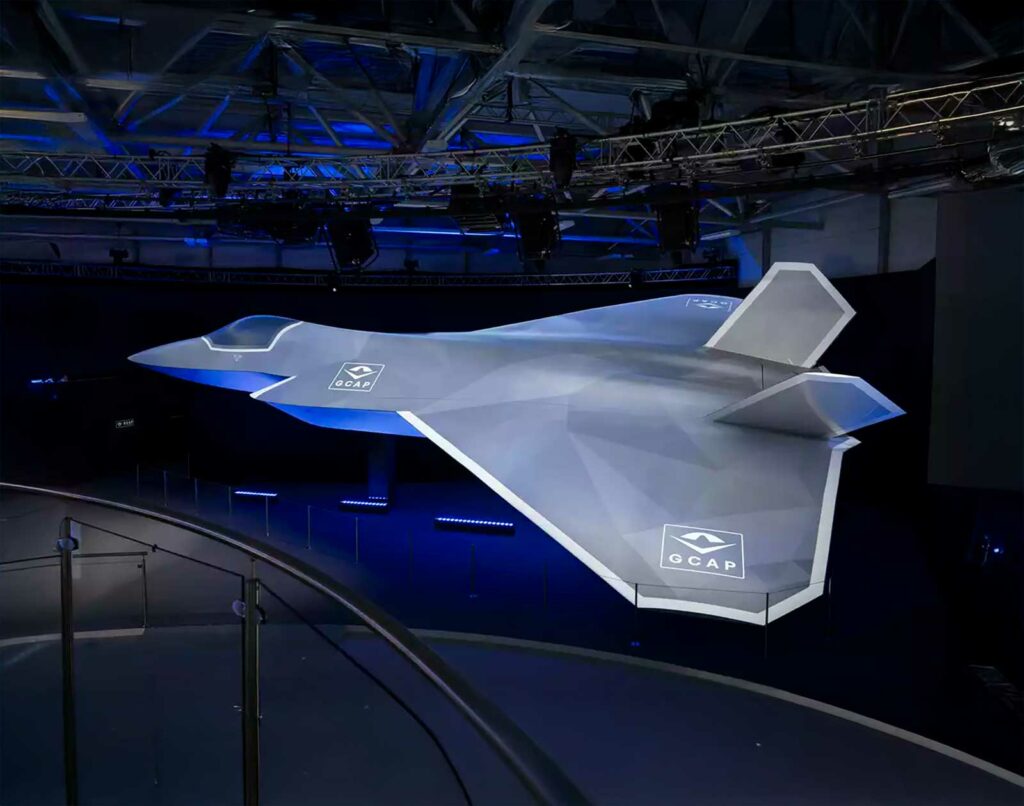
The real choice: continue with Tempest, yes, but at the cost of brutal discipline
Saying “we must continue with Tempest” is easy. Doing so without slippage requires a discipline that is rare in fighter programs.
Governance that prevents slippage
If the UK wants to limit budget overruns, it must lock in three things very early on: a stable definition of requirements, an open but controlled architecture, and an industrial distribution that avoids duplication. The temptation in a three-way cooperation is to give everyone “their share” even when this duplicates capabilities. This is politically comfortable, but technically costly.
The UK must also accept an uncomfortable truth: a 6th generation fighter will not be “better in every way and cheaper.” The higher the ambition, the higher the bill. Some British strategic analyses state it bluntly: either the program is funded to match its ambitions, or it must be scaled back or abandoned.
Operational credibility: mass, availability, ammunition
Even an exceptional aircraft is useless if the fleet is too small, if availability rates are low, or if ammunition stocks are insufficient. The risk of focusing too much political capital on Tempest is that it could lead to neglect of the “day-to-day battle”: maintenance, training, parts, base protection, ground-to-air defenses, and the ability to sustain a long campaign.
The RAF already has a recent lesson to ponder: budgetary attrition ultimately shows up in the number of aircraft actually available, not in brochures.
The UK’s position in Europe and NATO
Tempest/GCAP is also a geopolitical signal. In Europe, it places London on a different trajectory from the Franco-German-Spanish program (FCAS/SCAF). Two “sixth generation” programs in Europe is strategic redundancy, but also a form of industrial competition. For some allies, this is divisive. For others, it provides security: two programs mean less risk of dependence on a single failure.
In NATO, the issue is interoperability and nuclear credibility. The announced integration of the F-35A into an air defense mission anchors the United Kingdom in the allied nuclear posture, while the F-35B retains its British “aircraft carrier” specificity. Tempest, for its part, would be the lever of European superiority and autonomy, but only if it is actually delivered on time and in sufficient numbers.
The British paradox is therefore as follows: the more London relies on the F-35 for immediate operational reasons, the more difficult it becomes to finance Tempest at the necessary level. And the more Tempest becomes a budgetary risk, the more the F-35 appears to be a safeguard. This cycle can be virtuous if budgets increase. It becomes destructive if the overall effort stagnates.
The most realistic path for London
The United Kingdom should not “switch” to an all-F-35 program, unless it explicitly renounces its industrial autonomy in air combat. This would be a major strategic choice, with consequences for skilled employment, exports, and the ability to decide independently on certain developments.
Conversely, continuing with Tempest without safeguards would amount to accepting a program that sucks up resources, to the detriment of other services and support capabilities. The most rational course of action is therefore a two-pronged approach:
- Continue with Tempest/GCAP, but lock in a deliverable ambition, with milestones that allow the superfluous to be cut before it is too late.
- Purchase the F-35 in a consistent manner, accepting what it brings (interoperability and rapid effect) and what it costs (dependence and support bill), without deluding ourselves about a “cheaper” solution.
This is not a romantic choice. It is a power trade-off: maintaining the ability to act, while remaining capable of fighting tomorrow morning.
Sources
- House of Commons Defense Committee, “Global Combat Air Program” (report), January 14, 2025.
- House of Commons Library, “What is the Global Combat Air Program (GCAP)?”, November 14, 2024.
- UK Ministry of Defense (GOV.UK), funding and announcements on the future fighter program, April 14, 2023.
- National Audit Office (NAO), “The UK’s F-35 capability” (report), July 11, 2025.
- Public Accounts Committee (House of Commons), “The UK’s F-35 stealth fighter capability” (report), October 31, 2025.
- Reuters, creation of the GCAP joint venture (BAE/Leonardo/JAIEC), December 13, 2024.
- RUSI, critical analysis of the gap between GCAP’s ambition and funding, April 27, 2023.
- IISS, analysis “Tempest: Build, buy, or goodbye?”, September 20, 2024.
- House of Commons Library, “UK defense spending” (briefing), October 10, 2025.
War Wings Daily is an independant magazine.