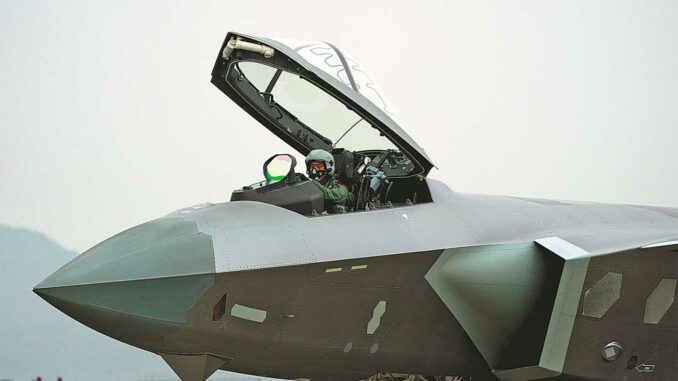
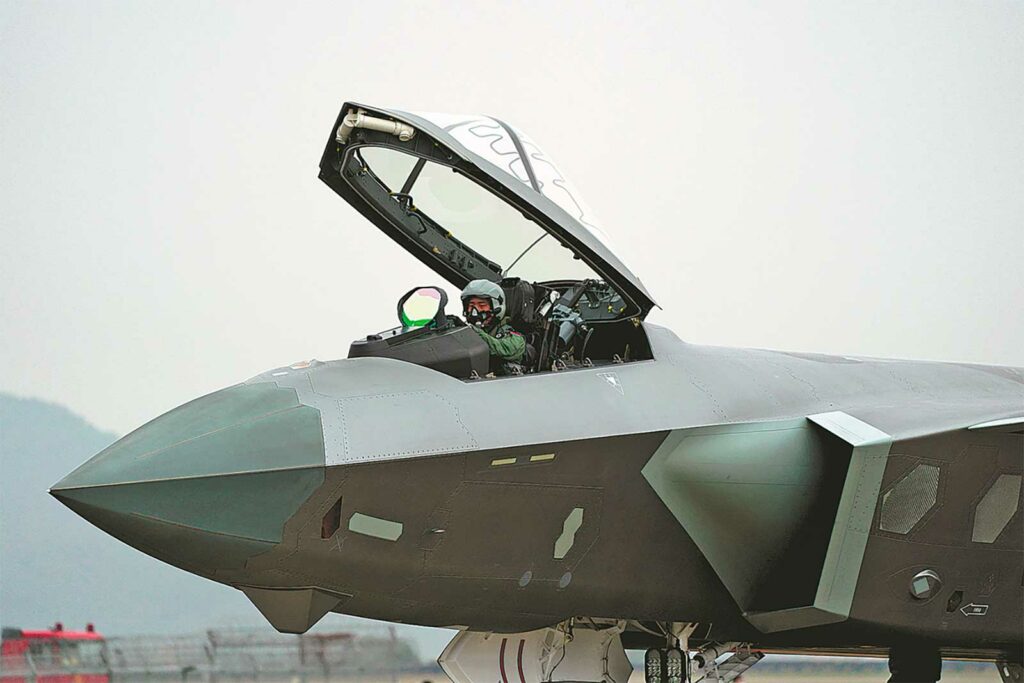
With the two-seater J-20S, China wants to transform its stealth fighter into a flying command post for accompanying drones. A deliberate tactical break.
In summary
The J-20S is the two-seater version of the Chinese J-20 stealth fighter. Its appeal lies not in the comfort of a second seat, but in its intended role: that of a mother ship capable of coordinating accompanying drones in the heat of battle. The idea is simple. The pilot is responsible for flying and survival. The second crew member manages information, sensors, and, above all, the control of several loyal wingman drones. This setup has a clear objective: to extend the range of sensors, saturate defenses, and increase the number of available “shooters” without exposing more pilots. Is China ahead of the game in collaborative combat? In any case, it scores a symbolic point: it is promoting a two-seater stealth fighter, while its Western counterparts remain mostly single-seaters. But the true extent of its lead depends on less visible factors: data link, the quality of sensor fusion, HMI ergonomics, and the maturity of the onboard artificial intelligence. The J-20S is less like a “plus” aircraft than an attempt to change the grammar of air combat.
The concept of the J-20S as an advanced command post
The J-20S is not just a training variant. China has no interest in “doubling” a cockpit on an expensive aircraft just to train pilots. The meaning lies elsewhere.
The aircraft embodies a logic of “manned-unmanned teaming”: a piloted aircraft acts as the conductor of unmanned aircraft. It monitors, decides, and delegates. In this architecture, the fighter becomes a mission platform, not just a firing platform.
The term “mothership” is appropriate because it accurately describes the intended role. The J-20S does not carry drones in its cargo hold. It “carries” them in the doctrinal sense: it guides them, employs them, and takes advantage of their sensors and weapons.
This idea is not new. What is new here is the association with a heavy stealth fighter, designed for long-range air superiority.
The second seat as a direct response to cognitive overload
A modern fighter generates too much information for a single brain to process, especially in a high-intensity battle.
The pilot already has to:
- navigate at high speed,
- monitor energy and the situation,
- manage ground-to-air and air-to-air threats,
- make decisions under time pressure.
However, collaborative combat adds a massive layer. Pilots must track multiple drones, their status, sensors, fuel, trajectories, stealth, and rules of engagement.
The second seat therefore becomes a pragmatic solution. An operator can focus on mission management. They can also play the role of “effects manager”: choosing which drone illuminates, which jams, which fires, and which serves as a decoy.
This choice sends a very clear message: China believes that the workload cannot be absorbed by current automation alone, or that it does not want to take that risk.
Equivalents around the world that show that the idea is shared
The J-20S attracts attention because it is a two-seater and stealthy. But the concept of a “pack leader” aircraft exists elsewhere.
The United States and the logic of escort drones
The United States is promoting the idea of combat drones associated with piloted aircraft, notably through programs such as Collaborative Combat Aircraft. The American approach focuses on more autonomous drones, with a human pilot supervising and validating the effects, without “remote piloting” every action.
The difference is clear: the West often seeks to avoid a second crew member, focusing on ergonomics and automation. China, with the J-20S, seems to accept that the human solution remains the most robust, at least in a transition phase.
Russia and the idea of a Su-57 “drone commander”
Russia has been talking about the Su-57 and S-70 Okhotnik combination for several years. Russian sources have even mentioned a two-seater version of the Su-57 capable of controlling several drones. The idea is very similar to that of the J-20S, but it remains less tangible in the field and in production.
Europe and the FCAS “Remote Carriers” logic
The future European SCAF/FCAS is based on a piloted aircraft and remote effectors. The philosophy is similar: shift the risk, multiply the sensors and weapons. But operational implementation is further away.
Simple conclusion: the concept is global. What sets the J-20S apart is the tool chosen to embody it.
Typical missions for a stealth “mothership” in a contested environment
The J-20S comes into its own in a scenario where the enemy’s defenses are dense, connected, and capable of firing from a distance.
A credible scenario looks like this:
- the J-20S remains in the background, discreet,
- drones advance to capture, provoke, or jam,
- the J-20S collects information,
- then triggers remote effects.
In this logic, drones can play several roles.
The role of the reconnaissance drone
A drone can approach to detect a target, provide a lead, and transmit a firing solution. The stealth fighter remains discreet by limiting its emissions.
The role of the decoy drone
A drone can simulate a signature, force the adversary to turn on its radars, or attract missiles. Even if destroyed, it has “bought” time and information.
The role of the jamming drone
A drone can carry electronic warfare capabilities and degrade enemy detection. It can also create tactical confusion by multiplying false leads.
The role of the shooter drone
Some drones can become firing platforms, including at a distance. This changes the dynamics: the piloted aircraft is no longer the only weapon carrier.
This is exactly the desired effect: transforming a patrol into a network of platforms.
Data link technology as the tipping point
Collaborative combat is won or lost on connectivity.
A “mother ship” needs a secure, fast, jamming-resistant, and discreet data link. Discreet, because a stealth aircraft that transmits too much becomes visible.
The challenges are well known:
- sufficient bandwidth to exchange tracks and images,
- low latency for real-time decisions,
- robust encryption,
- resistance to interference,
- ability to continue in degraded mode.
In an ideal world, the fighter uses directional links and waveforms with a low probability of interception. It can also operate with “short” data packets, focused on the essentials: coordinates, identifiers, status, and orders.
In short: less live video, more decisions guided by tracks and priorities.
This is one of the areas where China is difficult to assess from the outside. Demonstrations exist. The technical details remain opaque.
The human-machine interface as the real issue, more than the aircraft itself
You can build the best concept in the world. If the crew can’t operate it, everything falls apart.
The battle is therefore being fought over the HMI. A rear operator cannot manage four drones if the screen looks like an unreadable mosaic. They need an interface designed like a command post.
The plausible trends are well known:
- large multi-window screens,
- automatic prioritization of alerts,
- “merged” display of tracks rather than raw sensors,
- quick commands via context menus,
- integrated decision support.
The second seat then becomes a mission station, similar to what you find in a surveillance aircraft or control center, but compressed into a fighter cell.
If China has opted for two seats, it is probably because it is aiming for realistic operation: a human supervises, decides, and validates.
AI as a mission co-pilot rather than an autonomous pack leader
The media temptation is to say: “the J-20S pilots a swarm with AI.”
The reality will be more nuanced. For military and legal reasons, armies want to keep humans “in the loop,” at least for the use of lethal force.
The most credible scenario is this:
- artificial intelligence helps sort threats,
- it proposes options,
- it manages trajectories and formations,
- it maintains the network,
- but humans decide on major actions.
In other words, the operator does not fly each drone like a joystick. They give mission orders:
- “Reconnaissance this area”
- “Jammer this sector”
- “Remain on standby”
- “Attack if condition is met”
This is supervised control. It is not a video game.
This distinction is essential because it determines the true level of technological maturity.
The J-20S and the question of China’s lead in collaborative combat
To say “China is ahead” would be too easy. To say “it’s just communication” would also be a mistake.
The J-20S sends a strong signal for two reasons.
First, China is choosing a stealth platform for this mission. It therefore wants to manage collaborative combat where it is most difficult: in contact with the enemy.
Second, it is accepting the cost of a second cockpit. This indicates that it is aiming for serious operational use, not just a concept on paper.
But the real advantage can be measured in other ways:
- the number of drones available,
- their autonomy,
- their survivability,
- and the robustness of the network in the face of intense jamming.
The United States, for its part, is also working on this issue with enormous industrial depth. The game is therefore not “won” by a single aircraft.
What the J-20S proves above all is that Beijing wants to move quickly and put imperfect but usable solutions into service, rather than wait for a perfect system.
The J-20S as a revelation of an offensive and long-range doctrine
The choice of a two-seater J-20 is not neutral. The J-20 is designed for beyond-visual-range, long-distance engagements and to threaten high-value assets.
In an Indo-Pacific context, a stealth “mothership” can:
- push drones forward,
- detect refueling aircraft,
- force the adversary to disperse its resources,
- and create constant pressure on the enemy’s chain of command.
The J-20S thus resembles a force multiplier. Not a “fighter versus fighter” duel. A battle of network versus network.
The implicit bet: better to have an extra human brain than an extra drone
The most interesting message, ultimately, is this.
China seems to be saying: the bottleneck is not just the number of drones. It is the ability to use them intelligently under stress. And for that, a second human operator is a worthwhile investment.
It’s a very rational choice. It runs counter to the idea that “everything will be automated.” It reminds us of a reality: high intensity is messy, chaotic, confusing, and full of surprises.
In this context, even the best AI in the world remains fragile if it loses the network, if the environment changes, or if the rules of engagement shift.
The J-20S therefore confirms one thing: the future will be hybrid. Autonomy, yes. Humans, indispensable too.
Sources
The War Zone (TWZ) — “China’s Two-Seat J-20 Stealth Fighter Poised To Enter Operational Service,” July 8, 2025.
Defense News — “New variants of Chinese stealth fighters break cover,” October 29, 2021.
mod.gov.cn — “Twin-seat J-20S stealth fighter to be unveiled,” November 11, 2024.
Aerospace Global News — “Upgraded J-20A and twin-seat J-20S…,” January 13, 2026.
Chengdu J-20 (technical specifications and J-20S timeline), accessed 2026.
TASS — “Two-seat Su-57 fighter jet to be designed for control of drones,” July 27, 2021.
Forbes — “Adding A Second Seat To Russia’s Su-57…,” July 30, 2021.
War Wings Daily is an independant magazine.