
China is flying Jiutian, a carrier drone capable of deploying swarms. Concept, key technologies, and military implications of a system designed to saturate the battlefield.
In summary
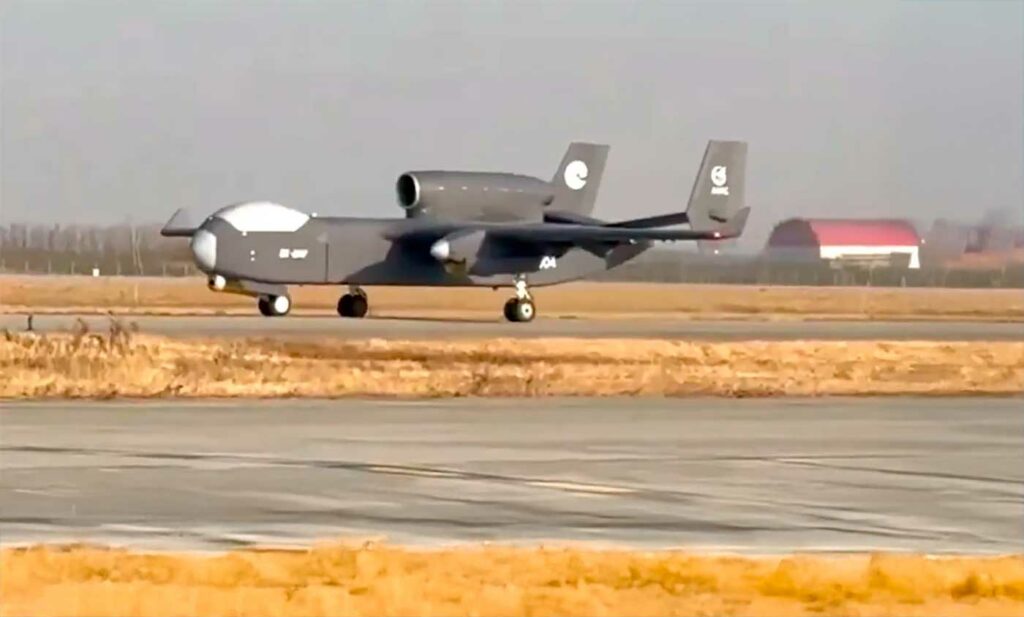
China recently flew Jiutian, a heavy drone designed as a modular platform capable of carrying and deploying swarms of smaller drones. This “mothership drone” concept marks an important step in the evolution of unmanned aerial systems. Jiutian is not just a reconnaissance or strike vehicle. It is designed as a force multiplier, capable of transporting, releasing, and coordinating dozens of light drones over long distances. The military interest is clear: saturation of defenses, extension of operational range, and reduction of risks to manned platforms. Behind this program lie specific technological choices, particularly in terms of modular payloads, distributed communications, and semi-autonomous swarm management. The potential impact extends beyond China and directly challenges regional military balances and the ability of conventional air defenses to cope with massed and decentralized threats.
The announcement of a flight that validates a strategic concept
The flight of the Jiutian drone is not just a media demonstration. It confirms that China has reached a sufficient level of maturity to evolve a long-theoretical concept into a credible platform. Jiutian stands out for its size and primary mission. It is a heavy-lift drone, designed to operate at medium or high altitudes and to carry a large payload in a modular compartment.
Initial public data suggests a maximum takeoff weight of several tons and a substantial internal payload capacity. This is a key point. Unlike many tactical drones, Jiutian is not limited to underwing payloads. It has an internal volume designed to accommodate mission modules, including light drone launch systems.
The message is clear. Beijing is investing in systems capable of structuring complex air operations without direct exposure of pilots. This flight validates the overall architecture, flight control systems, and, above all, the integration of a modular cargo hold compatible with a variety of missions.
The concept of a “mother ship” drone for swarms
The core of the Jiutian program is based on the concept of a drone carrier. The idea is simple in principle but complex in implementation. A heavy drone carries a large number of smaller drones, often disposable or low-cost. Once in the vicinity of the area of operations, it releases them in a controlled manner.
This approach allows constraints to be separated. The carrier drone optimizes endurance, range, and altitude. The lightweight drones optimize mass, stealth, and saturation. Jiutian therefore acts as an aerial projection platform, significantly extending the swarm’s range of action.
The modular compartment allows the mission to be adapted. Depending on the configuration, Jiutian can carry reconnaissance drones, kamikaze drones, communication relays, or specialized sensors. This flexibility is a major asset. It allows the platform to be quickly reconfigured without modifying the main airframe.
The operational logic behind swarm deployment
The effectiveness of such a configuration relies on several complementary mechanisms. The first is saturation. An air defense system is designed to deal with a limited number of simultaneous threats. By releasing dozens of drones from a high point, Jiutian can overwhelm enemy sensors and effectors.
The second mechanism is geographical dispersion. Once released, the drones can spread out over a large area, attack from different angles, or search for moving targets. This dispersion complicates defense and reduces the effectiveness of centralized systems.
The third mechanism is the progressive degradation of defenses. The first drones can be sacrificed to reveal radar positions or force the activation of surface-to-air systems. The next ones exploit these openings. In this logic, the carrier drone remains at a distance, out of immediate range, while orchestrating the attack.
This approach is part of a modern vision of air combat, where mass and coordination take precedence over the individual performance of a single platform.
Key technologies behind Jiutian
Jiutian is based on several critical technological building blocks. The first concerns the airframe and propulsion. A carrier drone must offer high endurance, flight stability, and the ability to operate at altitudes that allow for optimal payload release. This requires a robust structure and reliable engines capable of sustaining prolonged flights.
The second building block is modular payload management. The cargo system must allow for the safe and sequenced deployment of drones without disrupting the stability of the aircraft. This requires precise release mechanisms and standardized interfaces between the carrier and the modules.
The third component, often underestimated, is data link. Coordinating a swarm requires resilient communications capable of operating in a jammed environment. Jiutian must provide the link between the drones, ground stations, and possibly other aerial platforms.
Finally, software management is central. Modern swarms do not rely on constant individual control. They use collective behavior algorithms, with varying degrees of autonomy. The carrier drone must be able to initiate the mission, define the parameters, and then let the swarm operate semi-autonomously.
The military effectiveness of such a system against current defenses
The military value of Jiutian can be measured against contemporary air defenses. Modern ground-to-air systems are effective but expensive. Intercepting a light drone with a sophisticated missile creates an economic imbalance. A missile costing several hundred thousand euros against a drone worth a few thousand poses a sustainability problem.
By multiplying the number of vectors, Jiutian accentuates this asymmetry. Even if part of the swarm is destroyed, the cost to the adversary remains high. This logic of economic attrition is now central to modern conflicts.
Furthermore, swarms complicate the prioritization of threats. Not all drones are armed. Some serve as decoys, others as sensors. Defenses must choose in real time, under saturation constraints, which increases the risk of error.
Jiutian does not replace combat aircraft. It complements them. It opens corridors, exhausts defenses, and prepares the ground for heavier strikes.
Jiutian’s place in Chinese doctrine
The development of Jiutian is part of a broader evolution in Chinese doctrine. Beijing is investing heavily in unmanned systems, which are seen as a way to compensate for certain operational limitations and reduce the political risks associated with human casualties.
In a regional conflict scenario, particularly around Taiwan or in the South China Sea, a swarm-carrying drone offers new options. It allows defenses to be tested, enemy networks to be disrupted, and constant pressure to be created without immediate escalation.
Jiutian’s modularity also suggests dual use. Apart from offensive missions, the platform can be configured for maritime surveillance, electronic warfare, or communication relay. This versatility reinforces its strategic value.
The limitations and vulnerabilities of the concept
Despite its strengths, Jiutian is not without its limitations. The carrier drone remains a valuable target. Its size and radar signature are greater than those of light drones. In a highly contested environment, it will have to operate remotely or under cover.
Dependence on communications is another vulnerability. If links are jammed or cut, swarm coordination can be degraded. China is working on degraded modes and increased autonomy, but the challenge remains real.
Finally, the effectiveness of a swarm depends on the quality of the drones it carries. Unreliable or poorly coordinated drones reduce the desired effect. The system is therefore only as strong as its weakest link.
The overall impact on the military balance
The Jiutian flight does not immediately upset the global military balance. However, it sends a clear signal. China has now mastered complex architectures combining heavy platforms and distributed swarms. This capability strengthens its technological and military credibility.
For opposing forces, the message is just as clear. Air defenses must evolve. Anti-drone warfare can no longer be limited to ad hoc solutions. It must integrate multiple sensors, low-cost effectors, and automated threat management.
Jiutian illustrates a major trend. Air combat is becoming more distributed, more decentralized, and more economical in its offensive capabilities. Value is shifting from the single platform to the overall architecture.
What Jiutian reveals about the air warfare of tomorrow
Jiutian is not just another drone in the Chinese inventory. It embodies a vision. That of a saturated airspace, where superiority no longer relies solely on the performance of an aircraft, but on the ability to orchestrate multiple systems.
This evolution raises profound questions. How to protect critical infrastructure from massive swarms. How to maintain credible deterrence when unit costs plummet. And how to avoid a permanent technological escalation.
The answer is not solely technical. It is also doctrinal and political. Jiutian shows that China has made a clear choice. To focus on intelligent mass and modularity rather than a few elite platforms. A choice that, in the long term, could redefine the way powers conceive of air warfare.
Sources
- The War Zone — China’s High-Flying Swarm Mothership Drone Has Flown
- Global Times — Jiutian heavy drone completes first flight
- Aviation Industry Corporation of China — Uncrewed systems and modular payload development
- International Institute for Strategic Studies — Chinese UAV capabilities and doctrine
- China Aerospace Studies Institute — PLA approaches to drone swarms and autonomous warfare
War Wings Daily is an independant magazine.