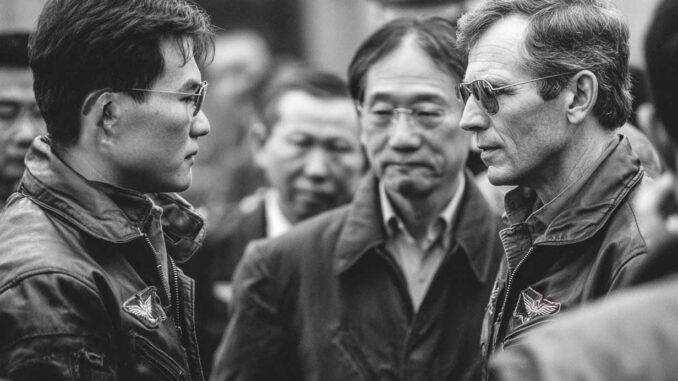
Scandal, laws, sanctions: how Beijing attracted former Western fighter pilots to train the PLAAF, and what we still know in 2026.
Summary
China’s recruitment of Western pilots has crystallized a sense of unease: former military personnel, some of whom are highly qualified, have monetized their rare expertise for the benefit of a rival power. The British authorities recognized the phenomenon as early as 2022, citing up to 30 former pilots attracted by high salaries via intermediaries based in South Africa. The United Kingdom then wielded the arsenal of the National Security Act 2023, while France strengthened its measures with prior control of activities benefiting foreign entities. In 2024, US measures targeting companies linked to this sector showed that the issue remained active or, at the very least, structured. Fundamentally, the case is neither a simple “business” nor “treason”: it all depends on the nature of the knowledge transferred, the intention, and state control. The red line is military value, not the contract.
The scandal and Beijing’s strategic logic
The scandal broke publicly in the fall of 2022. It then resurfaced in 2023 and 2024, with rapid political reactions. The mechanism is well known: the recruitment of Western pilots targets former military personnel, often highly experienced, to supervise training for the benefit of the Chinese air force.
The logic on the Chinese side is rational. An army can buy aircraft, radars, and ammunition. It cannot “buy” an operational culture in a quarter. Combat aviation is a sum of habits. Standardized mission preparation. Disciplined debriefing. A way of learning from mistakes quickly, without damaging equipment or losing crews. Better training saves time and therefore power.
Let’s be honest: gaining a year of tactical maturity is sometimes worth more than a state-of-the-art sensor. Especially if this advantage is paid for in private contracts, and therefore quietly.
The place of standards without entering into secrecy
Media reports have often emphasized the transmission of NATO tactics. This is telling, but often inaccurate. There is no single “NATO” manual that can be copied and pasted. There are procedures. Training methods. A logic of coordination. Communication reflexes. Ways of conducting a mission and learning from it.
All of this can be passed on without releasing a classified document. And that is precisely what is worrying. The main risk is not the leak of a secret plan. The risk is the dissemination of practices that increase the overall performance of a competing air force, including against Western aircraft such as the Rafale or Eurofighter Typhoon.
Recruitment channels and the profiles actually targeted
It wasn’t just rumors that sparked the controversy. The United Kingdom acknowledged the phenomenon with official alerts. British media reported that up to 30 former pilots were involved and that they were receiving very high salaries. Recruitment was reportedly facilitated through intermediaries, particularly in South Africa.
The names of organizations publicly cited revolve around a core group: the Test Flying Academy of South Africa (TFASA) and associated companies. In 2024, the United States also targeted companies linked to this industry through trade measures, including Grace Air (South Africa) and Livingston Aerospace (United Kingdom), as well as organizations based in Asia. This shows one thing: the scheme was not amateurish. It was sufficiently structured to be tracked, documented, and sanctioned.
The typical profile that really interests China
The most useful profile is not necessarily the one who has flown the “most modern aircraft.” It is the one who has supervised, evaluated, and taught. The one who knows how to transform a complex experience into educational progress. The one who understands how to construct an exercise, how to put a crew in a controlled difficult situation, and how to correct without breaking confidence.
In other words, the fighter pilots sought after are often those with a culture of instruction, not just flight hours. China already knows how to train pilots. What it is looking for is acceleration. And alignment with Western standards that have proven themselves in exercises and operations.
The line between legal and dangerous for safety
The “business or treason” debate quickly becomes a moral one. But the useful question is technical: what is actually being transmitted? Most of the former pilots involved will say that they did not reveal any secrets. Sometimes this is true in the legal sense. But it can still be problematic in the strategic sense.
The crux of the matter is tacit knowledge. This is what is not included in a manual. It is a way of prioritizing information in flight. A way of organizing a debriefing without complacency. A culture of useful failure. An instinct for what “misleads” a crew and how to avoid the trap. None of this is necessarily classified. All of it has military value.
Let’s be blunt: when a former Western instructor sells this type of know-how to a rival power, they reduce the relative advantage of their original camp. Even if it is done “properly” on paper.
The legal response in the United Kingdom and the rise of control
In the United Kingdom, the state has taken a hard line on communication. In 2023, the government reiterated that former personnel training foreign armies could be prosecuted under the National Security Act 2023. The message is clear: this is not a matter of “personal ethics.” It is a matter of national security.
This type of framework can be a deterrent. It can also serve as an example, especially if a case goes to court. But it has an obvious limitation: contracts must still be detected and the exact nature of the knowledge transferred must be proven.
The French response and the administrative framework for sensitive retraining
France has strengthened its system in a different way. A decree of December 13, 2023 (issued as an extension of the 2024-2030 military programming law) regulates the exercise of activities for the benefit of a foreign power or entity for certain personnel. The objective is simple: to impose a notice period, define sensitive areas, and allow the authority to oppose an activity.
It is less spectacular than a criminal law brandished at a press conference. But it is potentially effective because it creates a mandatory step. The problem, of course, is that it can be circumvented. A contract signed via a third country, under a “civilian” label, can escape detection. The law is not blind, but it is not omniscient.

The crux of the matter: money and the pilot training budget
Without money, there is no deal. British media reported offers of around £240,000 per year, or approximately €280,000 at the time of the revelations. This level is not a bonus. It is a strategy to attract talent. It targets rare experts at the end of their careers, sometimes with no immediate equivalent in the private sector.
To understand why countries are getting upset, you have to look at the cost of training a fighter pilot. In the United States, public estimates indicate that training a “basic qualified” pilot costs several million dollars depending on the platform. Often-cited figures put the cost at around $5.6 million for an F-16-qualified pilot and just over $10 million for an F-35A-qualified pilot, with even higher figures for highly specialized courses. These amounts aggregate heavy resources: training aircraft, simulators, fuel, maintenance, instructors, infrastructure.
The most honest reading of the Chinese budgets
China does not publish a transparent budget line for “foreign instructors.” We must therefore think in terms of orders of magnitude and be transparent about the uncertainty.
A conservative scenario is enough to show what is at stake. Ten instructors paid £240,000 per year represents an annual payroll of £2.4 million, excluding overheads and infrastructure. Add logistics, contracts, simulators, flights, and program management, and you quickly reach several million euros per year. If we are talking about dozens of instructors over several years, the bill becomes a significant expense, but one that is very sustainable for a power that invests heavily in its forces.
Viewed dispassionately, paying foreign instructors is a way of buying time for maturation, and thus reducing the future cost of errors, accidents, and failures in exercises.
The uncomfortable question: is this still going on?
The rigorous answer is nuanced. We cannot publicly claim that everything has stopped. But we cannot publicly prove that everything continues as before. On the other hand, public signals show that the issue has remained unchanged at least until 2024.
In July 2024, US measures (trade restrictions, blacklisting of companies) targeted companies involved in training Chinese pilots via South Africa. This type of action is not a symbolic gesture. It is based on cases considered to be sufficiently established.
After this type of sanction, there are two possible scenarios. Either the activity ceases because it becomes too risky, or it moves, changes names, changes countries, and becomes more discreet. The incentives remain constant: a demand for skills, an offer of retraining, and remuneration capable of overwhelming any scruples.
The most useful interpretation: neither pure morality nor total cynicism
It is tempting to call it “treason.” But that is also simplistic. Many of the former pilots involved see themselves as professionals. They want to retrain. They believe they are acting within the law. They tell themselves that they are not divulging anything classified.
Calling it “business” is equally inadequate. Combat aviation is not a neutral sector. Training a rival power has a direct consequence, even if we remain at a general level. It reduces the adversary’s uncertainty about the West. It professionalizes training. It standardizes methods.
Above all, this case reveals a blind spot: states have sometimes been ill-prepared for the retraining of their experts. When the national private sector does not offer a credible career path, foreign recruiters fill the void. And when the law has not anticipated the gray area, scandal becomes the method of correction.
The final idea to remember is simple: aviation expertise has become a strategic commodity. Countries that do not protect their human know-how end up indirectly financing the rise of their competitors.
Sources
GOV.UK, press release on possible prosecutions under the National Security Act (September 17, 2023).
Reuters, UK efforts to block pilot recruitment (October 18, 2022).
Sky News, salaries mentioned and number of former pilots involved (October 18, 2022) .
Janes, TFASA and public defense of its role (10/26/2022).
Le Monde, difficult supervision of the retraining of former pilots (01/16/2023).
Reuters, reactions and information sharing between allied services (03/01/2023).
Reuters, Australian investigation into the training of Chinese pilots (March 17, 2023).
Légifrance, decree relating to activities for the benefit of foreign entities (December 13, 2023).
Légifrance, 2024-2030 military programming law (August 1, 2023).
Reuters, companies added to list of restrictions for China-related training (07/02/2024).
FlightGlobal, sanctions related to Chinese pilot training (07/03/2024).
Forbes, estimates of the cost of training USAF fighter pilots (04/09/2019).
War Wings Daily is an independant magazine.