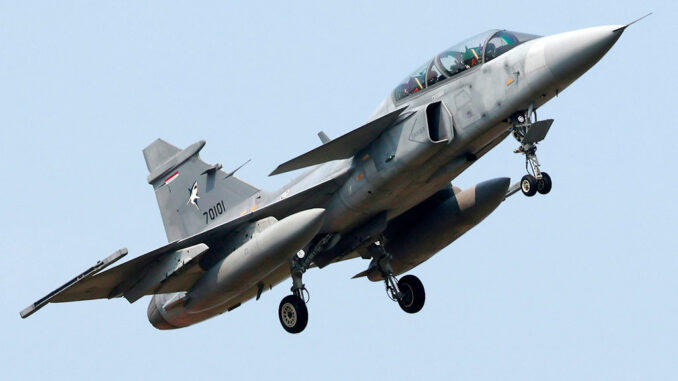
Bogotá signs a $4.3 billion contract for 17 Saab Gripen aircraft. Fleet modernization, strategic shift, and new regional tensions provide the backdrop.
Summary
Colombia has just formalized the purchase of 17 Saab Gripen E/F aircraft to modernize its combat fleet and replace its Israeli Kfir aircraft, which are reaching the end of their service life. The contract, valued at approximately $4.3 billion based on 16.5 trillion Colombian pesos, covers 15 single-seat Gripen E and two two-seat Gripen F aircraft, with deliveries scheduled between 2026 and 2032. This choice ends years of hesitation between the French Rafale, the American F-16, and the Swedish Gripen. Bogotá favors a modern, multi-role fighter jet that is less expensive per flight hour and comes with a significant industrial package. For President Gustavo Petro, these aircraft are a “weapon of deterrence to achieve peace” in a geopolitical environment described as “chaotic,” marked by crises in Venezuela, instability in Ecuador, and mounting US military pressure in the Caribbean. The acquisition reshapes Colombia’s air deterrence and sends a strong signal to the entire region.
Colombia’s decision and the terms of the contract
The Colombian government has confirmed the signing of an agreement with Saab for a fleet of 17 Gripen E/F aircraft, for an official amount of 16.5 trillion pesos, or approximately €3.1 billion and between $3.6 and $4.4 billion depending on conversions and the scope of the associated package. The agreement includes aircraft, weapons, training, logistical support, and investments in Colombian air infrastructure. Deliveries are scheduled to take place between 2026 and 2032, leaving a significant transition window for the Fuerza Aeroespacial Colombiana.
The timing is not insignificant. The final announcement comes after an initial decision in principle in early 2025 in favor of the Gripen to replace a fleet of Kfirs that are over 30 years old. These Israeli aircraft, acquired in the late 1980s, have become difficult to maintain, especially since the breakdown of diplomatic relations between Bogotá and Tel Aviv in 2024, which has made access to Israeli industrial support complex.
Politically, Gustavo Petro is presenting the operation as the most important military air acquisition in decades, emphasizing the logic of “deterrence for peace” rather than an offensive arms race. However, he is making a heavy budgetary choice in a country where internal violence linked to armed groups, coca, and the destabilization of regions such as Catatumbo continues to claim hundreds of lives.
Choosing the Gripen over the Rafale and the F-16
Colombia has long been evaluating three main options: Lockheed Martin’s F-16 fighter jet, Dassault Aviation’s Rafale, and the Saab Gripen E/F. On paper, each option has a different rationale.
The F-16 offered continuity with the American ecosystem, which is already central to Colombian military cooperation, particularly in the fight against drugs. However, Bogotá would have had to accept “second-hand” aircraft or sub-optimal configurations, which fueled criticism of the F-16s, considered “third-hand” in the local debate.
The Rafale offered a real qualitative leap in terms of range, payload, and sensors, but at the cost of higher acquisition and operating costs. For a country with a limited defense budget, the economic equation was difficult to defend politically, despite strong diplomatic pressure from France.
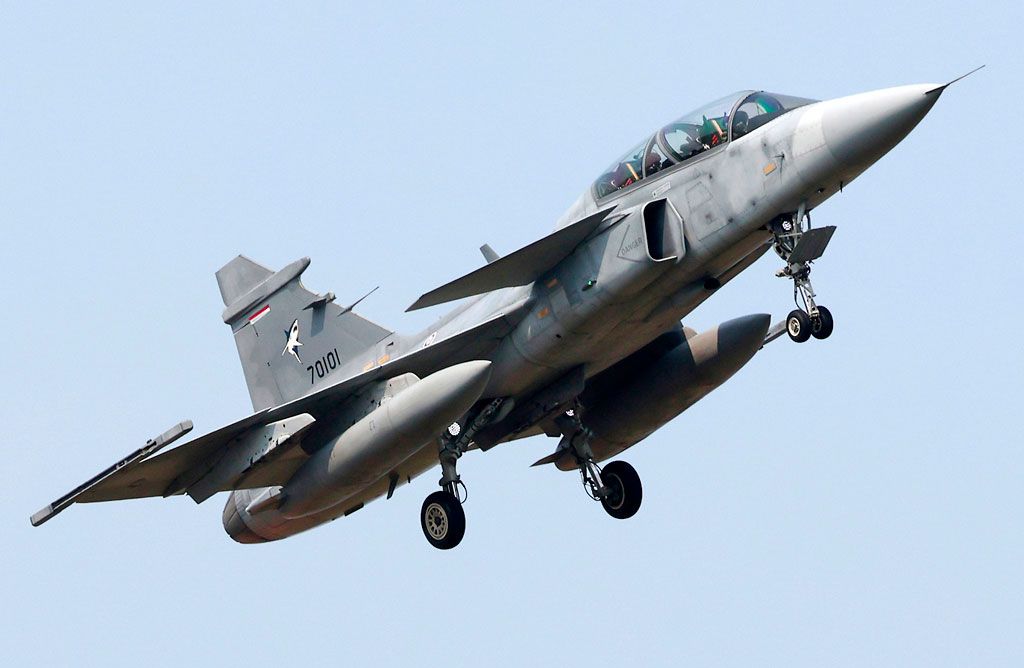
Finally, the Gripen E/F emerged as a compromise between performance and cost. The twin-engine aircraft, equipped with AESA radar and designed for short takeoffs from dispersed bases, is optimized for medium-sized air forces that want a credible multi-role tool without incurring the costs of a heavy fighter. Saab highlights an estimated flight hour cost of around 50 to 70% of that of heavier Western aircraft, although the exact figures remain confidential.
The presence of the Gripen in Brazil, under the designation F-39E/F, also carried weight. Brasilia ordered 36 aircraft and developed a local assembly and engineering line with Saab. This cooperation with Brazil offers Colombia the prospect of regional support, training exchanges, and, ultimately, possible industrial synergies. By joining the “Gripen family,” Bogotá is placing itself in a network that goes beyond a simple off-the-shelf purchase.
Integration of the Gripen into the Colombian Air Force
For the Fuerza Aeroespacial Colombiana, the transition from the Kfir to the Gripen represents a major technological leap. The Kfir, derived from the Mirage 5, is based on an old analog architecture, even if it has been modernized. The Gripen E/F, on the other hand, is a “4.5” generation fighter with advanced digital avionics, AESA radar, multi-sensor data fusion, and secure data links.
In concrete terms, these 17 aircraft will form the core of the future Colombian fighter fleet. They are expected to be assigned to a main combat wing, responsible for air policing, air defense, precision air-to-ground missions, and reconnaissance. With a range of over 1,300 km in air-to-air configuration and in-flight refueling capability, the Gripen can cover the entire Colombian territory, from the Caribbean coast to the Amazon, and provide sustained surveillance of the borders with Venezuela, Brazil, Peru, and Ecuador.
Integration also requires a significant investment in training. Colombian pilots will have to transition from an “analog” culture to a sensor and complex systems management approach. The contract includes training in Sweden and Brazil, as well as support for the development of national instructors. Maintenance will be carried out partly locally, with skills transfer in avionics systems and life cycle management.
Colombia is likely to retain some of its Kfir aircraft for a few more years in a secondary role, until the Gripen fleet reaches full operational capacity. This period of dual fleet operation will ensure continuity of air policing and interception missions while the new capabilities are gradually integrated.
Industrial and technological benefits for Colombia
Beyond the military aspect, one of the pillars of the $4.3 billion contract concerns industrial and social compensation. From the outset of negotiations, Saab and the Swedish government highlighted co-development projects in engineering, energy, and infrastructure, including solar power plants and access to drinking water in several Colombian regions.
The final contract confirms this approach. It provides for investments in the modernization of air bases, the creation of maintenance and training centers, and joint research programs in aeronautical and defense technologies. For local industry, this means skilled jobs in aeronautics, electronics, and related services, with the possibility of eventually participating in the Gripen subcontracting chain for other customers.
Colombia also seeks to use this acquisition as a lever to strengthen its overall technological capacity. Part of the offsets must benefit non-military sectors, through infrastructure and public health projects already mentioned in the decision in principle on the Gripen. The official objective is to avoid the contract being perceived as a purely military expenditure in a country where social needs remain immense.
One question remains: the state’s actual capacity to absorb and manage these projects over the long term. Past experiences with offsets in Latin America show that not all announced commitments always translate into concrete investments. The governance of the Gripen program will therefore be an important indicator of Colombia’s industrial maturity.
The regional implications of a Gripen fleet in Latin America
Strategically, the arrival of 17 Gripen E/F aircraft strengthens Colombia’s position in a region where the air balance has until now been dominated by fleets of F-16s (Chile), Su-30s (Venezuela), and aging Mirage or Mig aircraft (Peru, Ecuador). With Brazil already committed to 36 Gripens, Colombia becomes the second operator of this fighter in Latin America.
The message to Caracas is clear. While Venezuela touts its fleet of Russian-made Su-30s as the centerpiece of its deterrence strategy, the arrival of a modern fighter jet equipped with advanced sensors and latest-generation air-to-air missiles narrows Colombia’s technological gap. Colombia has no interest in escalation, but it wants to protect itself against a scenario in which Venezuelan air power becomes a direct tool of pressure.
Ecuador and Peru are also watching this move. Both countries face their own budgetary and security challenges, but Colombia’s acquisition could fuel internal debates on the modernization of their fighter fleets. In the medium term, Latin America could see the emergence of two technological poles: a modernized F-16 axis and a Gripen axis centered on the Brazil-Colombia duo.
Finally, Bogotá’s decision comes amid broader regional tensions, with the increased presence of US forces off the coast of Venezuela and diplomatic friction between Washington and Gustavo Petro creating a climate of mistrust. Petro is taking a more autonomous stance towards the United States, while remaining dependent on some US military and intelligence aid. The choice of a non-US aircraft, backed by Sweden and Brazil, is part of this desire for diversification.
Modernization that redraws the Colombian air force balance
With the replacement of the Kfirs by a fleet of 17 Gripens, Colombia is crossing a symbolic threshold: it is definitively leaving the era of Mirage-derived aircraft behind and entering the era of digital, interconnected, multi-role fighters designed to operate in a network. This modernization will not solve the structural problems of internal security, nor the root causes of the conflicts that are shaking the country and its borders, but it will permanently change the balance of power in the air.
The real question will be how Bogotá uses this new capability: as a simple defensive umbrella, an air deterrent against unstable neighbors, or a political lever in its relations with Washington, Caracas, and Brasilia. The Gripen program is, in fact, becoming a barometer of Colombian strategy: the degree of cooperation with Brazil, the margin of autonomy vis-à-vis the United States, and the ability to convert a massive military investment into tangible industrial and technological gains.
Gustavo Petro’s gamble is clear: invest heavily in a deterrent to secure the country in a regional environment deemed unpredictable. It is now up to the Fuerza Aeroespacial Colombiana and the civil authorities to demonstrate that this new generation of aircraft will not only be a symbol, but a coherent instrument in the service of a controlled security strategy.
Sources
- Official Saab press release – “Saab signs contract for Gripen E/F with Colombia,” November 15, 2025.
- Aviation Week – “Colombia Finalizes Order For 17 Gripen E/F Fighters,” November 2025.
- Al Jazeera – “Colombia’s Petro inks $4.3bn deal for 17 fighter jets amid regional tension,” November 15, 2025.
- AP News – “Colombia to buy Swedish fighter jets to replace aging Israeli aircraft,” 2025.
- Army Recognition, Breaking Defense, FlightGlobal, Defense Security Asia – analysis articles on the Colombian Gripen E/F contract and the regional context in 2025.
War Wings Daily is an independant magazine.