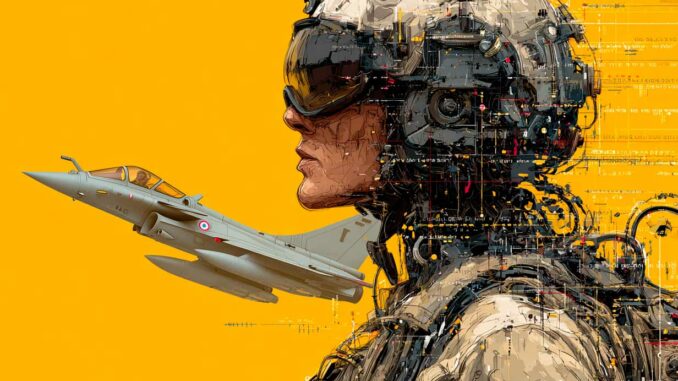
The integration of Harmattan AI into the Rafale F5 marks a key milestone for French combat aviation and raises questions about the future of defense start-ups.
Summary
The announcement on January 12, 2026, of the integration of French start-up Harmattan AI into the Rafale F5 program marks a structural change in French combat aviation. With an announced investment of $200 million, Dassault Aviation intends to accelerate the introduction of advanced onboard artificial intelligence capabilities designed to optimize sensor management, data fusion, and decision support in air combat. Harmattan AI, a young company specializing in real-time AI algorithms for critical systems, is thus becoming a central player in the future standard of French fighter jets. Beyond the technological promise, this integration raises several questions. What is the real role of AI on board a modern fighter jet? How mature is Harmattan in industrial terms? And above all, could this start-up have survived and grown without the direct support of a prime contractor such as Dassault? The operation sheds light on the state of the French defense AI ecosystem and its structural weaknesses.
The strategic context of the Rafale F5
The F5 standard as a capability pivot
The Rafale F5 standard is not a simple incremental evolution. It is designed as a transition platform between current combat aviation and future collaborative combat architectures. By the 2030s, the Rafale F5 must be capable of operating in a saturated, highly contested, and data-dominated environment.
The rise of onboard and remote sensors is creating a volume of information that is impossible for a pilot to process alone. AESA radar, optronic sensors, electronic warfare, tactical data links: the cognitive load is increasing faster than human capabilities. It is in this context that AI becomes a critical operational lever, rather than a simple optimization tool.
A clear commitment to technological sovereignty
By integrating a French start-up rather than a foreign player, Dassault Aviation is demonstrating a clear commitment to sovereignty. Decision algorithms, threat prioritization mechanisms, and learning models are not neutral. They structure the way an aircraft “sees” and “understands” the battlefield.
Entrusting these building blocks to a national player limits the risks of strategic dependence and facilitates state control over sensitive technologies, particularly in a context of export restrictions and defense secrecy.
Harmattan AI’s technological positioning
Specialization in real-time embedded AI
Harmattan AI is not a generalist AI start-up. Its positioning is narrow and deliberate: to develop algorithms capable of operating in real time on embedded platforms, with severe constraints in terms of computing power, latency, and robustness.
Unlike the massive models used in the civilian sector, military embedded AI must operate with limited computing power, withstand harsh environments, and remain explainable. The systems developed by Harmattan are aimed precisely at this niche: multi-sensor processing, anomaly detection, dynamic threat prioritization, and tactical decision support.
An approach focused on pilot assistance
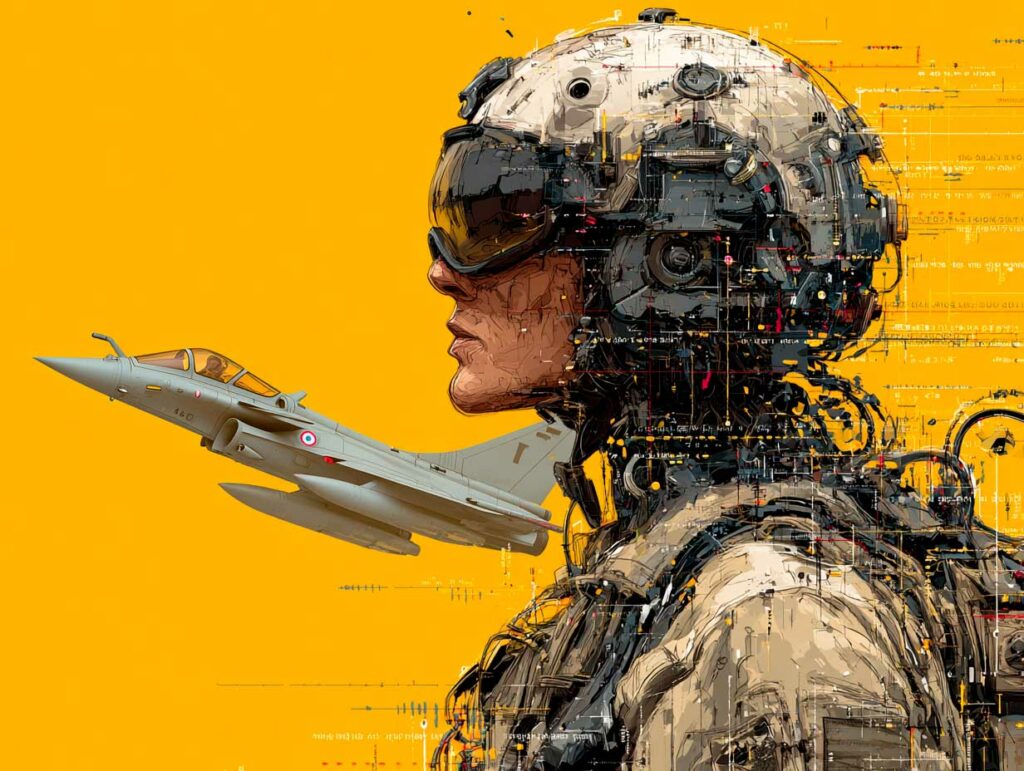
The proposed AI does not replace the pilot. It acts as a digital co-pilot. Its role is to filter, correlate, and prioritize information. In concrete terms, this means reducing the number of unnecessary alerts, proposing prioritized tactical options, and anticipating certain developments in the air situation.
This philosophy is essential for operational acceptance. In combat aviation, trust in the system is crucial. AI that is perceived as opaque or intrusive would be rejected, regardless of its theoretical performance.
Terms of integration with Dassault Aviation
Gradual integration under industrial control
The integration of Harmattan AI into the Rafale F5 program does not mean total autonomy for the start-up. Dassault Aviation retains overall project management, as well as control of avionics architectures and critical interfaces.
The algorithms developed by Harmattan are integrated within a strict validation framework, with testing phases in simulators and then in flight. This gradual approach limits technical risks and allows for controlled maturity. AI is not activated as a “black box,” but as an evolving module.
An investment that goes beyond simply purchasing technology
The announcement of a $200 million investment reflects an ambition that goes beyond a traditional subcontracting agreement. It is a long-term commitment, intended to secure skills, finance R&D, and adapt Harmattan’s technologies to military requirements.
This level of investment is significant for a French defense start-up. It makes it possible to absorb the long certification cycles, which are often incompatible with traditional venture capital business models.
The expected real operational impact
Better use of the information spectrum
The main contribution of Harmattan AI lies in advanced data fusion. By combining information from multiple sensors in real time, AI can provide a more coherent view of the tactical situation. This reduces response times and improves the quality of decisions.
In modern air combat, a few seconds can make all the difference. The ability to identify a priority threat more quickly, or to detect an inconsistency in a contact’s behavior, is a real advantage.
A measurable reduction in cognitive load
Initial internal assessments indicate a significant reduction in the pilot’s cognitive load during complex scenarios. Even without precise public figures, military feedback shows that information overload is one of the main factors in loss of efficiency.
By filtering information and offering options rather than raw data streams, AI helps keep pilots in an optimal decision-making zone, even in degraded environments.
The French defense AI ecosystem
Is Harmattan alone in this niche?
Harmattan AI is not the only French start-up active in defense AI. Other players are working on simulation, predictive maintenance, image analysis, and autonomous systems. However, few are as directly positioned in the field of critical embedded AI on board fighter jets.
This segment is particularly demanding. It requires a detailed understanding of aeronautical constraints, access to classified data, and the ability to engage with major manufacturers. These barriers to entry explain the small number of credible players.
A still fragile ecosystem
Despite its potential, the French ecosystem remains fragile. Long cycles, limited volumes, and regulatory constraints make it difficult for start-ups to survive without industrial or state support. Many promising initiatives fail due to a lack of concrete opportunities or adequate funding.
The integration of Harmattan into the Rafale F5 is more of an exception than the norm. It implicitly raises the question of France’s ability to produce champions in defense AI without the immediate backing of a large group.
The viability of Harmattan AI without Dassault
A difficult path to autonomy
Without the support of Dassault Aviation, Harmattan’s trajectory would have been much more uncertain.
The civilian market for critical embedded AI is narrow. Military applications offer limited volumes, but margins and long-term visibility.
Without this partnership, the start-up would probably have had to pivot towards less constrained civilian uses or seek export contracts, with all the risks that this entails in terms of sovereignty and control.
An accepted but structuring dependency
The backing of Dassault creates a dependency, but it also offers rare stability. Harmattan benefits from an industrial framework, access to end users, and immediate international credibility. This dependency is the price to pay for evolving in a sector where total autonomy is often illusory.
A decision that goes beyond the Rafale
The integration of Harmattan AI into the Rafale F5 is not just a technological advance. It is a signal. It shows that embedded AI is becoming a determining factor in air superiority and that mastery of it will determine the future effectiveness of the armed forces.
It also reveals the structural limitations of the start-up model applied to defense. Without massive industrial support, few players can survive. Dassault Aviation’s choice is therefore as much a technological gamble as it is a political act, in the noble sense of the term: that of structuring an ecosystem rather than allowing it to fragment.
Sources
- Dassault Aviation press release, January 12, 2026
- Statements by the Ministry of the Armed Forces on the Rafale F5 standard
- French parliamentary reports on defense AI
- Technical publications on AI embedded in combat systems
- Industrial analyses of the French defense and AI ecosystem
War Wings Daily is an independant magazine.