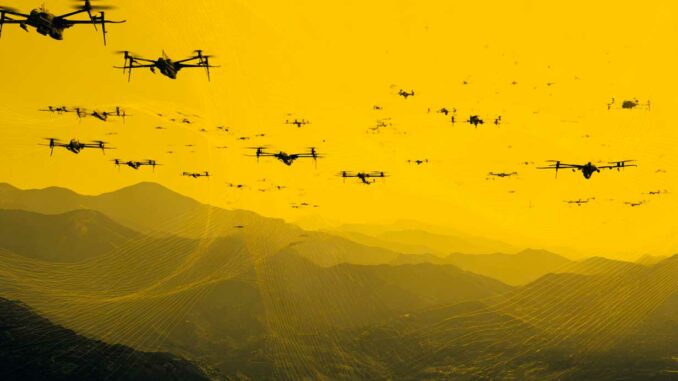
Why drone swarms win through saturation: tactics, communications, swarm sorties, and realistic countermeasures against defenses.
In summary
Drone swarms do not necessarily seek a “spectacular” breakthrough. They win through saturation. They multiply radar tracks, force hasty decisions, and deplete interceptor stocks. In recent conflicts, combined attacks using drones, missiles, and decoys have demonstrated a simple reality: short-range air defense works well… as long as it is not overwhelmed. At that point, the logic is reversed. The attacker sets the tempo, the defender pays the price. The heart of the problem is industrial and operational: rate of fire, sensor bandwidth, ammunition availability, and crew fatigue. Swarms add another layer: communications, local autonomy, in-flight reconfiguration, and the ability to “break away” to attack from another angle. Countermeasures exist, but none are magical. It requires a combination of jamming, cannons, lasers, interceptor drones, site hardening, and above all, a doctrine that accepts letting some vectors through in order to destroy others.
The shift in defense logic: from disruption to attrition
For decades, defense was thought of as a duel. A missile against an aircraft. A radar against a signature. One shot, one result. Drone swarms break this grammar. They do not promise technological “disruption.” They impose a physical and accounting reality: too many threats, too fast, on too many axes.
A short-range system operates on thresholds. Detection threshold. Tracking threshold. Engagement threshold. Ammunition threshold. When the flow exceeds these thresholds, performance does not decline gradually. It collapses. It’s brutal, and that’s precisely what a swarm is looking for.
Saturation also has a psychological effect. Operators must sort out in seconds what is lethal, what is a decoy, what has already been neutralized, and what will fall on its own. Under stress, the defense over-engages. And every engagement has a cost.
The mechanics of a swarm: speed, deception, overload
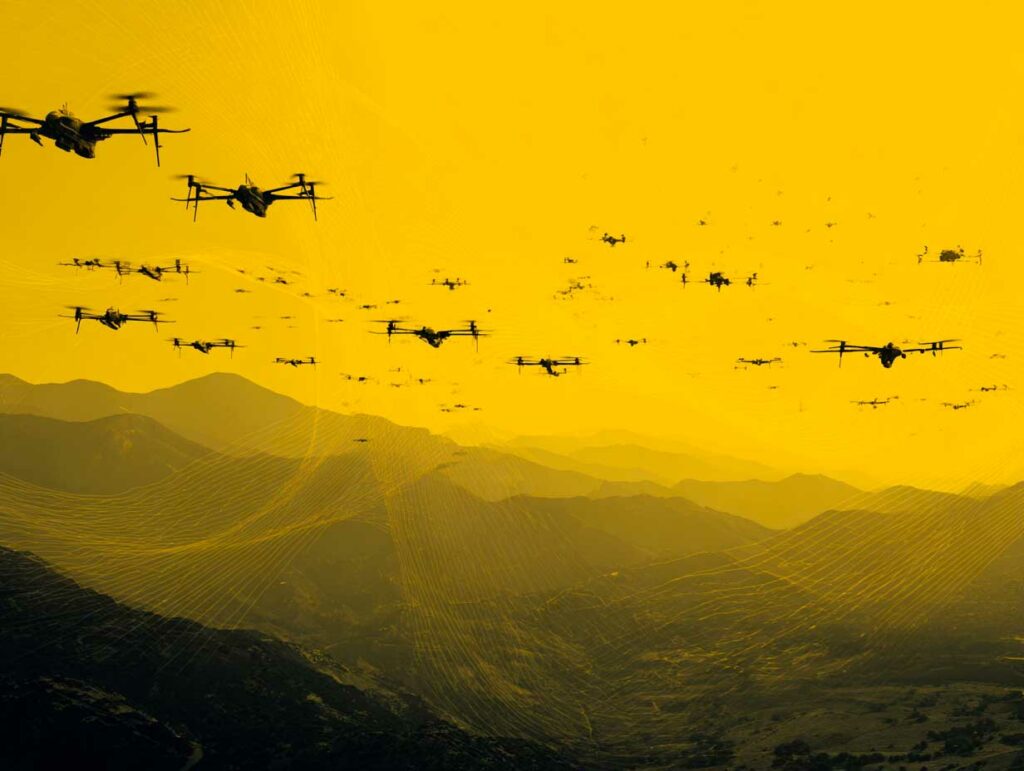
A swarm is not necessarily a hundred “intelligent” drones flying in perfect formation. In real life, it is often a heterogeneous package, designed to saturate different layers.
Mixing roles in the same wave
There are generally four roles, sometimes in the same salvo.
- Cheap drones to fill the screen and trigger fire.
- Attack drones or loitering munitions to strike a specific target.
- Reconnaissance vectors for real-time correction.
- Electronic warfare elements to blind or degrade enemy coordination.
The strength of this approach is simple: the defender can no longer “play chess.” They are subjected to a game of reflexes. And the attacker accepts the loss of some of the drones, because success is measured by the number that get through, not the number that survive.
Overloading sensors and the firing chain
Saturation also targets the invisible logistics of defense: the ability of radar to maintain tracks, the ability of the command post to prioritize, the ability of effectors to fire without “stepping on each other’s toes.” Even when ammunition is available, a firing window, identification, and authorization are required. A swarm compresses this entire cycle.
In the Ukrainian case, massive attacks have been described as designed to saturate defenses, with very high volumes in a single night. A striking example reported in 2025 refers to a combined salvo of 728 drones and missiles during an attack on July 9, precisely to overwhelm the defense by sheer numbers. This is not a laboratory experiment. It is a campaign method.
Communications between drones: the minimum viable, not the perfect “cloud”
We often imagine a swarm as a sophisticated and permanent network. In reality, operational swarms seek above all to be robust.
Radio networking and its limitations
The principle of radio networking is to avoid a “single point of failure.” If one relay goes down, information flows through another. In practice, the swarm does not need to share everything with everyone. It needs a few functions: to synchronize time, share positions, distribute targets, and report losses.
But this mesh is vulnerable to jamming, obstacles, and range. Drones fly low to survive. However, terrain, buildings, and the curvature of the Earth break the line of sight. Many swarms compensate with a hybrid approach: minimal communication and local logic.
Local autonomy as life insurance
This is where embedded autonomy becomes central. Each drone must be able to continue a mission even if the network goes down. Inertial navigation, pre-loaded waypoints, simple “if-then” behaviors. The drone doesn’t have to be brilliant. It has to be stubborn.
Autonomy also allows for deception. A drone can simulate an approach route, then change course without waiting for instructions. All that is needed are common rules: “if you lose contact, switch to plan B.”
The ability to break away from the swarm: the art of tactical disengagement
An effective swarm does not stay stuck in a pack. It reconfigures itself.
Decoupling to multiply angles
Short-range defense loves “clean” threats: one direction, one altitude, one speed. A swarm can deliberately split up. Some drones stay on course to maintain pressure. Others break away and pass through a less covered area. The goal is not to be invisible. The goal is to be “too everywhere.”
The role of interchangeable “leaders”
Even in simple swarms, there may be “lead” drones that have better navigation, a slightly more powerful sensor, or a coordination payload. If this leader falls, another takes over the role. It can be very basic: the first drone still active in a list becomes the new leader. It’s not elegant. It’s sufficient.
Returning to the mass
Breaking away is not a permanent exit. A drone can leave the formation, circle around, and then re-enter the stream to hide behind other signatures. This is a technique of confusion rather than stealth.
The effects on defense: the truth about point defense
The problem is not that point defense systems are “bad.” They are often excellent within their window. The problem is that they are not designed to absorb continuous, massive pressure.
The cost-effectiveness barrier
The debate quickly becomes cynical, but it is real: cost-effectiveness. Firing an interceptor costing several hundred thousand or even several million euros against a drone costing a few tens of thousands is sometimes a necessary choice… but rarely sustainable at high rates.
Public analyses of Ukraine have highlighted this asymmetry, with very telling orders of magnitude: Shahed-type drones valued at $20,000–50,000, compared to much more expensive interceptors (sometimes in the millions, or even tens of millions, depending on the system). Even if the exact figures vary, the trend is stable: a “missile against drone” firing strategy ends up depleting stocks and the budget, even before it stops the attack.
Depletion of stocks and crew fatigue
There is a lot of talk about missiles. We forget about the teams. A swarm does not just attack a base. It attacks the ability to remain vigilant. Repeated nights, constant alerts, repositioning, firing “just in case.” Defense becomes a marathon with no finish line.
Credible countermeasures: accept superposition, reject illusion
The question “what countermeasure?” calls for a frank answer: there is no stop button. There is architecture and discipline.
Electronic warfare as the first barrier
Electronic warfare is often the best first strike because it can deal with several targets “at once.” Jamming a control link, degrading satellite navigation, saturating a band. It doesn’t always destroy. But it disrupts. And a disrupted swarm becomes a set of isolated targets again.
The major limitation is that the adversary adapts. Inertial navigation, more robust antennas, autonomous modes. Jamming is not a solution. It is one layer.
The return of cannons and programmable ammunition
Anti-aircraft cannons are making a comeback because they fire a lot, fast, and are cheaper per shot. Programmable airburst ammunition increases the probability of destruction against small targets. Modern 35 mm systems, for example, emphasize this principle: creating a cloud of projectiles in the right place rather than aiming “surgically.”
The cannon does not replace the missile. It protects the missile by taking the brunt of the attack.
Drone interceptors: responding to numbers with numbers
Drone interceptors are a simple idea: if the enemy attacks with low-cost drones, we respond with even cheaper drones. Ukraine has announced the development of fast interceptor drones to counter attack drones, precisely to avoid burning scarce missiles. The approach is logical: low cost, rapid production, flexible engagement.
Limitations: weather, range, identification, risk of fratricide, and the need for a good detection network.
Directed energy weapons: promising, but with limitations
Directed energy weapons (lasers, microwaves) are attractive for saturation, because the “ammunition” is energy, not a cartridge. Recent tests and land and naval programs report successful shots against drones and capabilities designed to counter swarms.
But let’s be honest: a laser is not a magic wand. It has weather constraints (rain, fog, dust), thermal management, power supply, and “time on target” logic. When faced with a dense wave, it is necessary to fire in rapid succession. This is useful, but it is not enough on its own.
Hardening and dispersion: defense that doesn’t shoot
This countermeasure is underestimated because it doesn’t look spectacular. Dispersing resources, camouflaging, hardening hangars, multiplying false targets, protecting command posts, moving stocks. If the swarm gets through, it still has to find something worthwhile to destroy. Attackers hate hitting empty targets.
The doctrine that changes everything: learning not to fire
The most difficult point is cultural. A defense must accept that it cannot intercept everything. It must prioritize.
This implies clear rules:
- which vectors must be shot down at all costs,
- which can be allowed to pass through to less sensitive areas,
- when to switch from missiles to cannons,
- when to activate jamming,
- when to save for the next wave.
Saturation wins when the defender reacts to every stimulus. It loses when the defender imposes a cold hierarchy.
An open ending: mass industrialization versus defense industrialization
The drone swarm is not a fad. It is a mechanical consequence of mass production, cheap sensors, and rapid tactical adaptation. The armies that succeed are not looking for “the best system.” They build a defense in depth, accept compromises, and invest in cadence, not just performance.
The real debate is this: who can industrialize faster? The attacker who manufactures drones in volume, or the defender who manufactures sensors, munitions, effectors, and crews trained to choose without hesitation?
Sources
- CSIS, “Calculating the Cost-Effectiveness of Russia’s Drone Strikes” (February 19, 2025) .
- Financial Times, report on saturation tactics and penetration rates in Ukraine, with mention of massive salvos in 2025.
- Congressional Research Service, “Department of Defense Counter Unmanned Aircraft Systems” (March 31, 2025).
- GAO, “Air and Missile Defense Efforts…” (June 17, 2025).
- Defense One / DefenseScoop, articles on U.S. Army C-UAS budgets and systems (March 2024).
- Rheinmetall, product sheet “Oerlikon Skynex – Networked air defense.”
- Navy Times, HELIOS test against drones (February 2025).
- The War Zone, HELIOS and “directed energy” developments against drones/swarms (February 2025).
- Prism UA, analysis of the economic asymmetry between drones and interceptors and defense architecture (January 2, 2025).
War Wings Daily is an independant magazine.