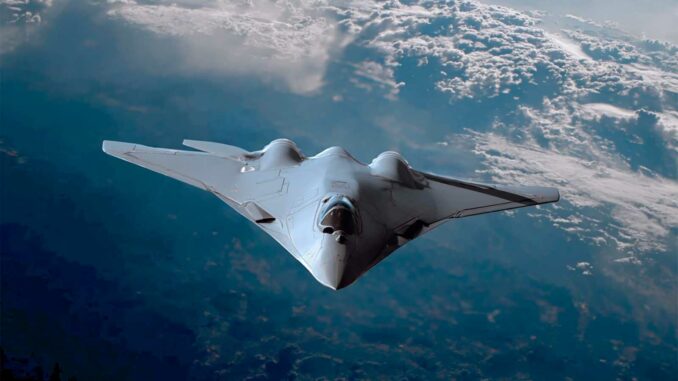
Boeing wins the NGAD program. The F-47, a sixth-generation fighter jet, represents a major technological and industrial breakthrough.
Summary
The announcement sent shockwaves through the industry. The Boeing F-47 NGAD was officially awarded to Boeing after a discreet but decisive competition for the future of American air superiority. This success puts an end to months of speculation and offers the aircraft manufacturer a strategic lifeline after several difficult years in both the civil and military sectors. Behind the name F-47 lies much more than an aircraft: it is an NGAD combat system designed to dominate high-intensity conflicts against adversaries of equivalent rank, particularly in the Asia-Pacific region. Initial information suggests a radical aircraft, with a design similar to a flying wing that prioritizes stealth, range, and human-machine integration over conventional maneuverability. This choice marks a doctrinal break by the US Air Force, which is already preparing for future air dominance.
The industrial shock caused by the award of the contract
The awarding of the NGAD program to Boeing goes far beyond a simple call for tenders. It is the most strategic military aeronautics program since the launch of the F-35. The exact amounts remain classified, but estimates suggest a total budget of over $200 billion over the entire life cycle, including development, production, and support.
For Boeing, this victory is a rebirth. The company has been weakened by successive crises involving the 737 MAX, delays on several military programs, and a tarnished image with the Pentagon. Winning the sixth-generation F-47 fighter immediately repositions Boeing as a central player in American combat aviation for the next 40 years.
For the Pentagon, the message is clear. The choice of Boeing reflects a desire to diversify prime contractors after decades of dominance by Lockheed Martin. This decision reduces industrial and political risks, while stimulating innovation through indirect competition between large groups.
The NGAD program as a doctrinal break
A system approach before the platform
The US NGAD program is not based on a single aircraft, but on a comprehensive NGAD architecture. The F-47 is the centerpiece, but it operates in symbiosis with loyal wingman drones, satellites, remote sensors, and advanced command networks.
The US Air Force no longer talks about aircraft, but about NGAD combat systems. This vision reflects an operational reality: survival and effectiveness depend on the ability to collect, merge, and exploit information faster than the adversary. The F-47 becomes a decision-making hub, capable of coordinating kinetic and non-kinetic effects over long distances.
The presumed successor to the F-22 Raptor
The successor to the F-22 Raptor is not intended to replace it in every respect. Whereas the F-22 focused on pure air superiority and close-range air-to-air combat, the F-47 emphasizes range, stealth, and persistence. Dogfighting is no longer the norm. Engagement takes place beyond the line of sight, in an environment saturated with sensors and jamming.
This evolution reflects a clear-eyed view of future conflicts. In the face of integrated defenses and technologically advanced adversaries, survival becomes as important as victory.
The F-47 design and the choice of flying wing
Stealth taken to the extreme
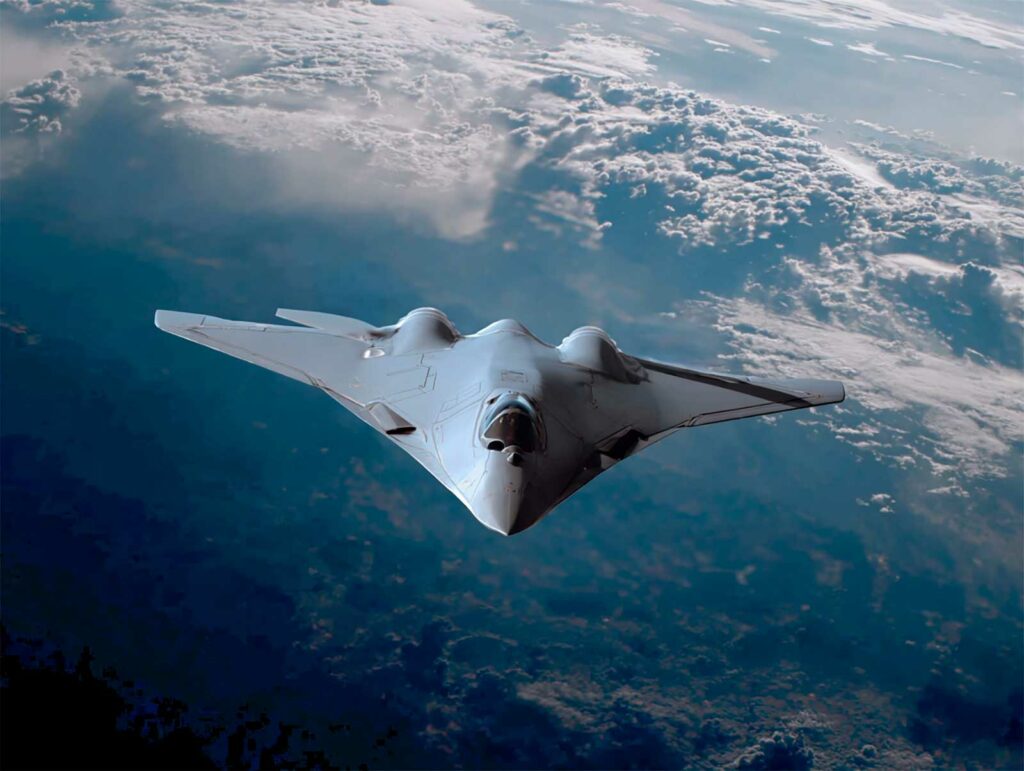
The first conceptual images suggest a blended wing-body design, similar to a flying wing. This choice is primarily aimed at ensuring the stealth of the F-47. By drastically reducing vertical surfaces and sharp angles, the radar signature of the F-47 would be significantly lower than that of current fighters.
This design is not entirely new. Boeing has been exploring this avenue for several decades, notably with its work on stealth drones and X-plane demonstrators. The NGAD is the culmination of this accumulated experience.
The accepted sacrifice of maneuverability
This aerodynamic choice comes at a cost. A flying wing offers less maneuverability than a conventional fighter with canards or large fins. The US Air Force accepts this compromise. The US Air Force’s NGAD doctrine considers that the survivability of the F-47 relies primarily on avoidance, stealth, and distance.
Close combat is seen as a failure of the system. The F-47 is designed to never find itself in that situation. This philosophy contrasts with that of previous generations, but it is consistent with the evolution of threats.
Key onboard technologies
Adaptive propulsion and supercruise
The F-47’s variable cycle engine is one of the pillars of the program. This adaptive propulsion system optimizes thrust, fuel consumption, and thermal management depending on the flight phase. The result is sustainable supercruise for the F-47, without afterburners, at speeds exceeding Mach 1.5 (approximately 1,850 km/h).
This capability increases the range of the F-47, estimated to be well above that of the F-35, and its operational radius, which is critical in the vastness of the Pacific. Autonomy becomes a strategic factor, on a par with stealth.
Electronic warfare and data fusion
The F-47 is designed as an advanced electronic warfare platform. Its sensors collect massive amounts of data, which is immediately processed using data fusion. The F-47’s artificial intelligence assists the pilot in decision-making by prioritizing threats and opportunities.
This level of automation transforms the human role. Collaborative piloting of the F-47 is based on constant human-machine interaction, where the pilot becomes a conductor rather than a mere executor.
Loyal wingman drones and collaborative combat
NGAD collaborative combat is inseparable from the F-47. NGAD loyal wingman drones can perform reconnaissance, jamming, strike, or decoy missions. They extend the fighter’s operational bubble without exposing the crew.
This human-machine logic in the NGAD program makes it possible to saturate enemy defenses while maintaining a high degree of tactical flexibility. The F-47 is never alone.
Strategic implications vis-à-vis China
The role of the F-47 vis-à-vis China is central to American thinking. The Indo-Pacific theater imposes unique constraints: immense distances, vulnerable bases, and a technologically competent adversary. The F-47 in the Pacific is designed to operate far, long, and discreetly.
When compared to China’s J-20, the F-47 and J-20 highlight two different philosophies. Beijing is banking on mass and rapid growth. Washington favors systemic quality, integration, and information dominance. The NGAD clearly falls into the latter category.
Comparisons and international positioning
Compared to allied and competing programs
A comparison of the F-47 and the F-35 reveals a fundamental difference. The F-35 is a multi-role fighter, designed for export and interoperability. The F-47 is a pure American air superiority aircraft, reserved for the US Air Force.
A comparison of the F-47 and the Tempest, or the F-47 and the SCAF, illustrates the difference in timing and ambition. European programs aim to enter service around 2040. The F-47 could be operational sooner, with an architecture already proven on secret demonstrators.
The place of the F-47 in the US Air Force
The place of the F-47 in the US Air Force will be that of a force multiplier. It will not replace all existing fighters, but will intervene in the most critical scenarios. Its high unit cost limits volumes, but its strategic effect more than compensates for this constraint.
An industrial and strategic gamble
The cost of the NGAD program and the NGAD budget are already sparking debate in Washington. However, the US Air Force believes that not investing would be even riskier. High-intensity air warfare requires the right tools, capable of surviving in a contested environment.
The industrialization of the F-47 also represents a challenge. Boeing will have to prove its ability to deliver on time, with impeccable quality. The NGAD industrial strategy is based on shorter development cycles and frequent updates, breaking with the rigid programs of the past.
The F-47 is not just an aircraft. It is the symbol of a reimagined American air deterrent, where superiority is no longer measured by the number of aircraft, but by the ability to control the information space. This contract of the century commits Boeing and the US Air Force to a demanding trajectory. The success of the F-47 will say a lot about the United States’ ability to maintain air dominance in the future.
Sources
US Air Force communications
Department of Defense briefings
Industry analyses Boeing Defense
Congressional Research Service
CSIS
RUSI
The War Zone
War Wings Daily is an independant magazine.