How the development of the McDonnell Douglas F-4 Phantom II redefined the design of Western multirole fighter aircraft.
Summary
The development of the McDonnell Douglas F-4 Phantom II was one of the most influential military aviation programs of the second half of the 20th century. Originally designed to meet the specific requirements of the US Navy, the F-4 quickly evolved into a multirole fighter capable of adapting to very different doctrines and armed forces. Its design, dictated by the priority given to interception and combat beyond visual range, broke with the standards inherited from World War II. The design of the F-4 Phantom II was based on deliberate, sometimes controversial industrial choices and the extensive integration of emerging technologies such as onboard radar and guided missiles. Successive adjustments to the program reflect the tensions between doctrinal theory, operational constraints, and feedback from the field. The history of the development of the McDonnell Douglas F-4 Phantom II thus sheds light on the profound evolution of Western military aviation at a time when air superiority was becoming a global strategic issue.
The genesis of the McDonnell Douglas F-4 Phantom II in a tense strategic context
The strategic context for the development of the F-4 Phantom II was firmly rooted in the early years of the Cold War. In the late 1950s, the priority of the US Air Force was clear: to quickly intercept Soviet bombers capable of delivering nuclear weapons. The military requirements behind the F-4 Phantom II therefore prioritized speed, altitude, and the ability to carry guided weapons.
The program began at McDonnell Douglas under the internal designation AH-1, then F4H-1. The goal was to offer the US Navy an aircraft capable of operating from an aircraft carrier, with sufficient range to cover vast maritime areas. At that time, dogfighting was considered obsolete. The prevailing doctrine relied on radar and missiles.
From the outset, the origins of the F-4 Phantom II fighter represented a conceptual break with the past. The aircraft was designed as a weapons platform, rather than purely as a light fighter. This philosophy would have a lasting impact on its development.
The design of the F-4 Phantom II and its architectural choices
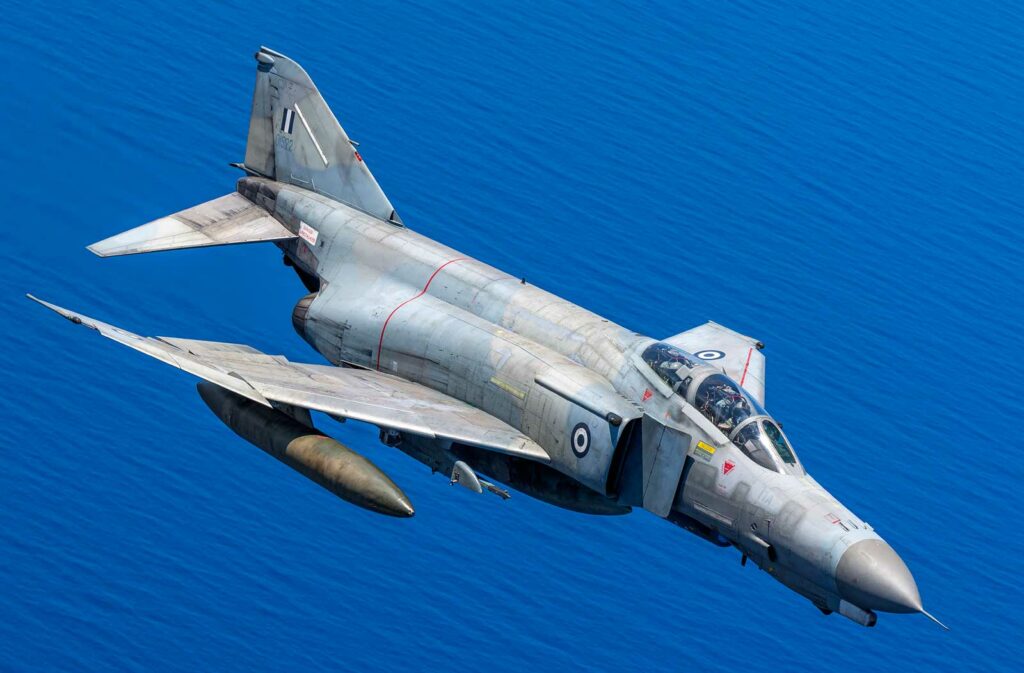
The design of the F-4 Phantom II was based on ambitious technical choices. The fuselage is large in order to accommodate two General Electric J79 turbojet engines, each developing approximately 79 kN of thrust with afterburner (17,900 lbf). This engine configuration allows the aircraft to reach Mach 2.2 at high altitude.
The variable-geometry air intakes, recognizable by their movable ramps, are optimized for supersonic flight. The choice of a 45-degree swept wing favors speed at the expense of maneuverability at low speeds. This compromise was accepted as part of the F-4 Phantom II development program.
Another key decision was the absence of an internal cannon on the early versions. The performance expected during the development of the F-4 Phantom II was based exclusively on the use of air-to-air missiles, such as the AIM-7 Sparrow and AIM-9 Sidewinder. This approach reflected the confidence at the time in the technological superiority of long-range combat.
The development of the F-4 Phantom II for the US Navy
The development of the F-4 Phantom II for the US Navy imposed specific constraints. The aircraft had to be capable of repeated landings on aircraft carriers, which required a reinforced structure and the integration of a robust landing gear. The empty weight quickly exceeded 13,700 kg, a high figure for a carrier-based fighter in the 1960s.
The initial test phases of the F-4 Phantom II revealed a fast and stable aircraft at high speeds, but one that was demanding during approach phases. Engineers introduced high-lift devices, such as leading edge slats, to improve lift at low speeds.
The aircraft’s initial role was clear: long-range interception. The AN/APQ-72 radar allowed targets to be detected and engaged well before visual contact. In this context, the F-4 quickly became a central element of US carrier-based air defense.
Adaptation of the F-4 Phantom II for the US Air Force
The adaptation of the F-4 Phantom II for the US Air Force marked a major turning point in the technical evolution of the McDonnell Douglas F-4 Phantom II. Initially designed for the Navy, the aircraft was adopted by the USAF under the designations F-4C, then F-4D and F-4E.
Air combat over Vietnam highlighted the doctrinal limitations of the program. Rules of engagement often required visual identification, making missiles less effective than expected. The technical challenges of the McDonnell Douglas F-4 Phantom II then became apparent. The lack of a cannon was perceived as an operational handicap.
In response, the F-4E version incorporated an internal 20 mm M61 Vulcan cannon. This modification illustrated the program’s ability to evolve in response to feedback from the field. The evolution of the F-4 Phantom II throughout its development thus shows a gradual balance between technology and operational reality.
Technological innovations of the McDonnell Douglas F-4 Phantom II
The technological innovations of the McDonnell Douglas F-4 Phantom II extend far beyond the field of weaponry. The aircraft introduced a tandem two-seat configuration, with a pilot and a weapons systems officer. This configuration optimized the management of radar, navigation, and complex engagements.
The F-4 was also one of the first Western fighters to fully exploit versatility. The development of the F-4 Phantom II as a multirole fighter resulted in its ability to carry out interception, ground attack, and reconnaissance missions.
From an industrial standpoint, the ramp-up of the F-4 Phantom II program was spectacular. More than 5,000 units were produced between 1958 and 1981. This volume reflects the confidence placed in the platform, but also its ability to be continuously modernized.
The positioning of the F-4 against Soviet aircraft
The positioning of the McDonnell Douglas F-4 Phantom II against Soviet aircraft was a central element in its development. Faced with aircraft such as the MiG-21, which were lighter and more maneuverable, the F-4 relied on power, radar range, and crew coordination.
Actual engagements show that these technological advantages must be properly exploited. Training programs are evolving, notably with the creation of schools dedicated to air combat, in order to take full advantage of the aircraft’s capabilities.
In this context, the development of the F-4 Phantom II during the Cold War illustrates a constant adaptation to adversarial strategies and geopolitical realities.
The place of the F-4 Phantom II in the history of fighter aircraft
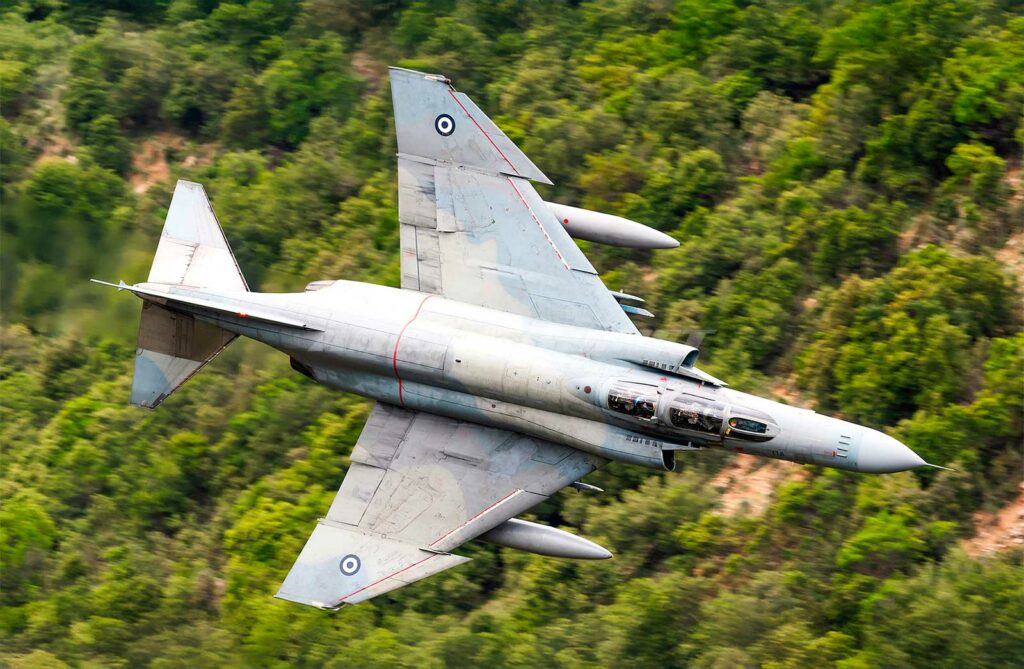
The impact of the development of the F-4 Phantom II on Western military aviation is considerable. It imposed a new vision of the fighter, conceived as a complex and evolving system. The place of the McDonnell Douglas F-4 Phantom II in the history of fighter aircraft is due as much to its performance as to its operational longevity.
Still in service with some air forces at the beginning of the 21st century, the F-4 demonstrates the relevance of its initial design choices. Its development has never been static. Over the decades, it has incorporated technical and doctrinal adjustments dictated by experience and strategic constraints.
This journey highlights an often-underestimated reality: a major aeronautical program is not a fixed entity, but a constant compromise between ambitions, constraints, and feedback from the field.
Sources
US Department of Defense historical archives
National Museum of the United States Air Force publications
Jane’s All the World’s Aircraft
McDonnell Douglas corporate archives
US Navy and US Air Force technical manuals
Back to the McDonnell Douglas F-4 Phantom II page.