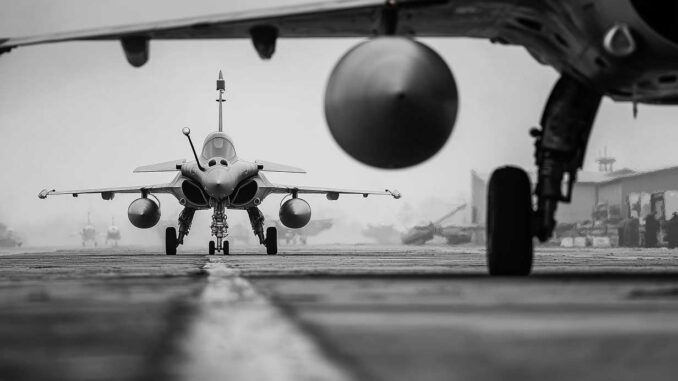
Why the Air Force is keeping the Mirage 2000-5 despite the Rafale F4: costs, interception, maintenance, and testing role in 2026.
In summary
France is keeping the Mirage 2000-5 alongside the Rafale F4 for one simple reason: these two aircraft do not optimize the same part of the combat system. The Rafale is the most complete, connected, and versatile platform, but this sophistication comes at a price in terms of maintenance and operating costs. The Mirage 2000-5, on the other hand, remains an effective solution for air defense and interception: it performs the daily tasks of permanent security, air policing, and rapid response, with a lighter logistical footprint. The cost per flight hour figures vary depending on the methods used, but public comparisons converge on a significant differential in favor of the Mirage. Finally, “keeping the Mirage” is not just a question of missions: in 2026, Mirages are still being used as a test bed for connectivity and experimentation, including around AI. It’s a choice of architecture, not nostalgia.
The apparent paradox of a “two-speed” fleet
Saying “we have the Rafale, so we should switch everything to Rafale” makes sense on paper. But an air force does not manage a garage. It manages a volume of activity, 24/7 alerts, deployments, training cycles, technical unavailability, parts stocks, and budget constraints.
The Rafale F4 is France’s best tool for modern high-intensity operations: sensors, electronic warfare, strike capability, data fusion, communications, the latest weaponry, and increased collaborative combat capabilities. But precisely because it does everything, it costs more to fly and maintain. And maintaining a permanent air security posture consumes continuous flight hours. Systematically assigning the most “high-end” aircraft to this mission amounts to burning capacity and budget on tasks that a simpler platform can already handle.
The Mirage 2000-5 is therefore being maintained not “despite” the Rafale, but to protect the Rafale from unnecessary wear and tear. This is not a sentimental decision. It is an industrial and operational logic.
The economic truth behind the cost per flight hour
The trap of single figures
There is no single “true” figure that sums up the cost of a fighter jet per hour. Depending on whether we are talking about:
- fuel and consumables,
- logistical support,
- scheduled maintenance,
- stocks and repairs,
- personnel,
- or the full cost including the structure,
we obtain different orders of magnitude. This is why public documents give several readings.
What the public orders of magnitude say
French parliamentary work provides a clear benchmark: a Rafale is estimated to cost around €25,000 per flight hour, compared to €17,000 for a Mirage 2000 (comparison of “cost per flight hour” in a Senate report on MCO). This difference is not marginal: it shapes day-to-day deployment decisions.
Another interpretation, more focused on maintenance, uses the EPM (scheduled equipment maintenance) indicator relative to flight hours. In a publicly reported hearing, the EPM per flight hour is given as around €14,596 for the Rafale, compared to €8,802 for the Mirage 2000. Here again, the difference is massive.
The strategic message is simple: for the same number of air policing and alert hours, the Mirage consumes fewer support resources. And this difference translates into money available for what really matters in high-intensity situations: rare parts, modern ammunition, complex training, electronic warfare, connectivity, and multi-domain operational readiness.
The operational logic of a “pure” interceptor in a permanent posture
The mission that wears down an air force
The permanent security posture involves alert takeoffs, interceptions, identifications, escorts, and trajectory controls.
It’s not glamorous. But it’s continuous. And it’s the foundation of credibility.
In this spectrum, the Mirage 2000-5 remains perfectly at home. It was designed around air defense: radar and air-to-air missiles, responsiveness, relative ease of use, and effectiveness in the QRA (Quick Reaction Alert) role.
The practical meaning of climb rate
The debate on raw performance is often misguided. Maximum level speed is not the dominant criterion. What matters in an interception is the time it takes to reach a given altitude and area.
In the performance data sheets published by the manufacturer, the Mirage 2000 has a maximum climb rate of 60,000 ft/min (approximately 305 m/s) and can climb to 36,000 ft (approximately 11,000 m) at Mach 1.8 in 5 minutes. These figures speak to operational personnel: they reflect an ability to “gain altitude” quickly, thereby reducing the intruder’s reaction window and securing an area.
The Rafale, for its part, is not “slow.” It is even given climb values of around 60,000 ft/min (approximately 305 m/s) according to technical data sheets published in naval aviation databases. But its operational reality is different: it carries more sensors and payloads, and is more often used in multi-mission profiles. In pure interception, the Mirage can be used in a more “dedicated” manner, with a simple configuration and a doctrine of use that aims for economic efficiency.
The important point is that keeping the Mirage means maintaining a robust interception capability without mobilizing the aircraft that is most valuable for complex missions.
The difference in maintenance is not a detail, it is a strategy
Simplicity as a military advantage
A modern army faces two constant risks: breakdowns and saturation of its supply chain. The more sophisticated a system is, the more it requires skills, test benches, diagnostics, specific parts, up-to-date software, and repair time.
The Mirage 2000-5, even when modernized, remains part of a generation that also sought robustness, maintainability, and standardization. This does not mean “easy.” It means more predictable, more industrializable, and often quicker to get back online in a repetitive mission environment.
Managing the Rafale’s “potential”
The Rafale is the heart of French air power. It must be available for:
- penetration and strike,
- multi-sensor air superiority,
- ground support,
- deterrence (depending on version and mission),
- networked warfare and coalitions.
The Rafale F4, in particular, adds collaborative combat, connectivity, and weaponry evolution capabilities. These capabilities are valuable, but they also add layers of complexity: software radios, links, communication servers, embedded cybersecurity, and denser software management.
If you use the Rafale to “fill the gap” on missions where the Mirage is sufficient, you automatically reduce:
- availability,
- the maintenance budget,
- and the ability to absorb a prolonged crisis.
Maintaining the Mirage therefore means maintaining a margin. A technical margin, a budgetary margin, and a margin of resilience.
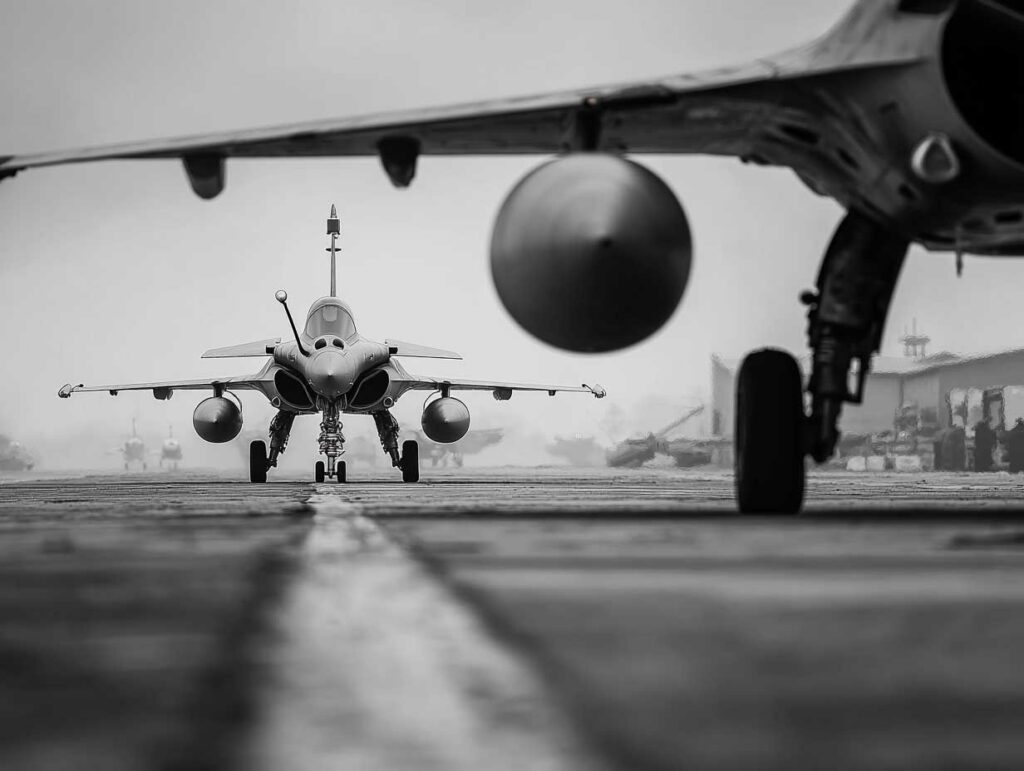
The strategic reality of the Rafale F4: an aircraft system, not just a fighter
Connectivity as a force multiplier
The Rafale F4 is not just an “improved Rafale.” It is a step towards the connected aircraft, designed to exchange, merge, and distribute information.
The DGA has qualified the F4.1 standard, highlighting, in particular, collaborative air combat capabilities and weapons integration developments. This is not a minor detail: it is the path towards networked combat, where effectiveness depends as much on data as on kinematics.
Why this pushes us to keep the Mirage
Because an aircraft system must be protected from “mundane” attrition. France needs Rafales that are available, modernized, and focused on missions where their sensors and connectivity make a decisive difference. The Mirage, meanwhile, maintains permanence, relieves the Rafale fleet, and avoids turning a technological gem into a workhorse.
The Mirage is not “obsolete” if it is used for what it does well
Efficiency is not a novelty
An aircraft is obsolete when it can no longer fulfill a useful mission in the face of a credible threat, or when its support becomes impossible. This is not the case with the Mirage 2000-5. It remains armed for air defense, it remains deployable, and it remains relevant in theaters where the main challenge is air policing and rapid response.
Parliamentary documents show that Mirage 2000-5s have recently been used for air policing missions on NATO’s eastern flank (deployments in Lithuania). This is not a “museum” job. It is an operational job.
“Just enough” modernization
The Mirage 2000-5 has undergone upgrades (including the integration of Liaison 16 according to configurations and standards). It is not intended to become a Rafale. It is intended to remain an effective interceptor, connected to the necessary level, without seeking to outbid others.
This is exactly how we maintain a sustainable fleet: by modernizing what prolongs its relevance and avoiding turning each airframe into a costly prototype.
The discreet role of the test bench and experimentation in 2026
Mirage aircraft as test platforms: not just a theory
One point is often overlooked by the general public: some innovation does not take place directly on front-line aircraft. It takes place on test benches, simulators… and test aircraft.
For example, the DGA (French Defense Procurement Agency) has announced that the Mirage 2000 B501 will be used as a test bed for systems related to the Rafale. This is a rational approach: you test, you instrument, you take controlled risks, without immobilizing the operational fleet.
AI and software building blocks: why an “old” aircraft can be an asset
In 2026, AI applied to air combat will not be limited to “an algorithm that flies the plane.” The real issue is decision support, sensor management, threat prioritization, tactical recommendations, and robustness in a cluttered environment.
In this field, an aircraft can remain useful even if it is not the newest: if it is available, instrumentable, and capable of carrying computers or test software chains. Public communications indicate that the refurbished Mirage 2000D (RMV) is being used as a test platform for combat AI. This does not mean that the Mirage 2000-5 is becoming an “autonomous fighter.” It means that the Mirage family remains a credible testing platform, particularly for preparing future standards.
In short, keeping the Mirage also means maintaining testing flexibility. And in an era where software is becoming a weapon, that flexibility is worth its weight in gold.
The political and industrial calculations behind a mixed fleet
France is managing a transition, not a switch
The total replacement of a fleet is not decided solely with an Excel spreadsheet. It requires:
- delivering the aircraft,
- training the pilots,
- training the mechanics,
- adapting the infrastructure,
- stabilizing support contracts,
- and absorb the shocks of activity (operations, posture, deployments).
As long as the Rafale fleet target is not reached in terms of volume and availability, withdrawing the Mirage too quickly creates a net capacity risk: fewer aircraft available for standby duty, and therefore more pressure on the remaining fleet.
Frankly speaking: yes, it’s also a question of money
The Rafale is a strategic tool, but it is expensive to fly. Keeping part of the activity on Mirage means buying time, availability, and critical mass. It is a pragmatic approach: we avoid putting all our eggs in one basket, especially when the basket is expensive and complex to maintain at 100%.
The perspective that matters: French combat architecture, not the Mirage vs. Rafale duel
The real issue is not choosing “the best aircraft.” The real issue is optimizing a system: posture, training, availability, costs, innovation, and the ability to ramp up. In this system, the Rafale F4 is the technological and operational leader. The Mirage 2000-5 is a brick of volume, interception, and sustainability.
What would be dangerous is not keeping the Mirage. It would be believing that one aircraft, even an excellent one, can do everything on its own without opportunity cost. France is keeping the Mirage because it wants the Rafale to be available when it really counts, and because it has understood a brutal rule of combat aviation: superiority is not measured solely in terms of performance, but in terms of aircraft that are actually present, armed, trained, and capable of lasting.
Sources
- Senate, Finance Committee, report on the maintenance of equipment in operational condition (MCO), October 2, 2024.
- Ministry of the Armed Forces (DGA), news on the Rafale’s qualification to the F4.1 standard, March 27, 2023.
- Ministry of the Armed Forces (DGA), video/news on the Mirage 2000 B501 as a test bed for the Rafale, June 20, 2023.
- Dassault Aviation, characteristics and performance of the Mirage 2000 (performance sheet).
- National Assembly, budget documents and reports on the activity and deployments of the Mirage 2000-5 (PLF 2024 / air policing missions).
- Senate, committee report mentioning the Mirage 2000-5 and transfers, October 21, 2024.
- Opex360 (Military Zone), public information on hourly cost and EPM Rafale vs Mirage, January 16, 2024, and on the Mirage 2000D RMV as an AI test platform, November 8, 2025.
- DGA / associated sources, information on flight testing and use of Mirage aircraft instrumented for the development of Rafale systems.
War Wings Daily is an independant magazine.