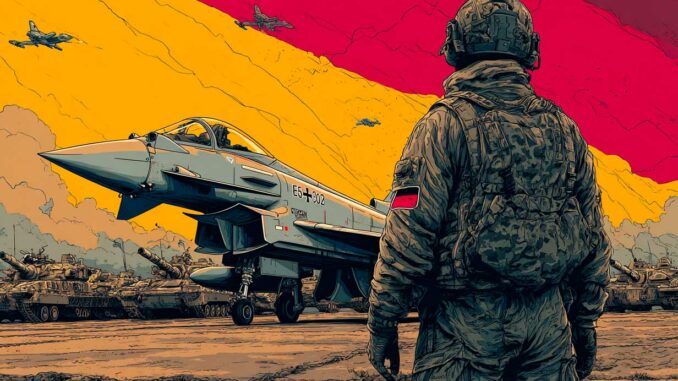
Berlin is accelerating the Zeitenwende. Record budgets, massive arms purchases, rising troop numbers. Can Germany become Europe’s leading conventional military power?
In summary
Since 2025, Germany has had a clear ambition: to become the leading conventional military power in Europe. Under the impetus of Chancellor Friedrich Merz, the Zeitenwende is no longer a slogan but a clear budgetary and industrial trajectory. The figures speak for themselves: a defense budget set to rise from €95 billion in 2025 to around €162 billion in 2029, or 3.5% of GDP. The aim is not to catch up, but to change scale. With latest-generation fighter jets, modernized heavy tanks, multi-layered air defense, and a sharp increase in personnel, Berlin wants to structure the military backbone of Europe. This rise in power is real, but it faces profound limitations. These include the absence of nuclear deterrence, recruitment difficulties, and bureaucratic slowness. Germany is moving fast, but not without blind spots.
Berlin’s strategic shift
For decades, German defense policy was based on a form of strategic restraint. The Bundeswehr was designed to contribute to NATO, not to dominate the European military landscape. This stance was shattered after 2022 and then crystallized politically in 2025.
With the arrival of Friedrich Merz in the chancellery, the Zeitenwende became a structuring project. The discourse changed. Berlin no longer spoke only of credibility, but of conventional military leadership. The objective was twofold: to ensure national defense in the face of a Russia perceived as permanently hostile, and to become the central military pillar of Europe, capable of compensating for the weaknesses of its partners.
The budget scale, at the heart of the transformation
The first break is financial. The German defense budget, already high in absolute terms, enters a new dimension.
A budget trajectory unmatched in Europe
In 2025, Germany will spend around €95 billion on defense. This sum includes the current budget and exceptional appropriations. By 2029, Berlin is aiming for €162 billion, or 3.5% of GDP. This level far exceeds the 2% threshold required by NATO.
At this rate, Germany will spend more than France and the United Kingdom combined on its conventional capabilities. This is not just a publicity stunt. It is a mechanism made possible by the size of the German economy and an unprecedented political consensus.
An unambiguous European comparison
In 2025, the estimated budgets illustrate the shift:
- Germany: ~€95 billion, without nuclear deterrence.
- United Kingdom: ~€65 billion, with deterrence.
- France: ~€51 billion, with deterrence.
- Poland: ~€40 billion, without deterrence.
Germany’s uniqueness lies in its combination of colossal financial resources and a focus on heavy conventional weapons.
Air capabilities, the cornerstone of the system
The transformation of the Luftwaffe is emblematic of this ambition.
The choice of the F-35 and European modernization
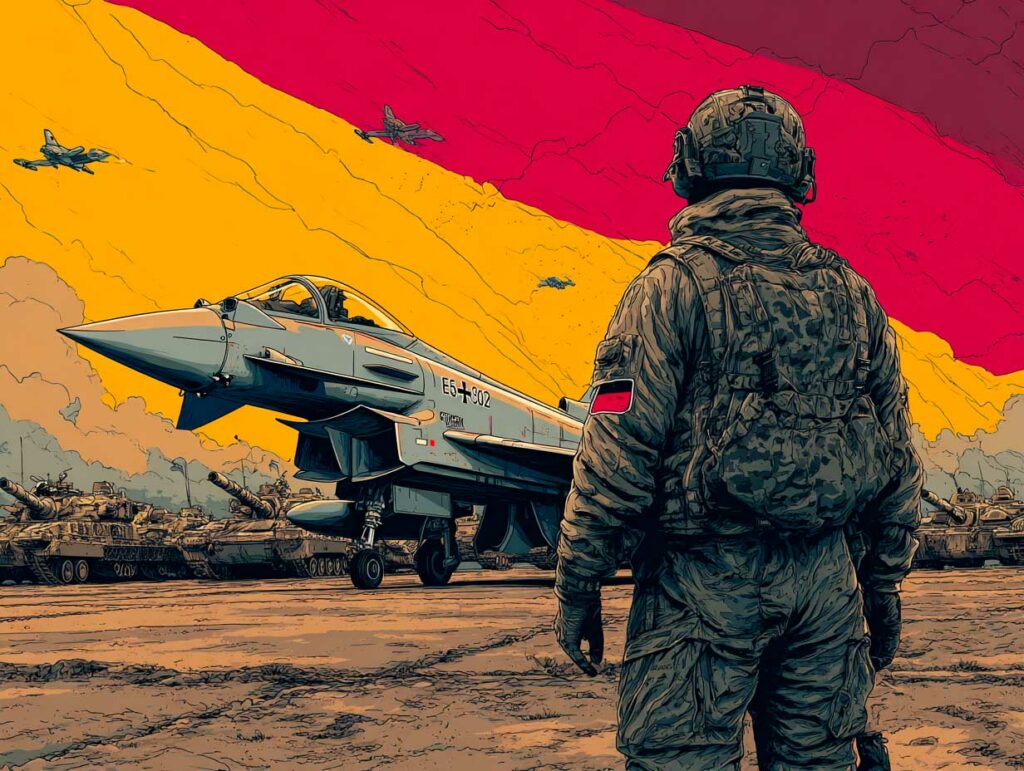
Germany has confirmed the acquisition of F-35 Lightning II fighters to carry out NATO’s nuclear sharing mission and strengthen its penetration capabilities. At the same time, Berlin is investing heavily in the modernization of the Eurofighter Typhoon, which will remain the backbone of the fleet.
This dual choice reflects a pragmatic approach. The F-35 provides technological superiority and interoperability with the United States. The Eurofighter guarantees a solid European industrial base and high operational volumes.
A direct impact on the European balance
With these combined fleets, Germany will eventually have one of the most powerful conventional air forces on the continent, both in terms of numbers and quality. For the first time, Paris and London will no longer be alone in being able to project credible high-intensity air power.
The long-neglected resurgence of land power
The land pillar is at the heart of the Zeitenwende, as it embodies the return to high-intensity warfare.
Leopard tanks and heavy artillery
Berlin has placed massive orders for Leopard 2A8, the most modern version of the German tank. The aim is to rebuild complete heavy brigades capable of operating on NATO’s eastern flank.
Artillery has not been forgotten. Germany is investing in long-range systems and the digitization of the battlefield. The message is clear: ground combat is once again taking center stage.
Asserted quantitative superiority
Thanks to its purchasing volumes, Germany is aiming for a critical mass that few European countries can match. This numerical superiority, combined with high technological quality, is changing the conventional hierarchy.
Air and missile defense, a lever of sovereignty
The war in Ukraine has shown the importance of protecting the skies. Berlin has fully embraced this.
The European Sky Shield Initiative
Germany is leading the European Sky Shield Initiative. The goal is to create a multi-layered European air defense system based on systems such as IRIS-T and Arrow-3.
This architecture aims to protect not only German territory, but also part of European airspace. It is a military project, but also a political one. Whoever protects the skies becomes indispensable.
A structuring role for Europe
By controlling the air defense architecture, Berlin is positioning itself as the central hub of European security. This is a form of power that is often underestimated, but decisive in times of crisis.
Manpower, the human challenge of power
The increase in material power only makes sense if it is supported by a sufficient number of men and women.
Ambitious goals
Berlin is aiming for 260,000 active soldiers and 200,000 reservists by 2035, compared to around 180,000 military personnel today. This is a considerable leap.
The recruitment wall
This is where the German project becomes fragile. Recruitment is stagnating. Military careers are struggling to attract young people who are not particularly interested in wearing uniform. The debate on a partial return to conscription resurfaced at the end of 2025, but remains politically explosive.
Without a structural solution, the staffing targets are likely to remain theoretical. However, without manpower, material superiority loses its substance.
The industrial factor, Germany’s comparative advantage
Germany can rely on a powerful defense industrial base.
Rheinmetall and KNDS at the heart of the system
Groups such as Rheinmetall and KNDS are benefiting directly from the budgetary effort. Production lines are running at full capacity. Lead times are shortening. Volumes are increasing.
This industrial momentum is strengthening German sovereignty and political influence. Those who produce weapons shape strategic choices.
Gradual domination of the European market
In the medium term, German industry could become dominant in the European land and air defense market. This is a lever of influence as powerful as armored divisions.
The timeline for ramp-up
Germany’s transformation is following a precise schedule.
The transition phase
Between 2025 and 2026, Germany will stabilize its efforts at over 2% of GDP. Contracts are piling up. Approximately €83 billion in orders are expected by the end of 2026.
The phase of budgetary superiority
Between 2027 and 2030, Berlin fully exploits its economic power. New equipment spending exceeds that of its neighbors combined. The European military center of gravity shifts.
The phase of operational maturity
By 2035, the new systems must be integrated, the brigades complete, and digitization completed. It is at this point that Germany will be able to claim the status of Europe’s leading conventional force.
Persistent structural limitations
Despite this rise in power, certain limitations remain insurmountable.
The absence of nuclear deterrence
Unlike France and the United Kingdom, Germany does not have a nuclear force. It depends on NATO sharing. In terms of ultimate sovereignty, Berlin remains in the background. This reality prevents any claim to global military power.
Bureaucracy and slow procurement
The German procurement system is notoriously slow. Procedures delay the delivery of equipment. The money is there, but administrative delays erode the strategic advantage.
Political dependence on consensus
The current transformation is based on a rare political consensus. There is no guarantee that it will survive intact through the next economic or social crises.
A central power, but not a hegemonic one
Germany is becoming the cornerstone of European conventional military power. It will have the mass, the budgets, and the industry. But it will not replace France and the United Kingdom in the field of nuclear deterrence and global projection.
The European landscape that is emerging is therefore more complex. Germany dominates in heavy conventional warfare. France remains central in strategic matters. The United Kingdom is a transatlantic pivot. This redistribution of roles is already underway.
The Zeitenwende is no longer a promise. It is a process that is already underway, with its strengths and blind spots. History will tell whether Germany will be able to transform this avalanche of billions into a coherent, sustainable, and politically accepted military power. What is certain is that the European military balance has already begun to shift.
Sources
- Bundesministerium der Verteidigung, budget documents 2025-2029
- Bundestag reports on the Zeitenwende and the Bundeswehr
- International Institute for Strategic Studies, Military Balance
- Rheinmetall and KNDS industry publications
- Comparative analyses of European defense budgets
War Wings Daily is an independant magazine.