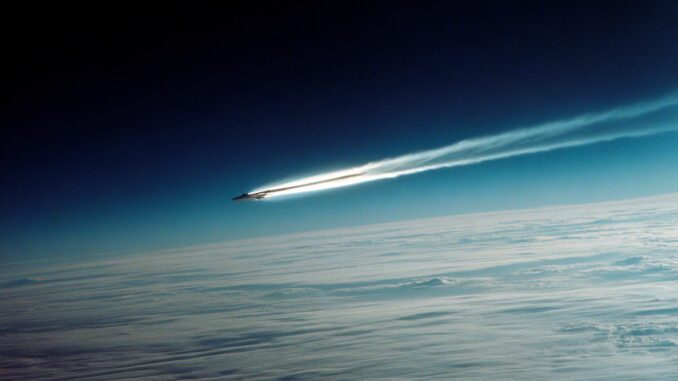
Europe is preparing its hypersonic weapons but must first resolve the challenge of communication blackouts caused by high-speed plasma.
Summary
Future European hypersonic flight systems are no longer the stuff of science fiction. France has already flown the V-MAX glider, a maneuverable demonstrator launched by ArianeGroup, while the European Union is funding the EU HYDEF program to intercept hypervelocity threats. At these speeds—beyond Mach 5 (more than 6,000 km/h)—vehicles are surrounded by hypersonic plasma that heats the structure to several thousand degrees and causes an ionized screen around the hull. This plasma cuts off radio links, disrupts GPS, and complicates terminal guidance. European engineers are therefore working on three fronts: targeting architectures combining inertial, autonomous navigation, and intelligent terminal guidance; materials and thermal protection capable of withstanding temperatures between 1,500 and 2,000°C; and solutions to overcome or circumvent the “blackout” by adjusting frequencies, antenna shapes, or advanced electromagnetic techniques. The challenge is simple: a missile or glider that flies fast but is “blind” does not provide the desired operational superiority.
Europe’s gamble on hypersonic weapons systems
Hypersonic refers to speeds greater than Mach 5, or more than 6,000 km/h at sea level. A hypersonic missile can reach Mach 10, 15 or even 20, i.e. from 12,000 to over 20,000 km/h, and travel several hundred kilometers in a matter of minutes. Their trajectories are lower and more maneuverable than those of a conventional ballistic missile, which makes detection and interception more difficult.
In Europe, the most visible showcase is the French V-MAX program. This V-MAX glider (Experimental Maneuvering Vehicle), developed by ArianeGroup and ONERA, conducted its first test in June 2023 from the Landes Test Center. According to publicly available information, it is expected to reach speeds in excess of Mach 5 and travel distances of around 1,000 to 2,000 km, with significant maneuverability in the atmosphere.
At the same time, the European Union is funding defense programs against these new delivery systems. The PESCO TWISTER initiative aims to detect and track hypersonic threats from space, while the EU HYDEF program, with a budget of around €100 million, is working on an endo-atmospheric interceptor capable of countering targets traveling at hypersonic speeds.
The logic is clear: if Europe wants to remain credible in the face of the United States, China, or Russia, it must be capable of developing offensive hypersonic weapons, as well as appropriate warning and interception systems. Behind the political announcements and trade show models, the real work is being done in hypersonic tunnels, material test benches, and trajectory simulators.
Hypersonic plasma and communication blackouts
Plasma created by extreme speed
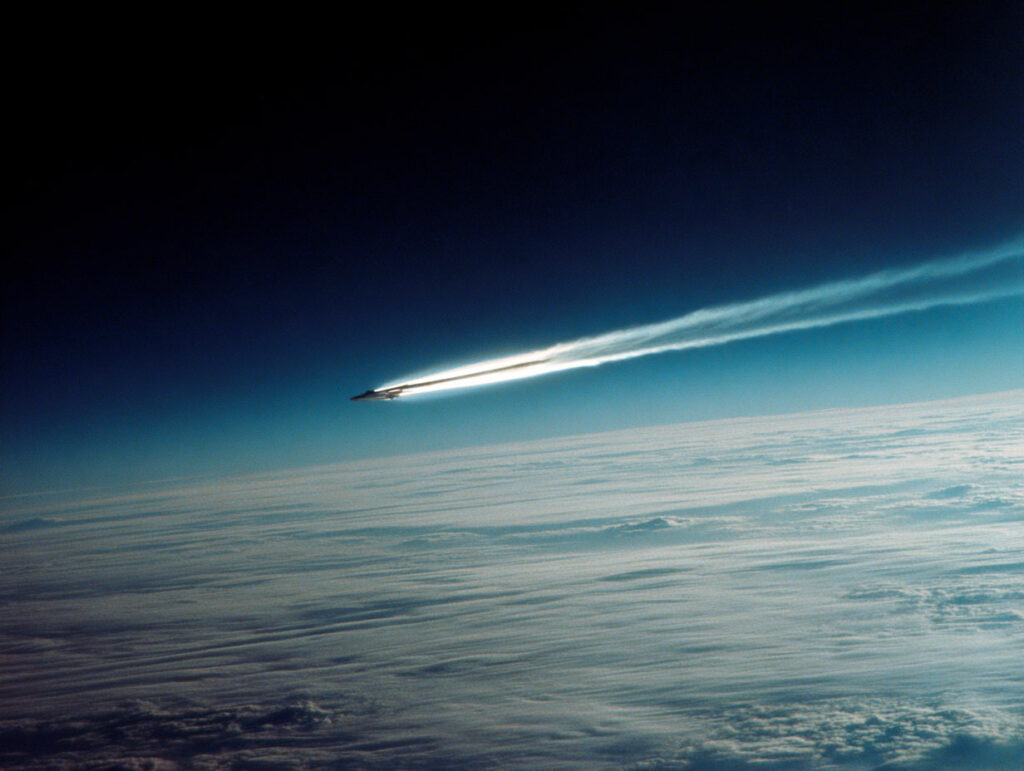
At Mach 5 and above, the compression of the air in front of the vehicle and friction on the surface cause a sudden rise in temperature. At Mach 10, the temperature of the gas at the point of arrest can exceed 3,000°C. The air molecules dissociate and then partially ionize, forming a cloud of hot gas composed of ions and free electrons: this is hypersonic plasma.
This plasma surrounds the missile or glider like a bubble. Its density and thickness depend on the speed, altitude, shape of the vehicle, and composition of the boundary layer. In practice, this envelope acts as a conductive medium around the antenna.
The origin of the communication blackout
Radio waves, particularly in the VHF, UHF, or L bands, are greatly attenuated by this plasma. When the signal frequency is lower than the local plasma frequency (related to electron density), the wave cannot propagate: it is reflected or absorbed. This is the well-known communication blackout that occurs during the atmospheric reentry of space capsules, but it also occurs for hypersonic weapons flying in the upper atmosphere.
This phenomenon poses three major problems:
- loss or degradation of command and control links;
- difficulty in receiving GPS or Galileo signals, thus posing a risk to navigation;
- limitation of the use of certain radar homing devices in the terminal phase.
The higher the speed and the longer the trajectory remains in dense layers of the atmosphere (e.g., 20 to 30 km altitude), the longer and deeper the blackout can be. Engineers cannot ignore this: any hypersonic weapon design must take this “silent zone” into account.
Targeting and guidance of hypersonic systems
The central role of inertial navigation
In the face of this blackout, the first response remains inertial navigation. A hypersonic missile or glider carries a very high-performance inertial navigation system, combining gyrolasers, accelerometers, and sometimes satellite navigation in the initial phase of flight. Once the blackout has set in, the system can fly several hundred kilometers without external updates, relying on its own measurements.
This approach is sufficient for large fixed targets such as air bases, ports, and industrial sites. The drift of a modern inertial unit can be measured in a few meters per minute; on a flight lasting a few minutes, the error remains compatible with a metric precision strike, especially if a terminal correction phase is planned.
For moving targets (ships, mobile systems), the situation is more delicate. Europe is therefore exploring mixed architectures: trajectory updates during the climb or cruise phase, then switching to autonomous mode during the fastest phase of flight, before possibly reopening the link in the terminal phase, when the speed drops and the plasma becomes rarer.
Terminal guidance sensors through plasma
Terminal guidance is the second pillar. The idea is that the missile or glider no longer depends on an external radio link but on its own sensors to correct its trajectory in the last few tens of kilometers. Several options are being studied:
- infrared (IR) homing devices capable of detecting the thermal contrast of the target;
- millimeter wave radars, operating at higher frequencies, sometimes better tolerated by the plasma layer;
- optical sensors (TV, IR) coupled with scene recognition algorithms.
Studies show that the plasma layer is not uniform around the vehicle. “Windows” exist, depending on the shapes, pressure regions, and position of the antennas. Optimizing the geometry—for example, dielectric tips or areas of lower ionization—can allow certain waves to pass through, particularly at high frequencies.
More ambitious approaches are emerging in the international literature: “magnetic windows” using a magnetic field to modify the properties of the plasma, injection of gas or particles to lower the electron density, or the use of extremely high frequencies (terahertz waves, optics). Most of these techniques are still at the experimental stage, but Europe cannot ignore them if it wants to maintain room for development.
Material resistance and thermal performance
Extreme heat flows on small surfaces
Hypersonic systems combine thermal and mechanical stresses. At Mach 5–7, heat fluxes can exceed several megawatts per square meter on the leading edges and bow. Surface temperatures can reach 1,500 to 2,000°C in certain areas, with very marked gradients between stagnant regions and the sides of the vehicle.
The materials used for subsonic cruise missiles are completely unsuitable. European projects are focusing on ultra-high temperature materials: advanced ceramics, carbon/carbon composites, C/SiC, carbides (HfC, ZrC) for the most exposed areas. These materials must remain stable, mechanically resistant, and compatible with the integration of antennas, radomes, and sensors.
The difficulty is all the greater because volumes are limited: a hypersonic glider carries a guidance system, a military payload, and sometimes actuators for high-load maneuvers, all in as compact and lightweight an envelope as possible.
The compromise between ablation, reuse, and stealth
Historically, space reentry vehicles have used ablative shields: the material burns away, taking heat with it. For modern hypersonic weapons, this strategy poses a problem. Massive ablation disrupts the shape, can pollute the plasma, and complicate terminal guidance. It also limits the possibilities for prolonged flight and fine maneuvers.
Europeans are therefore exploring hybrid solutions: thin ablative layers on certain areas, combined with high-temperature composite load-bearing structures. ONERA has been working on these families of materials for a long time, initially for launchers and reentry vehicles, and is now transferring this expertise to hypersonic concepts such as V-MAX.
Stealth adds an additional constraint. At these speeds, the infrared signature is very high. It is therefore necessary to limit temperature peaks in certain areas, control ejection plumes, and design shapes that reduce radar visibility while remaining compatible with thermal performance.
The European strategy for dealing with communication blackouts
A combination of offensive and defensive programs
Europe is approaching hypersonic technology from both ends: offensively with V-MAX and studies on hypersonic cruise missiles, and defensively with EU HYDEF and TWISTER. This dual approach requires a very detailed understanding of communication blackouts and plasma signatures, as these are precisely the phenomena that serve as the basis for detecting, tracking, and intercepting threats.
One of the challenges is digital modeling. Recent work funded by the European Union and several universities is focusing on simulating plasma around hypersonic vehicles and studying mitigation methods: choosing appropriate frequencies, electromagnetic “windows,” and applied magnetic fields. This research intersects with both civilian (reusable capsule reentry, suborbital flights) and military interests.
Integration into the NATO framework and European sovereignty
Operationally, European hypersonic systems will need to remain compatible with NATO command architectures. This means clearly defining:
- which flight phases remain connected via NATO networks (pre-launch, ascent, cruise);
- which segments switch to autonomous mode, without relying on a data link;
- how to integrate information from these weapons into the collective decision-making chain.
At the same time, the issue of sovereignty cannot be ignored. France, for example, associates hypervelocity with its strategic credibility and deterrence, even though V-MAX is officially non-nuclear. Autonomous access to hypersonic flight technologies, critical materials, and advanced guidance is becoming a criterion of power.
For the moment, demonstrators remain rare, testing is highly regulated, and political communication is cautious. But the path has been laid out: in the 2030s, European forces will need to be capable not only of detecting and intercepting enemy hypersonic vectors, but also, potentially, of deploying their own reliable, accurate, and “connectable” hypersonic systems despite plasma.
Hypersonic technology is not just a race for raw speed. It is an engineering battle over plasma control, guidance robustness, and material durability. Europe has chosen to enter this competition in its own way, focusing on a combination of aerodynamics, plasma physics, and digital architectures. The question is no longer whether hypersonic systems will exist, but which ones will manage to remain intelligent, accurate, and communicative while the air around them turns into ionized fire.
Sources:
– ArianeGroup, “Hypersonic systems” (hypersonic glider concepts, speeds Mach 5–20).
– Wikipedia / IHEDN, “V-MAX” and “Hypervelocity: once a pioneer, France is back in the race” (V-MAX program, tests in 2023).
– Le Monde, “ArianeGroup pushes ahead with hypersonic weapons,” June 16, 2025 (concepts of range and Mach 16 speed).
– Ametra Group blog, “How hypersonic missiles will revolutionize European defense,” May 22, 2025 (definition and European challenges).
– EU HYDEF / OCCAR / PESCO TWISTER, official fact sheets on hypersonic interception and early warning programs.
– Pugwash Briefing Paper, “What technical challenges do hypersonic weapons raise?” (plasma, guidance, and blackout).
– NASA / Aerospace Corporation / academic work on RF blackout and mitigation methods (plasma sheath, frequencies, magnetic fields).
– Journal articles on hypersonic vehicle guidance (Sciencedirect, arXiv) and technical summaries on hypersonic gliders.
War Wings Daily is an independant magazine.