Japan is launching an ambitious program to replace the aging Kawasaki T-4 with a new modern training aircraft, with strategic and industrial implications.
Summary
The Japanese Ministry of Defense has announced the development of a successor to the Kawasaki T-4, the intermediate jet trainer aircraft of the Japan Air Self-Defense Force (JASDF), which entered service in 1988 and has more than 197 units in operation. This project is part of a comprehensive modernization of pilot training capabilities, aimed at effectively preparing crews for fifth and sixth generation fighter aircraft such as the Lockheed Martin F-35 Lightning II and future aircraft from the Global Combat Air Program (GCAP). Several solutions are being considered, including domestic development (“T-X”) by Mitsubishi Heavy Industries (MHI), international partnerships, or the acquisition of aircraft such as the Boeing T-7A Red Hawk or the Leonardo M-346. This effort responds to specific technical needs, budgetary considerations, and export ambitions that could reshape part of the Japanese aerospace sector.
The key role of the Kawasaki T-4 in pilot training
Since entering service in 1988, the Kawasaki T-4 has been the backbone of JASDF pilot training after the basic phase with turboprop aircraft. Designed and produced in Japan by Kawasaki Heavy Industries, this subsonic jet trainer replaced older platforms such as the Lockheed T-33 and Fuji T-1.
The aircraft has a range of approximately 1,670 km and a maximum speed of close to 1,038 km/h, which has allowed it to serve effectively in the intermediate training role. It has also found a prestigious place in the Blue Impulse national aerobatic team.
However, after more than 35 years of service, its performance is considered insufficient to prepare pilots for the challenges of modern aircraft, particularly stealth fighters such as the F-35 or future joint aircraft from the GCAP program.
Why a new training aircraft is essential
Production of the T-4 ceased several years ago, and the fleet in service is rapidly aging. Major concerns have emerged regarding the training capacity of this type of aircraft in the face of the increased demands of contemporary combat missions.
Newer generation aircraft, such as the F-35A/B currently in service, require more advanced skills that a T-4 cannot fully provide. In addition, Japan is engaging in future projects such as the GCAP with the United Kingdom and Italy, which reinforces the need for a corresponding training system.
The replacement is not only about basic or intermediate training, but also about preparing pilots to evolve from the beginning of their careers into digital tactical environments, including the simulation of modern electronic equipment, coordination with advanced mission systems, and coordinated operations with other platforms.
The “T-X” project: a domestic response
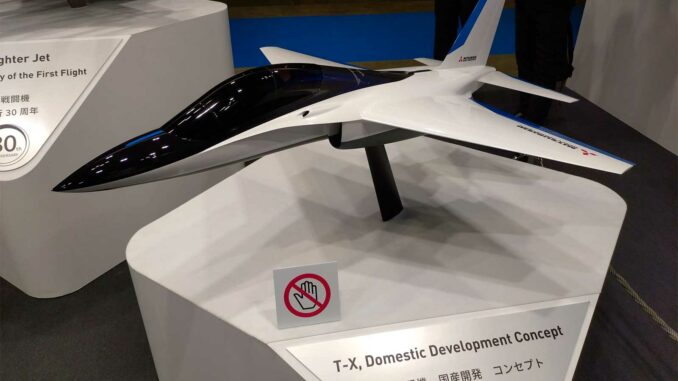
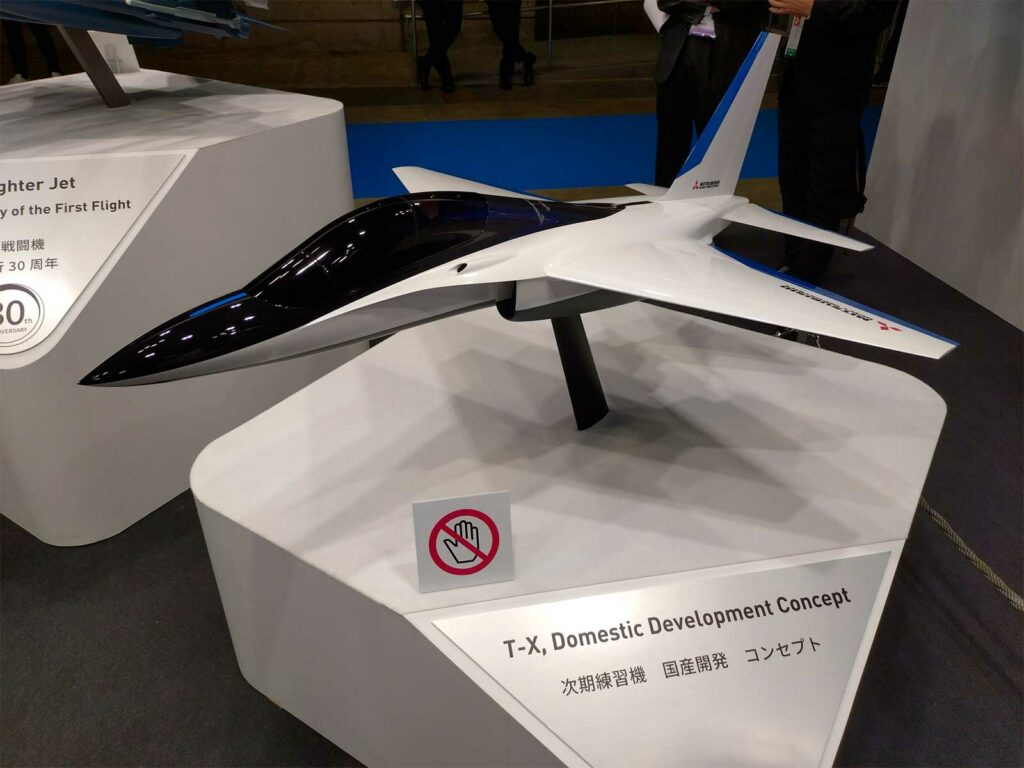
In response to these needs, Japan has put forward a concept for a new-generation training aircraft, known as the “T-X Domestic Development Concept”, presented by Mitsubishi Heavy Industries (MHI) at the DSEI Japan 2025 exhibition.
This concept proposes a two-seat, twin-engine aircraft equipped with a modern cockpit with touch screens and advanced integrated systems designed to simulate realistic operational environments. It will also incorporate on-board simulation functions for training in complex scenarios, including radar and missile threats.
The domestic approach responds to a desire for technological and industrial autonomy, but also to a strategy to strengthen local expertise in defense aeronautics. MHI’s experience, particularly with the former T-2 and T-4 programs, provides a foundation that can facilitate the development of the future aircraft.
International alternatives and cooperation
Japan is not limiting itself to a purely local solution.
International options feature prominently in discussions. Among them, the Boeing T-7A Red Hawk, developed by Boeing and Saab for the US Air Force, is often cited as a potential candidate.
The T-7A is designed to prepare pilots for modern combat aircraft thanks to its digital platform, simplified maintenance, and compatibility with advanced training technologies. Collaboration or acquisition of this type could generate economies of scale and strengthen interoperability with US forces.
The Leonardo M-346 trainer, already used for advanced training at the International Flight Training School (IFTS) in Italy, is also among the options being considered, particularly for later stages of training.
These alternatives offer proven solutions, but involve trade-offs between autonomy, cost, and strategic cooperation.
Budgetary challenges of the program
The cost of a modern flight training program is high. Onboard technologies, engines, simulation systems, and ground training represent substantial investments. Adopting a domestic model requires significant budgets for R&D, flight testing, certification, and the establishment of production lines.
On the other hand, international cooperation or the purchase of an existing platform under license can reduce unit costs, but limit the involvement of Japanese manufacturers in the production chain and export opportunities.
The JASDF remains cautious in its financial approaches, with requests for information and cost-benefit assessments, particularly since October 2024, when a formal request for information was issued for the replacement of the T-4.
Export prospects
One of Japan’s strategic concerns is to make the successor to the T-4 not only a national tool, but also an exportable product. A modern and competitive platform could be of interest to countries with air forces seeking to modernize their training fleets.
In particular, the Asia-Pacific region, the Middle East, and certain European nations could be potential markets, especially if the aircraft incorporates advanced technologies, simplified maintenance, and controlled life-cycle costs.
International cooperation could also open up access to markets dominated by Western aircraft, but this will require strategies to align with international standards and solid bilateral agreements.
A transformation of Japanese aviation training
The project to replace the Kawasaki T-4 represents more than just a renewal of aircraft. It symbolizes a profound adaptation of Japanese pilot training methods to the realities of 21st-century aviation, while strengthening Japan’s position in the global defense aviation sector.
Whether it is an ambitious domestic development, a strategic collaboration with partners such as the United States, or a combination of both, the objective remains clear: to ensure that Japanese pilots have a training platform that is up to the challenges of the future.
This project illustrates the desire to reconcile autonomy, modernity, and competitiveness in a demanding geopolitical environment.
Sources
- Japan to develop successor to Kawasaki T-4, Militarnyi
- New jet trainer in the cards as Japan seeks training fleet refresh, Breaking Defense
- Japan targets T-4 replacement ahead of GCAP, Shephard Media
- Mitsubishi Heavy Industries unveils trainer concept, The Aviationist
- Legendary Aircraft: Mitsubishi proposes a successor to the T-4
- Avianews: future TX training aircraft developed in Japan
- Wikipedia Kawasaki T-4
War Wings Daily is an independant magazine.