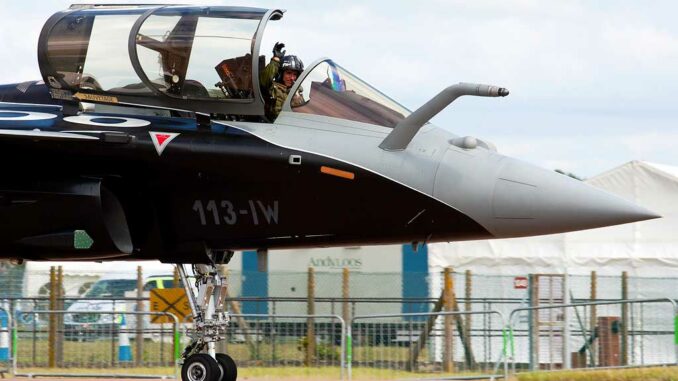
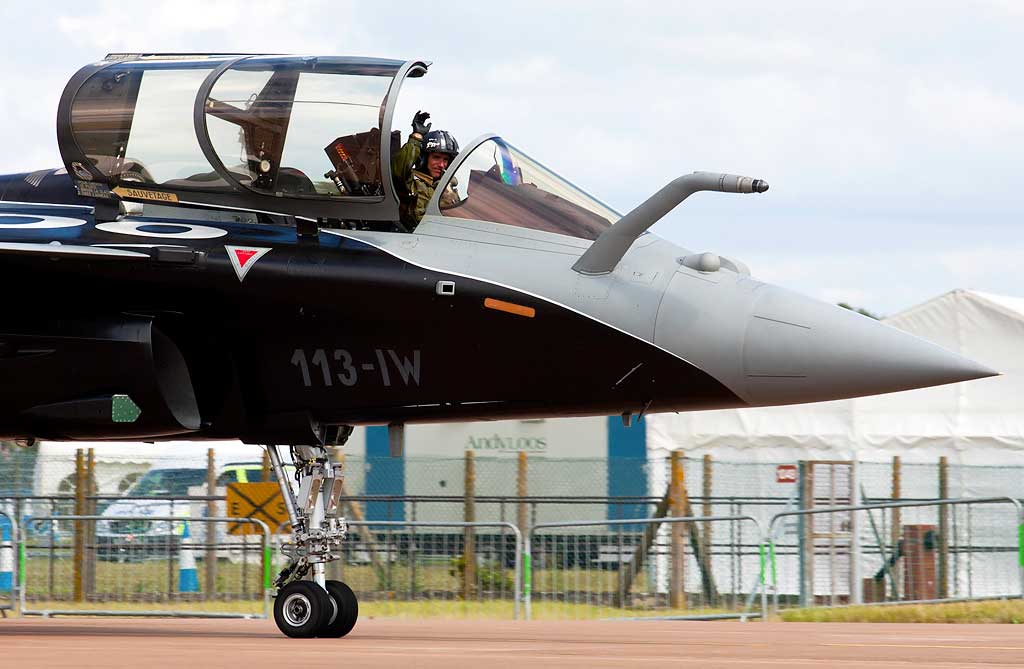
From the F1 standard to the future F5, the Rafale has evolved through successive technological advances. Detailed analysis of its standards, capabilities, and innovations.
Summary
The Dassault Rafale is not a static aircraft. Since entering operational service in the early 2000s, it has evolved through successive standards, each representing a concrete response to an identified military need. From the F1 standard, deliberately limited but operational in emergencies, to the F3R standard, a true capability pivot, the Rafale has gradually expanded its mission spectrum. The transition to the F4 standard marks a change in logic: the aircraft becomes a connected system, focused on data, cooperation, and information superiority. The F5 standard, expected by 2035, is already preparing for the Rafale’s integration into air combat dominated by drones, advanced electronic warfare, and renewed deterrence. This trajectory illustrates a pragmatic approach: evolving the same aircraft to remain credible over several decades, without any sudden industrial disruption, while maintaining a high level of operational performance.
The F1 standard, a deliberately constrained entry into service
The F1 standard is the Rafale’s first operational capability. It entered service in 2004 with the French Navy, aboard the aircraft carrier Charles-de-Gaulle, in the immediate context of operations related to Enduring Freedom.
This standard is often described as “minimalist.” It is exclusively dedicated to air-to-air missions, with the primary objective of air defense for the naval force. The Rafale F1 replaced the F-8 Crusader, whose limitations had become critical. Technically, the aircraft already had its fundamental architecture: a versatile airframe, fly-by-wire controls, RBE2 passive antenna radar, and an initial version of the SPECTRA electronic warfare system.
Its kinematic performance was already high. The Rafale F1 reached Mach 1.8, with limited but real supercruise capability in certain configurations. Its range exceeds 1,800 km, including in-flight refueling. On the other hand, the lack of air-to-ground capabilities severely limits its versatility.
This deliberate choice of a limited standard responds to an urgent operational constraint. It allows the French Navy to quickly acquire a modern carrier-based fighter, even if it means accepting a gradual ramp-up.
The F2 standard: a controlled move towards true multi-role capability
The F2 standard, declared operational in 2006, marked a decisive turning point. The Rafale became a true multi-role aircraft, capable of performing both air-to-air and air-to-ground missions during the same flight.
This evolution was based on the integration of new weapons and sensors. The Rafale F2 could now deploy the AASM (modular air-to-ground weapon), offering metric precision, as well as the SCALP cruise missile, with a range of over 250 km. These capabilities change the nature of the aircraft, transforming it from a naval interceptor to a deep strike weapon.
Operationally, the F2 has been deployed in Afghanistan since 2007. Feedback highlights the robustness of the weapons system and the Rafale’s ability to operate in a complex environment with short maintenance cycles. The availability rate regularly exceeded 85%, a remarkable figure for an aircraft of this generation.
However, the F2 remained an intermediate standard. Certain functions, particularly in reconnaissance and laser designation, could still be improved. Above all, it paved the way for a more ambitious upgrade.
The F3 and F3R standards: full operational maturity
The transition to the F3 standard, then to its modernized F3R version, marks a strategic turning point. The Rafale becomes an all-role aircraft, capable of covering the entire spectrum of Air Force and Navy missions.
The F3 introduces major capabilities. It allows the ASMP-A nuclear missile to be carried, placing the Rafale at the heart of French deterrence. It also integrates the Exocet anti-ship missile, as well as the Reco NG reconnaissance pod, offering sub-meter resolution at high altitude.
The F3R standard, certified in 2018, further enhances this package. It features the RBE2 AESA radar, which improves air-to-air detection range by 50% compared to the passive antenna, while allowing simultaneous tracking of dozens of targets. The Meteor missile, with an effective interception range exceeding 100 km, transforms combat capabilities beyond visual range.
The gradual replacement of the Damocles pod by the Talios improves laser designation and tactical reconnaissance. The Rafale F3R has distinguished itself in operations in the Levant, where it carries out ISR missions, precision strikes, and air protection, sometimes during the same sortie.
The F4 standard: the aircraft becomes a connected system
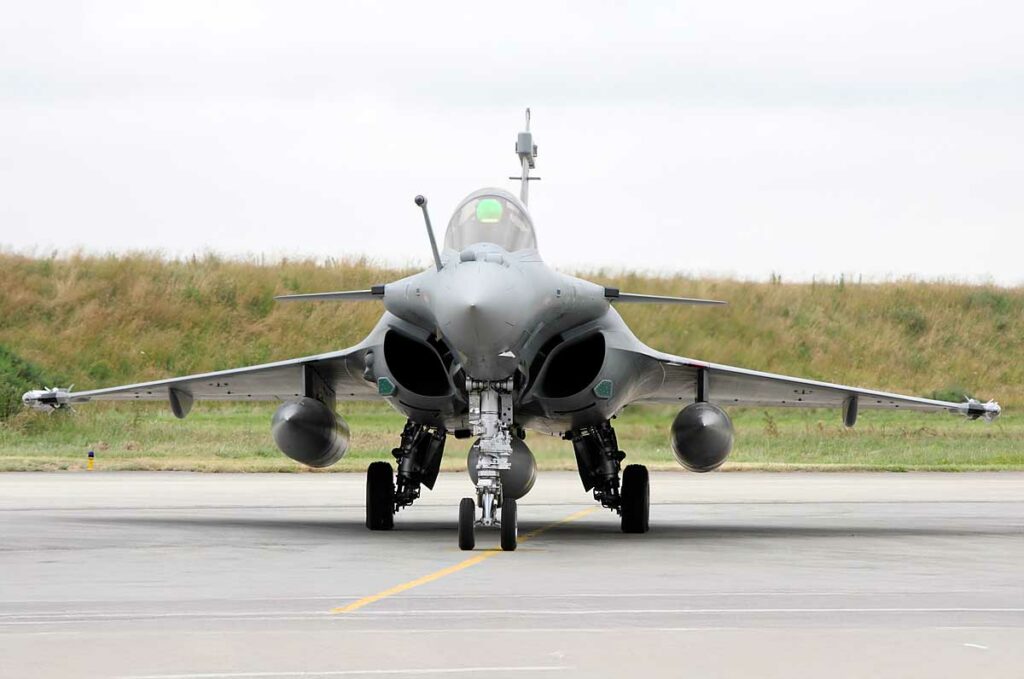
With the F4 standard, the Rafale is entering a new era. It is no longer just a question of adding weapons, but of transforming the aircraft into a data node within a collaborative combat environment.
The F4 comes in two versions, F4.1 and F4.2, with qualification scheduled between 2023 and 2027. The upgrades focus on connectivity, data fusion, and cockpit ergonomics. Data links are enhanced, enabling near real-time exchange with other platforms, including drones.
The SPECTRA system benefits from improved algorithms, capable of more accurately identifying radar threats and proposing appropriate countermeasures. Maintenance is also evolving, with a predictive maintenance approach that reduces downtime.
On the human side, the human-machine interface has been redesigned to reduce the pilot’s cognitive load. The Rafale F4 aims to make better use of data, rather than simply accumulating sensor data.
The F5 standard: preparing for air combat in the 2040s
The F5 standard, still in development, is designed to ensure the Rafale remains relevant until the 2040s. It is part of a profoundly transformed strategic environment, marked by the proliferation of drones and the rise of electronic warfare.
The F5 is designed to accompany the renewal of nuclear deterrence, with the integration of the future ASN4G missile. It is also designed to operate in close cooperation with combat drones, capable of extending detection range or saturating enemy defenses.
Expected developments also concern sensors, with data processing boosted by artificial intelligence, and even more integrated electronic warfare. The Rafale F5 will not be an isolated aircraft, but the conductor of a distributed air combat system.
Evolution through standards, an industrial and strategic choice
The evolution of the Rafale’s standards illustrates a unique approach. Rather than developing radically different versions, France has opted for incremental evolution, controlled in industrial and budgetary terms.
This model allows costs to be smoothed out, while gradually integrating operational feedback. It also explains the Rafale’s longevity on the export market, where each standard meets specific needs without compromising the overall architecture of the aircraft.
The Rafale has not remained competitive by chance. It has become so through a series of consistent technical decisions taken over a long period of time. This continuity explains why, twenty years after entering service, it remains a central player in modern air combat.
Sources
Ministry of the Armed Forces
DGA – Rafale programs
Dassault Aviation – technical files
Parliamentary reports on nuclear deterrence
Feedback from the Chammal and Harmattan operations
War Wings Daily is an independant magazine.