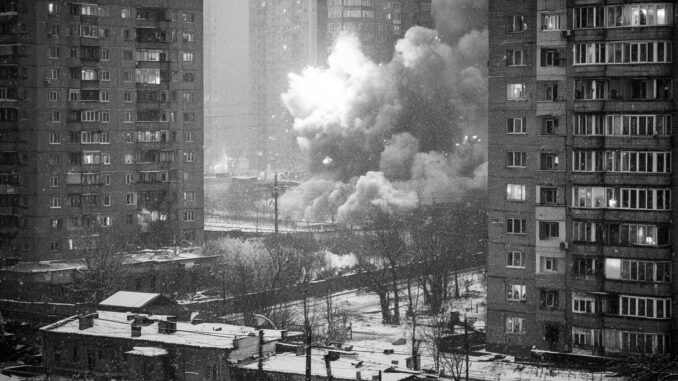
In January 2026, the Russian military dropped a record number of guided bombs on Ukraine, marking a dramatic escalation in its air campaign against Ukrainian infrastructure and military positions.
Summary
Russia dropped approximately 5,500 guided bombs on Ukraine in January 2026, accompanied by more than 6,000 attack drones and 158 missiles. This unprecedented intensification of the Russian air campaign is primarily targeting energy infrastructure, railways, and urban areas. Su-34 and Su-35 bombers are launching these munitions equipped with UMPK guidance kits from altitudes of 10,000 to 13,000 meters, out of range of many Ukrainian air defense systems. Civilian casualties have increased by 31 percent compared to 2024, with 2,514 civilians killed in 2025. Ukraine’s electricity production capacity has fallen to 14 gigawatts, only 60 percent of the country’s needs.
The barrage of Russian glide bombs
Figures released by Ukrainian President Volodymyr Zelensky reveal the scale of the air offensive. In January 2026, Russia used approximately 5,500 guided aerial bombs against Ukraine. These munitions are in addition to more than 6,000 Shahed-type attack drones and 158 missiles of various types. In the week leading up to the end of January alone, Moscow deployed more than 980 attack drones, nearly 1,100 guided bombs, and two missiles.
Russian forces are maintaining an unprecedented rate of bombing. On January 19, 2026, 204 KAB guided aerial bombs were dropped in a single day, accompanied by 7,518 kamikaze drones. This intensity represents more than five drones per minute and demonstrates Russia’s strategy of attrition through saturation.
Guided bombs are now Moscow’s weapon of choice. These munitions, designated by the acronym KAB or equipped with the UMPK guidance module, transform old Soviet bombs into modern precision weapons. Russia is converting its massive stocks of FAB-500 (500-kilogram) and FAB-1500 (1,500-kilogram) bombs into gliding weapons capable of traveling between 60 and 90 kilometers after being dropped.
Air platforms and altitude tactics
Su-34 bombers form the backbone of this air campaign. These two-seater aircraft take off from airfields located on Russian territory and climb to altitudes between 10,000 and 13,000 meters before dropping their munitions. This tactic allows Russian aircraft to operate beyond the range of most Ukrainian short- and medium-range air defense systems.
Each Su-34 can carry up to four guided bombs per sortie. The aircraft typically drop their munitions at a distance of 35 to 50 kilometers from the front lines, although this range can be extended further when dropping from high altitudes. Su-35 fighters frequently escort the Su-34s, ensuring air superiority and providing long-range radar coverage.
The Russian Su-34 fleet has between 150 and 180 operational aircraft in early 2026, despite the documented loss of at least 41 aircraft since February 2022. Rostec, the Russian industrial conglomerate, claims to be maintaining continuous production to compensate for attrition and support the war effort. The Novosibirsk factory regularly delivers new batches of aircraft.
The Su-34 Fullback is 23 meters long and has a wingspan of 15 meters. Powered by two Saturn AL-31F engines, each generating 122.5 kilonewtons of thrust with afterburners, it reaches a maximum speed of Mach 1.8. Its Leninets V004 phased array radar can track ten targets at distances of up to 150 kilometers. The armored cockpit and Khibiny electronic countermeasures suite provide protection against anti-aircraft defenses.
Glide bomb technology
FAB-500 bombs contain 213 kilograms of PBXN-109 explosive.
They measure approximately 2.13 meters in length with a diameter of 36 centimeters. Their destructive radius exceeds 30 meters against personnel and light infrastructure. Equipped with the UMPK kit, they achieve a diving range of 70 kilometers with accuracy comparable to modern guided munitions.
The FAB-1500 is the heaviest weapon in this category. These 1,500-kilogram bombs carry nearly 675 kilograms of explosives. They dig craters 15 meters in diameter and destroy fortifications. A Ukrainian soldier from the 46th Airborne Brigade testifies that FAB-1500s are hell for defenders, causing concussions even among survivors and exerting considerable psychological pressure.
The UMPK module costs about $20,000. This economical conversion allows Russia to exploit its vast stocks of unguided ammunition dating back to the Soviet era. The kit includes retractable wings and a satellite guidance system that corrects the trajectory during gliding. Compared to cruise missiles costing several million dollars, guided bombs are a low-cost weapon solution.
By early 2025, Russia was already dropping around 3,500 UMPK-equipped bombs per month, or more than 100 per day across the entire front. This pace continued to intensify throughout 2025 and into January 2026.
Targets and humanitarian consequences
Energy infrastructure is the primary target of this bombing campaign. Russia is systematically targeting power plants, substations, and distribution networks. Ukrainian Energy Minister Denys Shmyhal confirms that all of the country’s power generation facilities have been hit at least once since February 2022.
Ukraine’s electricity generation capacity has fallen from 33.7 gigawatts at the start of the invasion to around 14 gigawatts in January 2026. The grid now covers only 60 percent of national needs. Power cuts lasting up to four days are affecting some regions. Kiev is experiencing outages of up to 16 hours a day.
This energy attrition strategy comes in the middle of winter, when temperatures drop to minus 20 degrees Celsius. Millions of Ukrainians are left without electricity, heating, and running water. Residential buildings, particularly high-rise apartment buildings in large cities, become uninhabitable when indoor temperatures drop to dangerous levels.
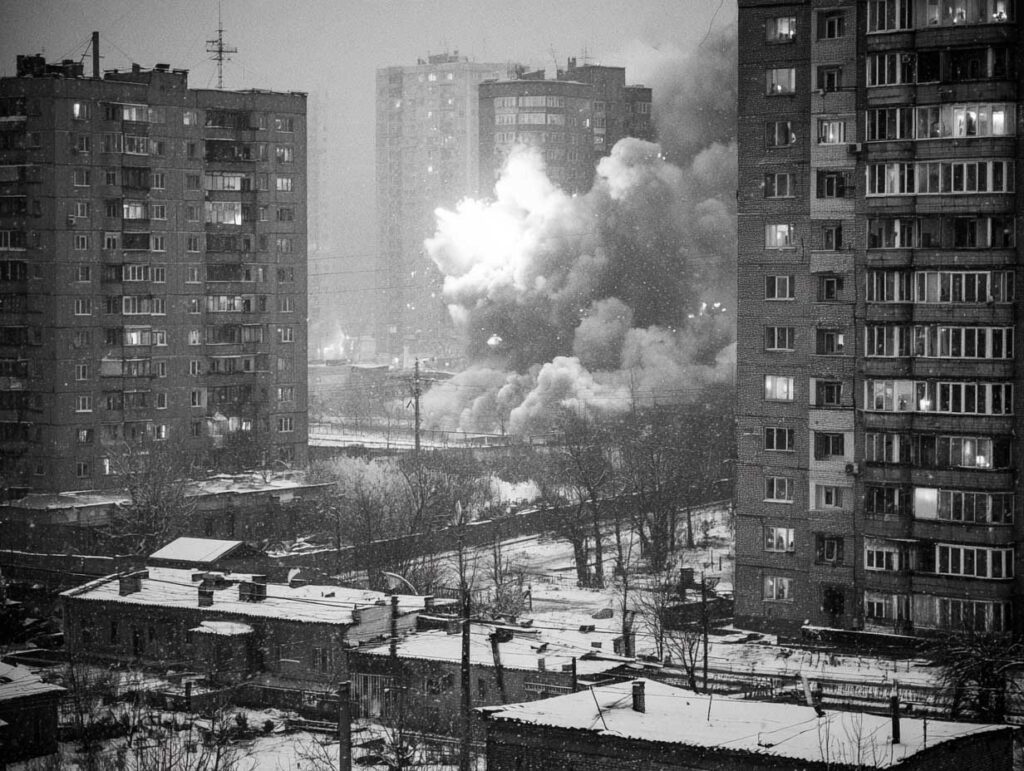
Air strikes are not limited to infrastructure. Russian forces are also bombing residential areas, military command centers, ammunition depots, and logistics lines. The cities of Kharkiv, Zaporizhzhia, Odessa, and Dnipro are under regular bombardment. Towns near the front line, such as Pokrovsk, Huliaipole, Gulyaipole, and Kostiantynivka, endure a daily barrage of fire.
The human toll and civilian casualties
The year 2025 was the deadliest for Ukrainian civilians since 2022. The United Nations Human Rights Monitoring Mission in Ukraine verified 2,514 civilians killed and 12,142 wounded in 2025, an increase of 31 percent compared to 2024. These figures represent a 70 percent increase compared to 2023.
The vast majority of these casualties, 97 percent, occurred in territory controlled by the Ukrainian government as a result of attacks by Russian forces. Long-range weapons caused 35 percent of civilian casualties in 2025, with 682 deaths and 4,443 injuries, marking a 65 percent increase compared to 2024.
The elderly pay a particularly heavy price. Individuals aged 60 and over account for more than 45 percent of civilians killed in areas close to the front line in 2025, even though they make up only 25 percent of the national population. These individuals often remain in frontline villages due to a lack of means of evacuation.
The deadliest attack of 2025 occurred on November 19 in Ternopil, western Ukraine. Russian long-range weapons killed at least 38 civilians, including eight children. Ten families lost at least two members each. At least 99 other people, including 17 children, were injured.
On January 8, 2026, a massive strike on Kyiv killed at least four people and injured about 25 others. The victims included a paramedic who was rescuing others as part of an emergency response team. Four health workers were injured and three ambulances were damaged.
The military situation on the ground
Military casualties are reaching unprecedented levels. The Center for Strategic and International Studies estimates that Russia suffered 1.2 million casualties, including up to 325,000 deaths, between February 2022 and December 2025. Ukraine, with its smaller army and population, has recorded between 500,000 and 600,000 casualties, including up to 140,000 deaths.
The total number of casualties on both sides could reach 1.8 million and exceed 2 million by spring 2026. These figures make the war in Ukraine the deadliest conflict in Europe since World War II. No major power has suffered such military losses in a conflict since 1945.
Russian forces are advancing slowly but steadily. Analysis of data from the Institute for the Study of War shows that Russia gained 79 square miles of Ukrainian territory between December 16, 2025, and January 13, 2026. In 2025, the average monthly rate of Russian gains was 171 square miles.
Russia currently controls approximately 116,250 square kilometers of Ukrainian territory, or 19.26 percent of the country. This area is roughly equivalent to the U.S. state of Ohio. Since February 24, 2022, Moscow has conquered an additional 29,028 square miles of Ukrainian territory, or about 12 percent of the country.
Fighting is concentrated in the Donetsk and Zaporizhzhia oblasts. The Russian advance in the Zaporizhzhia oblast now threatens villages located just seven kilometers from the regional capital, a city of 670,000 people. Russian forces are putting particular pressure on Pokrovsk, a key logistical hub, and Huliaipole, a strategic position in the south.
On January 19, 2026, the Ukrainian General Staff reported 165 clashes in 24 hours. The Pokrovsk and Huliaipole sectors saw the heaviest fighting. Ukrainian defenders repelled 44 Russian assaults that day. Russian forces fired 4,124 artillery and mortar rounds, including 74 from multiple rocket launchers.
Challenges for Ukrainian air defense
Ukraine has improved air defense capabilities, but they are insufficient to counter this threat. The Patriot systems provided by the United States have a range of 160 kilometers against aerodynamic targets. These batteries have shot down several Russian Su-34 and Su-35 aircraft, including three Su-34s in December 2024 in the Kherson region.
Ukrainian Air Force spokesman Yuri Ihnat explains that air defense is strengthening, but remains insufficient. Russian aircraft are not getting as close to the front lines as they would like, but more long-range defense systems would be needed to shoot down these aircraft at greater distances.
Electronic warfare is the most effective countermeasure against glide bombs. The Pokrova system and other specialized jammers have proven capable of degrading the accuracy of UMPKs. Ukraine’s widespread use of dispersion and camouflage complicates Russian efforts to obtain accurate and up-to-date target coordinates.
Ukrainian defenders are also attempting to intercept the bombs in flight. On January 16, 2026, air defense systems shot down 31 guided bombs, 21 HIMARS projectiles, and three Neptune missiles. However, the volume of Russian munitions far exceeds available interception capabilities.
The arrival of Western F-16s is expected to increase pressure on the Russian Air Force. These fighters will enable Ukrainian forces to more effectively challenge Russian air superiority and target bomb launch platforms. Even without achieving air-to-air victories, the presence of F-16s will force Russian aircraft to devote more resources to self-defense, thereby reducing their ability to support ground operations.
Russian industrial production and war effort
Rostec claims to be maintaining continuous production of combat aircraft 24 hours a day, seven days a week. The stated goal is to compensate for losses and maintain pressure on Ukraine. Official Russian statements on January 25, 2026 highlighted continued production of the Su-34 and Su-35.
United Aircraft Corporation delivered several batches of Su-34s throughout 2025, with deliveries in April, July, August, September, October, November, and December. Russian officials claim that the new aircraft incorporate improvements drawn from combat in Ukraine, with upgrades designed to improve the accuracy of long-range strikes.
Actual production remains difficult to verify as Moscow no longer publishes detailed figures. Open-source assessments suggest that the Russian Air Force operates approximately 150 to 180 Su-34s in early 2026. This number remains relatively stable despite documented losses, indicating that Novosibirsk production is managing to offset attrition.
Western sanctions have failed to halt this production. Russia continues to access the necessary components, particularly for UMPK guidance kits, and keeps its assembly lines running. The term 24/7 should be understood as an industrial mobilization slogan describing a shift-based organization and a priority given to military over civilian production.
This industrial war is not being fought solely on technological sophistication. It depends on daily output, the ability to produce, deliver, and repeat. The central question becomes less about who has the best aircraft and more about who can maintain the tempo for the longest time.
Sources
Ukrinform
Atlantic Council
Russia Matters
Center for Strategic and International Studies
UN Human Rights Monitoring Mission in Ukraine
The Economist
GlobalSecurity.org
CNN
Joint Air Power Competence Centre
Army Recognition
BBC Russian Service
Mediazona
War Wings Daily is an independant magazine.