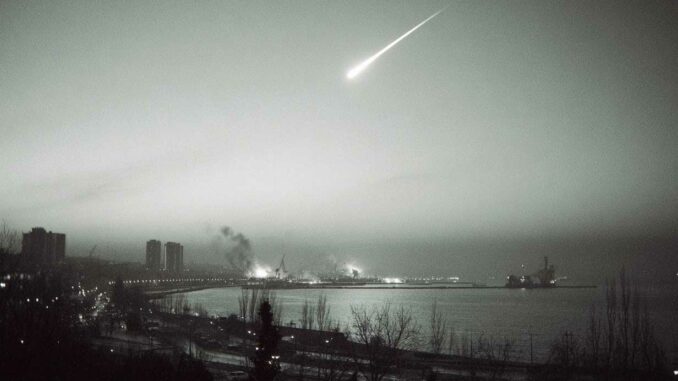
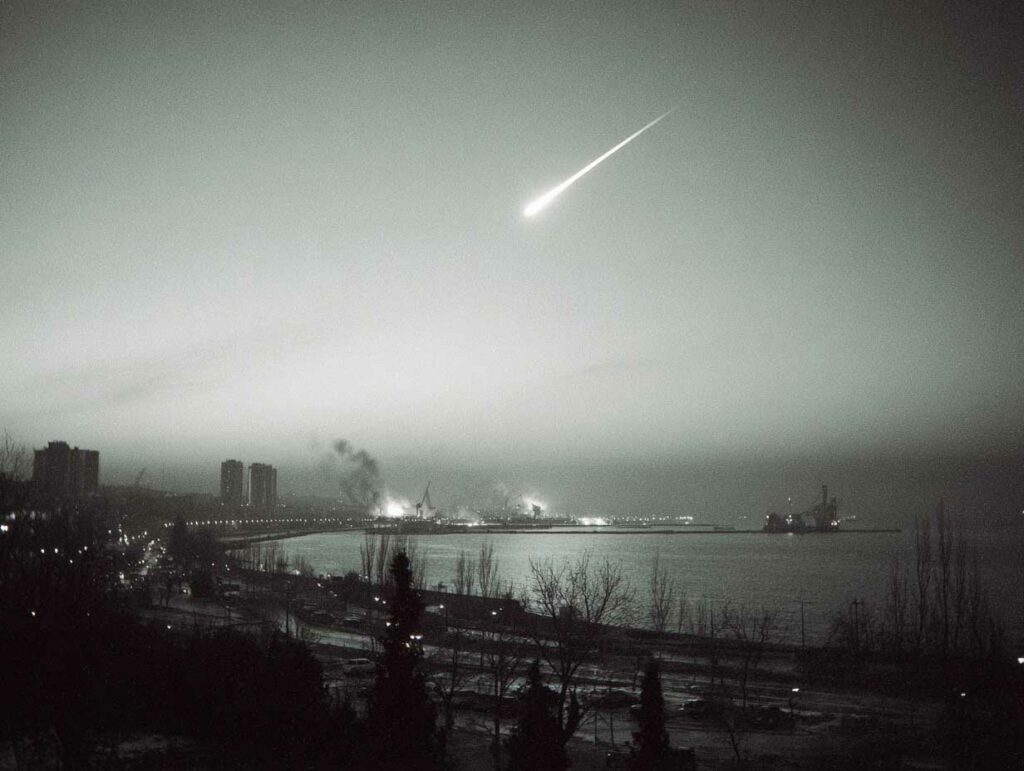
Russian missiles and drones strike Odessa. Moscow targets Ukraine’s maritime access. Kiev reorganizes its air command to hold the Black Sea.
Summary
Between December 20 and 21, Russia conducted a massive strike campaign against Odessa’s port infrastructure, combining missiles and drones to overwhelm Ukraine’s air defenses. Nearly 100 missiles were reportedly launched in one night, targeting docks, silos, and logistics hubs. The objective is clear: to reduce Ukraine’s maritime access to the Black Sea, weaken its exports, and increase economic pressure. In response, Kyiv announced the replacement of the head of the “South” air command, responsible for protecting the coastline, in order to strengthen the effectiveness of interception. This sequence illustrates a war of attrition in which Moscow is relying on mass and repetition, while Ukraine is trying to adapt its command and defenses. The central question remains: is this Russian strategy really working, or is it mainly strengthening Ukrainian resilience and ingenuity?
The sequence of strikes and what it reveals
The night of December 20-21 marked a notable intensification. Russia combined attack drones and cruise missiles, seeking to saturate sensors and force the Ukrainian defense into costly choices. The impacts reported around Odessa targeted civilian infrastructure used for logistics: grain silos, terminals, warehouses, and secondary power grids.
The operational logic is well-established. Drones arrive first to exhaust interception munitions. Missiles follow, with varied flight profiles, to strike higher-value targets. This orchestration reflects centralized planning and a desire to maintain pressure despite limited stocks.
Russia’s maritime lockdown strategy
Russia’s objective goes beyond simple spot destruction. It is to challenge Ukraine’s access to the Black Sea in the long term, after failing to impose a total naval blockade. By striking Odessa, Moscow is targeting the heart of Ukrainian exports, particularly grain, which remains vital to Kiev’s economy and diplomatic influence.
Why Odessa is a priority target
Odessa is home to essential port facilities. Even with alternative routes, any disruption increases costs, slows down flows, and raises the cost of marine insurance. Ultimately, Russia is seeking to deter shipowners and undermine the credibility of trade corridors.
An alternative to naval blockade
Deprived of undisputed naval superiority since its setbacks in the Black Sea, Russia now favors remote air pressure. Precision strikes are replacing direct control of sea lanes. It is a strategy of denial, less visible than a blockade, but potentially just as effective if sustained over time.
The means employed by Moscow
The campaign relies on a mix of vectors, each serving a specific function.
Attack drones
Shahed-type drones, used in large numbers, remain the preferred saturation tool. Their unit cost is low compared to missiles, allowing for repeated salvos. Their moderate speed and sometimes erratic trajectory make low-cost interception difficult, forcing Ukraine to use more expensive systems.
Cruise missiles
Missiles fired from the Black Sea or Russian territory have a range of several hundred kilometers. Their accuracy allows them to strike fixed targets identified in advance. Their use is more sparing, but their psychological and material impact is greater.
The logic of saturation
The key element is combination. By launching nearly 100 missiles in one night, Moscow is seeking less immediate destruction than the gradual erosion of Ukraine’s defense and repair capabilities.
The real effectiveness of the campaign
The question of effectiveness deserves a cold analysis. In the short term, the strikes cause damage, temporary outages, and logistical delays. Some facilities require weeks of repair. Exports may be slowed down, sometimes diverted.
In the medium term, the picture is more nuanced. Ukraine has demonstrated an ability to repair quickly, disperse stocks, and adapt routes. Alternative maritime corridors, although risky, continue to operate intermittently. Economic losses exist, but they have not yet paralyzed access to the sea.
Russia’s strategy is therefore working partially. It imposes costs and uncertainty, without achieving a total lockdown.
Ukrainian air defense put to the test
Faced with this pressure, Ukrainian air defense is being pushed to its limits. The systems have to cover a large area, with limited ammunition and maintenance constraints.
The interception dilemma
Intercepting a low-cost drone with a sophisticated missile poses a problem of military cost-effectiveness. Each night of strikes forces Kiev to choose between protecting critical targets and preserving its stocks.
Tactical adaptation
Ukraine has stepped up its use of simpler means, such as anti-aircraft artillery and mobile systems, to deal with drones. Missiles are reserved for the most dangerous threats. This adaptation improves endurance, but does not eliminate vulnerability.
The reshuffle of the “South” air command
In this context, Kiev has announced the replacement of the head of the “South” air command. This decision is both operational and political.
An internal signal
The message to the forces is clear: protecting Odessa is a strategic priority. The change aims to speed up decision-making, improve coordination between radars, interceptors, and civil authorities, and correct identified weaknesses.
An external message
Externally, this reshuffle shows that Ukraine is not suffering passively. It is adjusting its approach, taking responsibility, and seeking to strengthen the credibility of its defense. This is an important factor in maintaining international support.
Broader geopolitical consequences
The strikes on Odessa do not only affect Ukraine and Russia. They indirectly affect global agricultural markets, importing countries, and marine insurers. Each attack fuels price volatility and caution among economic actors.
For Moscow, this international dimension is a lever. By disrupting flows, Russia hopes to increase diplomatic fatigue and encourage some of Kiev’s partners to prioritize short-term stability.
The structural limits of Russia’s strategy
Despite its brutality, the campaign has its limits. Missile stocks are not infinite. Production, although sustained, remains constrained by sanctions and industrial capacity. Repeated strikes reduce the element of surprise and allow the adversary to anticipate.
Above all, the strategy does not resolve the central issue: Ukraine retains maritime access, albeit reduced. Until this access is completely neutralized, the strategic objective remains unachieved.
A war of nerves and endurance
The events of December illustrate a war of nerves. Moscow is banking on endurance, attrition, and saturation. Kyiv is responding by adapting, repairing, and reorganizing its command structure. Neither side has gained an immediate decisive advantage.
The battle for Odessa is being fought as much in the air as in industrial and diplomatic calendars. Each night of strikes brings Russia closer to its goal of maritime denial, but also strengthens Ukraine’s determination to hold out at all costs. The outcome will depend less on a spectacular strike than on the ability of both sides to sustain this effort for months or even years.
Sources
- Ukrainian Armed Forces press releases, December
- Ministry of Defense of the Russian Federation, official statements
- Strike assessment reports, European military analysis centers
- Public data on maritime traffic in the Black Sea
- Strategic analyses of the air war in Ukraine
War Wings Daily is an independant magazine.