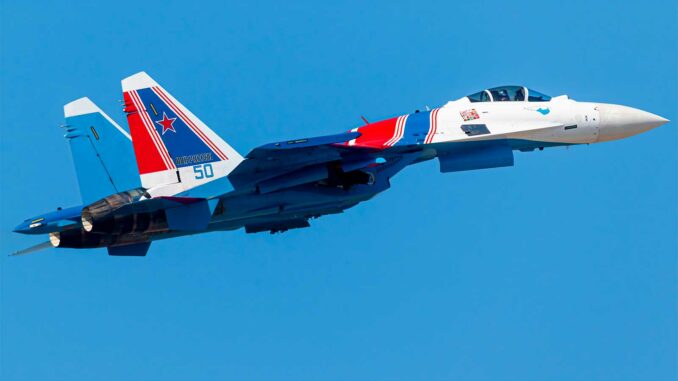
Under pressure in Ukraine, Russia is brutally wearing down its Su-34 and Su-35 aircraft, while the production of parts and glide bombs is reaching worrying limits.
Summary
At the beginning of 2026, the Russian Aerospace Forces (VKS) find themselves caught in a strategic contradiction. On the one hand, Moscow has made the Su-34/Su-35 tandem the cornerstone of its long-range bombing campaign in Ukraine, particularly around Zaporizhia, with several thousand glide bombs dropped each month according to Western estimates. On the other hand, this intensity of use accelerates wear and tear on the airframes, consumes theoretical flight hours faster than expected, and requires maintenance cycles for which the Russian industry lacks critical parts and components, particularly electronic ones, due to sanctions. At the same time, the ramp-up of UMPK guidance kits and new UMPB glide bombs has made it possible to transform stocks of FAB bombs into a low-cost precision arsenal, but at the cost of well-identified industrial bottlenecks. This imbalance between strike capability and technical sustainability now raises a key question: how long can Russia maintain this pace without permanently damaging the potential of its combat fleet and its strategic room for maneuver vis-à-vis Ukraine and NATO?
The rise of the Su-34 and Su-35 in the war of attrition
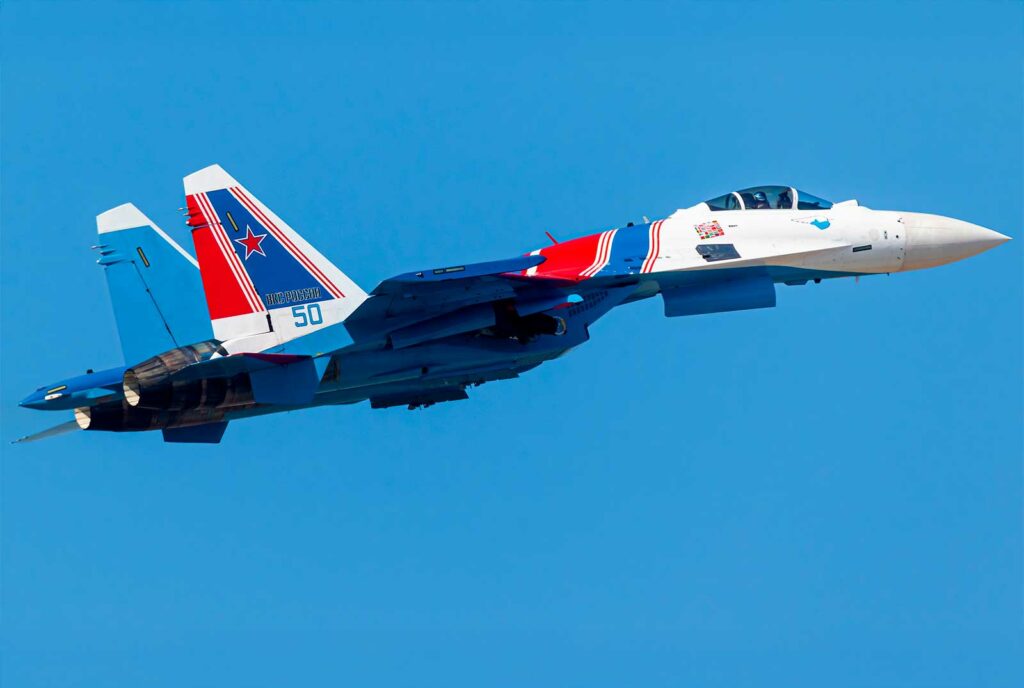
Since 2023, the VKS has refocused its efforts on the Su-34 and Su-35S to carry out strikes from a safe distance, directly on the front line. The Su-34, a two-seat tactical bomber, has become the main carrier of UMPK kits, which transform FAB-500 (approximately 500 kg) or FAB-1500 (1,500 kg) smooth bombs into low-cost guided gliding munitions. The Su-35S, a multirole fighter, provides escort, local air superiority, and air-to-air and air-to-ground missile delivery.
Open source reports estimate that at the beginning of 2025, the VKS had approximately 150 to 180 Su-34s in operational service, despite at least 41 aircraft destroyed or damaged visually documented since 2022. In 2025, Russia is believed to have lost another 18 to 21 tactical aircraft, including Su-34s and Su-35s, as a result of the combined effect of Ukrainian ground-to-air defenses and drone strikes on the Morozovsk and Marinovka bases. To compensate, United Aircraft Corporation and Rostec have accelerated deliveries: Moscow has announced the delivery of a new batch of Su-34s at the end of 2025, completing the annual production plan and keeping the Novosibirsk assembly line in operation.
This strategy is clearly aimed at maintaining a permanent strike capability: Su-34s often take off several times a day, drop glide bombs at ranges of over 50 km (up to 60–70 km, or even around 90 km for some models) and remain out of reach of Ukrainian short-range air defenses. But this high-intensity pace of operations relies on a limited and already proven fleet, built for a much less demanding operational profile.
Accelerated airframe aging and the issue of flight hours
Modern combat aircraft are designed for a certain airframe life (structural flight hours) spread over several decades. In the case of the Su-34 and Su-35, repeated flight profiles—heavy takeoffs, high-altitude flight, loaded maneuvers, return to full external payload—place a heavy strain on the structures. An analysis report cited by the UK Ministry of Defense estimates that the VKS is “eating up” the service life of its aircraft at a rate well above pre-war projections.
In concrete terms, this means that aircraft that are still relatively new on paper are prematurely approaching thresholds that require extensive inspections, structural reinforcements, or complete reprocessing of certain sections (wing-fuselage joints, stringers, fin struts).
In a war context, these projects are immobilizing a growing number of aircraft, even as operational needs push for maximum availability. The VKS thus finds itself caught between flight safety requirements and the temptation to extend the use of aircraft whose potential is eroding.
The first visible consequences were a decline in availability rates and an increase in technical incidents. Since 2023, Western analyses have pointed to growing difficulties in maintaining fleets beyond a certain threshold of combat-ready aircraft, particularly for the most heavily used types such as the Su-34 and Su-35S. In the long term, there is a risk of reaching a point where it is no longer possible to maintain the same frequency of sorties without taking structural risks or reducing the number of available aircraft.
Bottlenecks in parts and components under sanctions
This accelerated wear and tear is directly hampered by supply constraints. Since 2022, Western sanctions have targeted electronic components, avionics systems, and a wide range of aircraft spare parts, creating a deficit that affects both aircraft and precision munitions. As early as 2022, Russian and European media were already reporting the closure or mothballing of defense-related factories due to a lack of deliveries of German equipment or other imported components.
The Su-34 and Su-35 incorporate numerous subsystems that depend on foreign components: processors, sensors, navigation modules, electrical converters, and active antenna radar components for the Su-35S. Some of these can be replaced by Chinese or locally produced equivalents, but often at the cost of increased logistical complexity, reduced reliability, or longer lead times. The UK Ministry of Defense has pointed out that the additional maintenance required by the war is “complicated by a shortage of spare parts” linked to sanctions and increased demand.
Added to this is a human factor: Ukrainian and Western sources mention the departure of skilled specialists from the Russian aviation industry after 2022 and the difficulty of replacing them quickly. However, major airframe overhauls, engine reconditioning, and advanced avionics repairs require an experienced and stable workforce. This technical deficit slows down the return of aircraft to service, even when parts are available.
Glide bomb production between expansion and limitations
In terms of ammunition, Russia has undergone a major transformation by focusing on guided glide bombs. The UMPK (Unified Gliding and Correction Module) kit, estimated to cost around $20,000 to $24,000 per munition, allows wings and a satellite or inertial guidance module to be attached to FAB-500, FAB-1500 and even FAB-3000 bombs, giving them ranges of over 50 km, typically 60 to 70 km, and up to around 90 km for some variants. In 2025, a RUSI report relayed by the British press mentioned a target of 75,000 UMPK bombs produced over the year, or several hundred per day.
This ramp-up transformed a stockpile inherited from the Soviet era into a massive volume of precision munitions “sufficient” for a static war of attrition, targeting fixed positions, depots, or infrastructure.
Western assessments now suggest that several thousand glide bombs are being dropped every month on the Ukrainian front, particularly against Zaporizhia, Kharkiv, and Avdiivka.
But this expansion faces several bottlenecks:
- the production of kits (aerodynamics, actuators, guidance electronics) remains limited by access to certain components that are imported or circumvented via re-exports, which complicates ramp-up beyond a certain threshold;
- The industrial capacities of companies such as Tactical Missiles Corporation must be shared between different families of weapons (anti-ship missiles, air-to-air missiles, cruise missiles), which requires trade-offs.
- The new UMPB D-30SN glide bombs, which appeared in the spring of 2024 and feature a more optimized design, offer increased range (potentially up to 90 km) but still appear to be produced in much smaller volumes than the UMPK.
Analysts point out that, while Russia has “hundreds of thousands” of smooth bombs in stock, the real bottleneck remains the ability to rapidly produce guidance kits and associated electronic components. In the medium term, this constraint could force Moscow to choose between the quantity of glide bombs used on a daily basis and preserving a stockpile for possible larger-scale scenarios.
Operational implications around Zaporizhzhia and across the front
On the ground, the combination of worn-out fleets and ammunition shortages paints a mixed picture. Around Zaporizhzhia, recent strikes show that Russia retains a sustained bombing capability, able to strike Ukrainian targets 50–70 km from the front line while remaining out of range of short-range surface-to-air systems. These bombardments undermine defenses, destroy ammunition depots, and complicate Ukrainian troop rotations, directly impacting Kyiv’s offensive capabilities.
However, this tactical effectiveness relies on a limited number of bases, air corridors, and vectors. Ukrainian long-range drone strikes on Morozovsk and Marinovka in 2024–2025 showed that targeted attacks could destroy several Su-34s in a single night and temporarily disrupt the tempo of operations. The more the fleet shrinks or wears out, the more each marginal loss weighs on overall power projection capabilities.
Furthermore, the growing dependence on these gliding bombs reveals a risk profile: these weapons are optimized for fixed targets and positional warfare, less so for highly maneuverable operations or engagements against an adversary with NATO-style deep air defenses. If Russia must maintain a reserve of higher-end precision munitions (Kh-101 missiles, Iskander missiles, etc.) for regional deterrence, this reduces the margin for continuing massive UMPK campaigns at the same pace.
The strategic consequences for the VKS and for Moscow
For Moscow, the stakes go beyond the Ukrainian theater. The Su-34 and Su-35 must also cover conventional deterrence missions in the Arctic, the Baltic, and the Pacific, as illustrated by the Zapad 2025 exercises, where Su-34s simulated large-scale strikes against targets in the Far North. The accelerated erosion of these aircraft’s potential, combined with difficulties in producing new airframes and parts, potentially reduces Russia’s strategic flexibility.
Announcements of increased production of Su-34, Su-35, and Su-57 aircraft should be viewed in this light: the primary goal is to compensate for attrition and wear and tear rather than to qualitatively transform the fleet.
As long as sanctions limit access to certain key components, Russia will have to choose between modernization (Su-57, advanced systems) and the production of “all-purpose” platforms such as the Su-34 and Su-35, which are immediately useful in Ukraine but costly in terms of fleet potential.
For the VKS, the threat is not a sudden loss of capability, but a gradual shift towards a smaller fleet that is more heavily used and more difficult to maintain at the desired technical standard. This could lead to:
- a gradual decline in the number of aircraft available simultaneously at the front;
- more frequent use of cautious flight profiles to preserve airframes, with an impact on tactical effectiveness;
- increased reliance on less sophisticated but more abundant precision munitions, to the detriment of strike spectrum diversity.
In the medium term, Russia’s ability to simultaneously wage a war of attrition in Ukraine and deter or contain NATO in several theaters will be at stake. The current gamble is to endure high attrition today in order to gain territory or political advantage, in the hope that industry and sanctions circumvention channels will be sufficient to rebuild the fleet and ammunition stocks in time.
Sources
Army Recognition, “Russia Adds New Su-34 Fighter Bombers…”, January 12, 2026.
BulgarianMilitary.com, “Russia to mass-produce 75,000 UMPK bombs in 2025,” February 21, 2025.
Breaking Defense / 19FortyFive, analyses on VKS attrition and spare parts shortages, 2023–2025.
Le Monde, “Russian military aviation weakened by sanctions,” July 25, 2022.
JAPCC, “Countering Russia’s Glide Bomb Warfare in Ukraine,” November 18, 2025.
MilitaerAktuell, “Russia increases glide bomb production and deployments,” November 2, 2025.
Reports and summaries on Russian aircraft losses 2024–2025 (Defence24, Oboronka).
Various analyses on Su-34/Su-35 production and Rostec statements, 2024–2026.
War Wings Daily is an independant magazine.