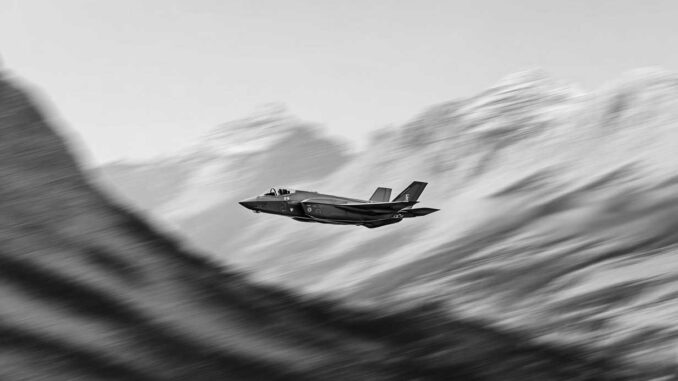
Above Jordan, the British F-35B scored its first aerial victory. This sequence validates its sensor fusion capabilities.
Summary
On March 3, 2026, the United Kingdom confirmed that an RAF F-35B Lightning II had destroyed drones over Jordan. London presented the event as the first destruction of a target in operations by a British F-35. According to corroborating press sources, several Iranian-designed Shahed attack drones were shot down with the support of other British assets deployed in the region. This is significant, but it is important to understand why. This sequence not only proves that the F-35 can fire a missile at a slow-moving target. Above all, it validates the very logic of the aircraft: early detection, rapid classification, merging of disparate data, and then engagement in a confusing airspace. In a war saturated with drones, jamming, and data flows, the F-35B is not primarily an “elegant” fighter. It is a combat node capable of transforming sensors into tactical decisions. This is precisely what this interception demonstrated.
A success that marks a symbolic turning point for the British F-35B
On March 3, 2026, the British Ministry of Defense confirmed that RAF F-35Bs had shot down drones over Jordan, with the support of Typhoon and a Voyager tanker aircraft. The official statement specifies that this is the first time an RAF F-35 has destroyed a target in operations. This point is central. The British F-35 is no longer just a costly, ambitious program that is sometimes criticized for its delays. It has just recorded a real air-to-air combat action under the British flag.
The event has strong symbolic significance for London. The United Kingdom has already invested heavily in the program. In July 2025, the National Audit Office reported that the country had contracted for 48 F-35Bs, while subsequently announcing an upcoming batch of 15 additional F-35Bs and 12 F-35As, as part of a broader program that the government continues to link to the historic target of 138 F-35s. However, this program still suffers from availability constraints, delays in weapons integration, and support tensions. In this context, a successful interception in a real-world environment is politically worth much more than a successful exercise.
The regional context that turned a patrol into a real engagement
This interception did not come out of the blue, figuratively speaking. It was part of a sudden rise in regional tension in early March 2026. The British government announced at the same time that it was sending the destroyer HMS Dragon and additional resources to the eastern Mediterranean, explaining that Iran was continuing what it considered to be reckless attacks against British and allied interests in the region. The same statement also mentioned that a Typhoon operating with the UK-Qatar joint squadron had destroyed an Iranian attack drone targeting Qatar, while a British anti-drone unit neutralized other aircraft in Iraqi airspace. In other words, the F-35B’s firing was not an isolated incident. It is part of a wider sequence of aerial clashes against attack drones.
British media sources add a useful detail: according to The Guardian and The Times, a British pilot shot down two Shahed drones over Jordan during a mission lasting several hours, in skies crowded with American and Israeli allied aircraft. This point is not stated as precisely by the British Ministry, which refers to drones in the plural without officially specifying the exact number or type. The rigorous wording is therefore as follows: London confirms the destruction of drones; several leading British media outlets identify them as Iranian-designed Shaheds, at least two in number.
The F-35B: not only stealthy, but built to see before others
To understand why this interception matters, we need to look at the architecture of the F-35B Lightning II. The F-35B is the short takeoff and vertical landing version of the F-35 program. It is this variant that the United Kingdom operates from land and from its Queen Elizabeth-class aircraft carriers. Its uniqueness lies not only in its stealth capabilities. Its true technological heart is the integration of its sensors, electronic warfare, and data links into a single tactical picture for the pilot. Official British documentation specifically emphasizes this combination of low observable technology, sensor fusion, and data linking.
In concrete terms, the F-35 aggregates several sources of perception. Its AN/APG-81 AESA radar detects and tracks air and surface targets. Its Distributed Aperture System is based on six infrared sensors distributed around the aircraft. Its EOTS electro-optical system contributes to identification and targeting. Added to this is the electronic warfare suite and data exchange with other platforms. The pilot does not receive this information in separate streams that he has to sort through himself. The aircraft merges it into a coherent image. It is this logic that makes the F-35 different from older fighters equipped with very good sensors but less well integrated.
Sensor fusion becomes decisive against slow and discreet drones
The case of attack drones is interesting precisely because it thwarts certain reflexes. We often imagine that fighter planes are designed to destroy other fast aircraft, not slow and relatively inexpensive targets.
However, Shahed-type drones pose a real tactical problem. Their speed is modest. Their signature can be reduced. Their flight profile, often at low altitude, makes them difficult to distinguish in a space saturated with clutter, terrain, heat interference, and friendly traffic. They are not invisible. But they can be difficult to spot, classify, and engage properly at the right moment.
This is where sensor fusion comes into its own. The RAF itself summed up this logic in 2025: the F-35 combines radar, infrared, and electronic warfare data to highlight threats and opportunities, with a clearer and faster image than on a previous-generation fighter. In an environment where the challenge is not only to “see” a drone but to distinguish it from other objects, confirm its hostile nature, and then deal with it without error in a busy sky, this integration is a game changer. It is not an ergonomic detail. It is an operational advantage.
However, we must avoid exaggeration. The British success alone does not “prove” that the F-35 always detects low-signature targets better than anything else. It shows something more serious and concrete: in a real mission, in coalition, against hostile drones, the F-35 system enabled the successful detection, identification, and engagement of several targets. That is already a lot.

Engagement that also highlights the economic limitations of air combat
It is also important to mention what often bothers military leaders, even though they cannot avoid it: destroying an attack drone with a fifth-generation stealth fighter and an air-to-air missile remains a tactically effective solution, but an economically imperfect one. Iranian Shahed-type drones cost very little compared to the price of an F-35B or even a modern missile such as the ASRAAM, which several British media outlets say was used in this interception. The UK may have won the tactical battle, but this sequence also highlights the classic challenge of modern air defense: how to neutralize low-cost threats without burning through expensive resources too quickly.
This observation does not detract from the performance. It simply underscores that the F-35 is not a universal solution to everything. It is extremely useful when it is necessary to react quickly, far away, in a complex sky, with a strong need for discrimination and allied coordination. For a prolonged campaign against swarms of low-cost drones, armies will inevitably seek more economical solutions: helicopters, lighter missiles, cannons, jamming, lasers, or dedicated anti-drone layers. In fact, the British press release of March 3, 2026 also announces the deployment of Wildcat helicopters armed with Martlet missiles to reinforce this regional anti-drone layer. This clearly shows that London is already thinking in terms of multi-layered defense, not a single solution.
The aircraft that proves its value as a coalition hub
This first aerial victory for the British F-35B Lightning II has another merit: it reminds us that this aircraft almost never fights alone. The official press release mentions the support of Typhoon and Voyager aircraft.
Reports indicate that the airspace was shared with other allied assets. This is typically the type of mission where the value of the F-35 goes beyond the mere firing of missiles. The aircraft is also used to illuminate the entire system, share data, reduce uncertainty, and speed up decision-making. The F-35 is designed as a connected sensor-shooter, not just an interceptor.
For the United Kingdom, this aspect is essential. NAO documentation already emphasized that the F-35 could enhance other British platforms through its survivability, information-sharing capabilities, and effects in a contested environment. The engagement over Jordan finally provides concrete, albeit limited, demonstration of this promise. As such, the event goes beyond a simple “first victory.” It becomes a partial operational validation of the British program’s philosophy.
The results confirm the logic of the F-35 in the sensor war
Perhaps the most interesting aspect of this case is not that the F-35B won its first British air victory. The most interesting aspect is the nature of the target. An Iranian attack drone is nothing like the mythical duel between piloted fighters. Yet it is precisely against this type of ambiguous, small, slow, and difficult-to-classify threat that the F-35 demonstrates its true capabilities.
The F-35B was not only designed to go unnoticed. It was designed to understand what is happening around it faster than the adversary, and then to inject that understanding into combat. Above Jordan, this promise is no longer theoretical. It has taken the very simple form of a successful engagement, in a complicated sky, against a real threat. And that explains why this first victory will probably count for more in the history of the program than many demonstrations at air shows.
War Wings Daily is an independant magazine.