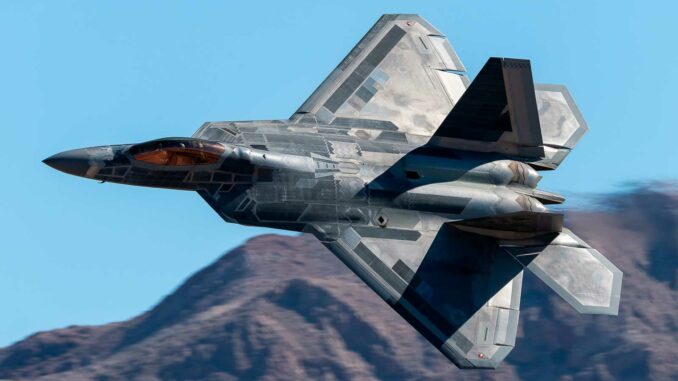
Why some F-22s appear with a mirror coating: discreet tests against IRST and lasers, and clues about the future NGAD.
In summary
Since 2022, and again in 2024 and 2025, several F-22 Raptors have been photographed over Area 51 and Nellis Air Force Base with a reflective, almost chrome-like coating. These images immediately attracted attention. They are not simply a change of paint. They suggest advanced testing of a new generation of surface treatments designed to counter threats that now go beyond radar. The challenge is twofold: to reduce infrared detection by modern IRST systems and to offer increased protection against directed energy weapons, particularly lasers. Although production of the F-22 ended in 2012, it remains a prime test bed for critical technologies. This “Chrome Stealth” is not intended for deployment in an operational fleet. It serves as a flying laboratory to prepare for the future American 6th generation aircraft, the NGAD, where thermal and energy management will be as decisive as radar stealth.
Unusual sightings that have reignited speculation
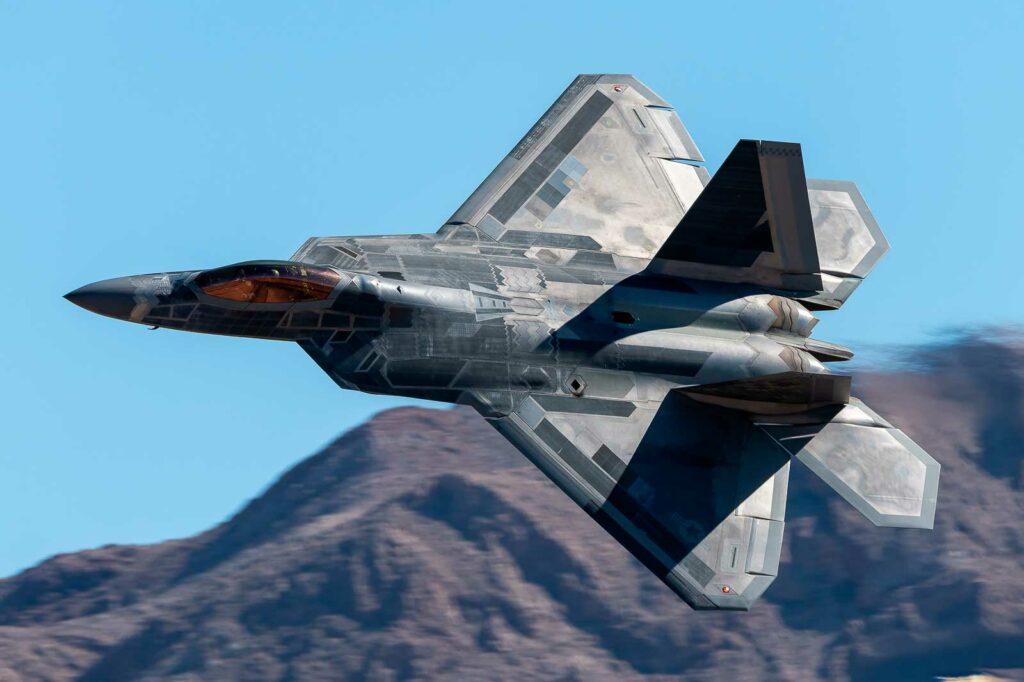
The first photos of mirror-like F-22s appeared in 2022, captured by civilian observers around Groom Lake and Nellis Air Force Base. In 2025, new photos confirmed that the phenomenon was not a one-off. The aircraft have a highly reflective surface, reflecting the sky and desert like a polished mirror.
These observations do not correspond to any known US Air Force paint scheme. Nor are they compatible with a simple primer or conventional anti-corrosion paint. The regularity of the coating, its homogeneity, and its persistence over time clearly indicate structured flight testing.
The choice of location is not insignificant. Area 51 and Nellis are historically associated with the most sensitive programs, whether stealth aircraft, experimental drones, or advanced sensors. When an F-22 flies there with a new coating, the message is clear: these are tests, not an aesthetic fantasy.
The myth of “chrome” and the reality of materials
The term “Chrome Stealth” is misleading. It is not chrome in the traditional sense, nor is it a shiny metal applied as on a demonstration aircraft. The coating observed is probably a multi-layer composite layer, incorporating reflective and ceramic materials.
These layers may include thin metals, conductive oxides, or nanometric structures capable of managing electromagnetic and thermal radiation differently. Their mirror-like appearance is a side effect of their main function: to reflect or redistribute incident energy.
Unlike traditional radar-stealth coatings, which absorb some of the waves, this approach relies more on controlled reflection at certain wavelengths, particularly in the infrared.
The rise of infrared threats
Radar stealth is no longer enough. IRST (InfraRed Search and Track) systems have evolved significantly. Modern, passive, and increasingly sensitive, they detect aircraft not by their emissions, but by their thermal signature.
Despite its exceptional radar stealth, an F-22 remains a thermal machine. Its engines generate tens of kilonewtons of thrust. The surfaces heat up at high speed. Air friction at Mach 1.5 causes significant heating of the airframe.
Modern IRSTs can detect a fighter at over 90 kilometers in certain favorable conditions (approximately 50 nautical miles), and sometimes even further at high altitudes. This is a game changer, especially when facing adversaries capable of merging infrared and radar data.
The possible role of mirror coating against IRST
The coating tested on the F-22 could aim to reduce or redistribute the infrared signature. Several mechanisms are plausible.
A highly infrared-reflective material can limit direct thermal emission to an enemy sensor. Instead of radiating diffusely, heat is partially reflected or re-emitted at angles less favorable to detection.
This type of treatment does not make the aircraft “cold.” It changes the way thermal energy leaves the airframe. This is a major difference. The goal is not invisibility, but disruption of the infrared signal, making tracking more unstable or less accurate.
Potential protection against directed energy weapons
Another major issue concerns directed energy weapons, particularly lasers. The armed forces are investing heavily in these systems, which are capable of damaging sensors, surfaces, or structures with a concentrated beam.
A reflective coating can offer partial protection against this type of threat. By reflecting some of the incident energy, it reduces local heating and delays damage. This does not make the aircraft invulnerable, but it does increase its resilience.
In high-intensity combat, gaining a few seconds against a laser can be enough to break engagement, change course, or neutralize the threat. This logic fits perfectly with the requirements of next-generation air combat.
Why the F-22 serves as a test bed
The F-22 is a paradox. It is no longer in production, but it remains one of the most capable aircraft ever designed. Its airframe, electrical power reserve, and stealth architecture make it an ideal platform for testing advanced technologies.
The US Air Force regularly uses modified F-22s for covert testing. Their small number, with around 180 aircraft in service, facilitates control and confidentiality. Their limited deployment also reduces the risk of inadvertent disclosure.
Testing an experimental coating on an F-22 allows its impact on overall signature, maintenance, aerodynamics, and durability to be evaluated without committing to an entirely new program.
A direct link to the NGAD program
The NGAD (Next Generation Air Dominance) is designed as a system of systems, centered on a 6th generation aircraft. The announced requirements far exceed those of current aircraft: multi-spectral dominance, advanced energy management, integration with drones, and survivability in the face of ubiquitous sensors.
In this context, stealth can no longer be solely radar-based. It must be comprehensive, covering radar, infrared, optics, and even acoustics in certain phases.
The F-22’s “Chrome Stealth” appears to be a technological indicator, not a final solution. It shows that engineers are working on adaptive surfaces capable of handling multiple types of threats simultaneously.
The limitations and costs of such an approach
Advanced coatings never come free. Multilayer materials are expensive to produce. Their application requires controlled environments. Their maintenance is complex. A simple scratch can alter their thermal or electromagnetic properties.
In addition, a highly reflective coating can cause secondary problems. It can increase optical visibility at certain angles or under certain lighting conditions. It can also complicate repairs in the field.
These constraints explain why this type of solution is reserved for the most critical programs and tested extensively before any operational integration.
What these tests say about the evolution of aerial combat
The “mirror” F-22s tell a broader story. Aerial combat is no longer just about being seen or not seen by radar. It is a clash between sensors, algorithms, and physical signatures.
The surface of the aircraft becomes an active interface between the machine and its environment. It is no longer used just for flying. It is used to manage energy, deceive sensors, and survive in a space saturated with passive detection.
This shift is fundamental. It heralds aircraft where the coating will be as important as the shape, and where stealth will be dynamic, not static.
A mirror that reflects above all the future
These mirror-coated F-22s are not intended to patrol continuously in this state. They fulfill their role silently: testing, measuring, comparing. Their virality was probably not sought after, but it reveals the public’s appetite for the weak signals of military innovation.
Behind the spectacular visual effect lies a more sober reality. Tomorrow’s air supremacy will be determined by the ability to manage heat, energy, and signature across all spectrums. Once again, the F-22 serves as a messenger.
And this mirror, far from reflecting the Nevada sky, mainly reflects the image of a future where stealth will no longer be simply the art of disappearing, but the art of controlling what the enemy believes it sees.
Sources
Photographs and public observations of F-22s over Groom Lake and Nellis
US Air Force communications and technical documents on IRST threats
Specialized analyses on thermal coatings and infrared management
Defense publications on directed energy weapons and aircraft protection
Open studies on the NGAD program and its technological requirements
War Wings Daily is an independant magazine.