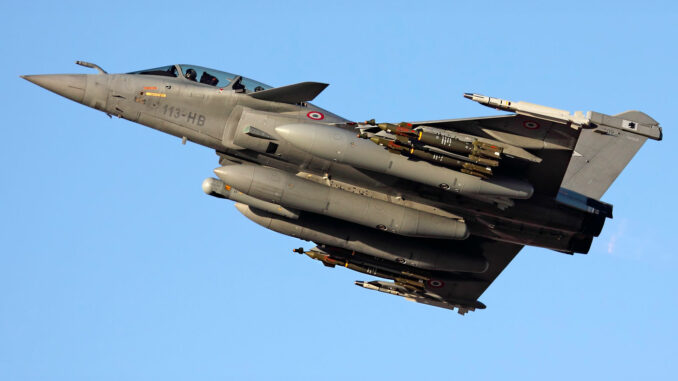
The Rafale played a central role in the French intervention in Libya. Missions, weapons, successes, and limitations: analysis of a landmark engagement for Dassault.
Summary
The use of the Rafale in Libya in 2011 marked the French fighter jet’s true baptism of fire. On March 19, Rafale aircraft from the French Air and Space Force struck Muammar Gaddafi’s forces around Benghazi as part of Operation Harmattan, before joining NATO’s Operation Unified Protector. The aircraft was engaged in a wide range of missions: air superiority, interdiction, precision strikes, reconnaissance, and ISR support. The Rafale C and B versions, based in Saint-Dizier and then Solenzara, and the Rafale M from the Charles de Gaulle aircraft carrier, carry AASM munitions, laser-guided bombs and SCALP-EG cruise missiles, demonstrating the reality of the “multi-role aircraft” concept. With 1,039 sorties and 4,539 flight hours, without any aircraft losses, the campaign serves as an operational showcase for Dassault Aviation, directly influencing future export campaigns.
The Rafale’s entry into Libya as part of Operation Harmattan
The French intervention in Libya began on March 19, 2011, after the adoption of UN Security Council Resolution 1973. The objective was clear: to protect the civilian population, particularly in Benghazi, threatened by the offensive of loyalist forces. The first aircraft to intervene were Rafale jets from the French Air Force, taking off from Saint-Dizier in northeastern France.
These aircraft carried out very long-range raids, with in-flight refueling, to intercept the armored columns and artillery pieces converging on Benghazi. The first strikes destroyed several tanks and armored vehicles southwest of the city, halting the immediate advance of Gaddafi’s forces.
Very quickly, the force was reinforced. Rafale C and B aircraft were redeployed to the Solenzara base in Corsica, closer to the area of operations. At the same time, the carrier strike group around the Charles de Gaulle aircraft carrier left Toulon and arrived off the coast of Libya, deploying Rafale M aircraft. France thus placed its Rafale fighter aircraft at the heart of the first phase of the air campaign, before handing over command to NATO.
The Rafale versions deployed and their capabilities
The Libyan theater allowed for the first time the simultaneous deployment of all three versions of the Rafale:
- Rafale C, a single-seat land-based aircraft.
- Rafale B, a two-seat aircraft used for complex missions requiring an additional weapons systems officer.
- Rafale M, a naval version deployed aboard the Charles de Gaulle.
The Air Force aircraft mainly take off from Saint-Dizier and Solenzara, while the Rafale M operates from the flight deck of the aircraft carrier, positioned in the central Mediterranean. This combination offers great flexibility: land bases for permanence and heavy logistics, aircraft carriers for proximity to the area and rapid repositioning capability.
A fully exploited multi-role aircraft
One of the most visible features of the Rafale in Libya is the concrete implementation of its “multi-role” concept. On a single flight, an aircraft can provide air defense, reconnaissance, and air-to-ground strike capabilities.
Typical configurations include:
- For air defense: up to six MICA EM/IR missiles and external fuel tanks.
- For reconnaissance: MICA for self-protection, RECO NG reconnaissance pod, and fuel tanks.
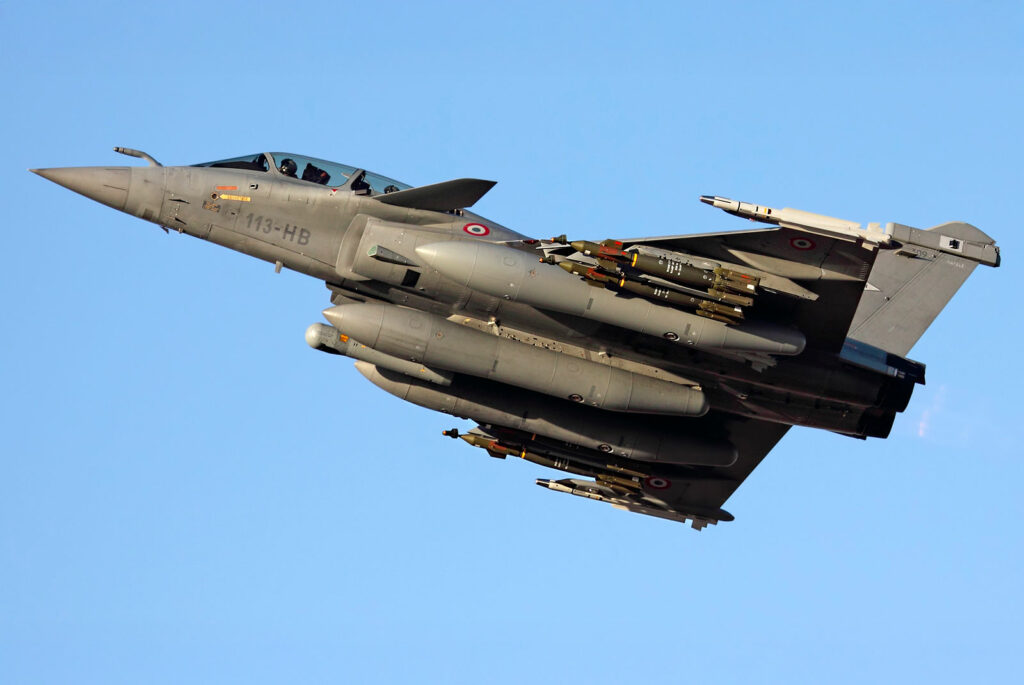
- For ground attack: two MICA for self-defense, four 250 kg AASM guided bombs, and fuel tanks.
The Rafales are also equipped with the Damoclès laser designation pod, enabling the use of GBU-12 laser-guided bombs, and the SPECTRA self-protection system, which reduces dependence on specialized air defense suppression aircraft.
This array illustrates the density of sensors and weapons that a single aircraft can carry, a point that will be widely promoted by Dassault after the campaign.
Missions carried out over Libya
Air superiority and the protection of Benghazi
In the early days, the priority was to establish a bubble of air superiority over Benghazi and the main combat zones. The Rafales patrolled at medium and high altitudes to prevent any action by loyalist aircraft and protect the civilian population and rebel forces.
The enemy’s air defenses were limited, but they did exist: short- and medium-range surface-to-air missiles, anti-aircraft artillery, and a few aircraft that were still operational. The Rafale used its relatively low radar signature, SPECTRA, and its air-to-air missiles to control the airspace without requiring a dedicated escort.
A symbolic episode occurred on March 24, 2011, when a Rafale destroyed a Libyan Soko G-2 Galeb as it landed on the runway at Misrata, using AASM munitions. This engagement demonstrated the aircraft’s ability to combine intelligence, identification, and precision firing in a complex environment.
Interdiction strikes and deep missions
Very quickly, missions expanded to include operational interdiction and strikes on strategic targets. On March 24, Rafale and Mirage 2000D aircraft fired SCALP-EG cruise missiles at an air base located approximately 250 km inside Libyan territory.
These strikes targeted command centers, ammunition depots, runways, and air defense installations. They were conducted both day and night, based on long-range attack profiles. The combination of SCALP, AASM, and GBU-12 missiles made it possible to engage a wide variety of targets, from isolated armored vehicles to hardened infrastructure.
Operation Harmattan was characterized by the massive use of guided munitions. Throughout the Libyan campaign, French forces delivered approximately 1,205 guided munitions, including 225 AASMs and 15 SCALP-EGs. A significant proportion of these weapons were fired from Rafale aircraft, reinforcing the image of an aircraft capable of carrying a wide range of precision weapons.
Reconnaissance and ISR support for NATO forces
The Rafale also plays a key role in the intelligence chain. Versions equipped with the RECO NG pod carry out tactical and operational reconnaissance missions for France and NATO, mapping the movements of loyalist forces, artillery positions, depots, and logistics routes.
The images and data collected are quickly merged with those from drones and other ISR platforms. This makes it possible to refine the list of targets, verify the effects of strikes, and reduce collateral damage. Post-campaign assessments indicate a success rate of over 95% for the use of guided weapons in compatible conditions.
This intelligence dimension is often less visible than strikes, but it consolidates the Rafale’s position as a credible ISTAR platform, capable of identifying, designating, and striking targets in quick succession.
Operational results: effectiveness and limitations
The figures illustrate the central role played by the Rafale. Of the approximately 5,600 sorties flown by French aircraft during the Libyan campaign, including around 4,000 by the Air Force, the Rafale flew 1,039 sorties, totaling 4,539 flight hours. No aircraft were lost, despite missions sometimes being conducted over areas still covered by surface-to-air systems.
The operational effectiveness is clear. More than 1,000 targets were destroyed by French forces, including armored vehicles, artillery pieces, ammunition depots, and command centers. The Rafale contributed directly to the erosion of Gaddafi’s capabilities and the effective establishment of a no-fly zone.
But this success came at a cost. The limited number of aircraft meant that they had to fly at a very high rate. One Rafale reportedly flew up to 140 hours in a month, a level of use well above the usual standards. The Charles de Gaulle aircraft carrier spent 220 days at sea over a nine-month period, illustrating the strain on resources.
These figures also show the limitations of a reduced combat fleet. Technical availability remains good, but equipment is being used to its maximum capacity. The campaign highlights the need to maintain a sufficient fleet size to absorb peaks in activity without weakening the fleet in the long term.
The impact on Dassault Aviation and Rafale exports
For Dassault Aviation, the Rafale’s deployment in Libya was a turning point. Before 2011, the aircraft suffered from an image of being a “good aircraft with no export references.” The lack of a comprehensive operational demonstration hampered several commercial campaigns.
Libya changed the game. The Rafale then appeared, compared to the Eurofighter Typhoon also in service, as a complete combat system, capable of switching from air superiority to precision strikes in a matter of hours. Analyses at the time spoke of a “better showcase” for a combat aircraft since the Iraq War.
This operational credibility weighed heavily in subsequent negotiations. France clearly highlighted the Libyan experience with its prospects. Egypt, the Rafale’s first export customer in 2015, was looking for aircraft that were available quickly to secure its borders, particularly in the face of the chaos in Libya. French political sources acknowledge the direct link between the situation in Libya, the need to maintain the production line, and the signing of the Egyptian contract.
Subsequent successes in Qatar, India, Greece, and the United Arab Emirates are part of this dynamic. The Rafale is no longer just an industrial project, but a proven fighter jet that has been tested in a real high-intensity campaign.
Operational lessons learned from the use of the Rafale in Libya
The use of the Rafale in Libya offers several key lessons for the French forces and for the very concept of the Rafale fighter jet.
First, it validates the omni-role concept. The aircraft has shown that it can effectively combine air superiority, strike, and reconnaissance capabilities in the same theater, with rapid reconfigurations between sorties. This flexibility reduces the number of aircraft needed to achieve a given military effect.
Second, the campaign confirms the importance of large quantities of precision-guided munitions. Stocks of AASM, GBU-12, and SCALP-EG munitions were heavily depleted. France realized that a multi-month operation against a state adversary consumes large volumes of guided munitions, which must then be replenished.
Finally, equipment wear and tear highlighted the need for a format that is consistent with political ambitions and available resources. An aircraft may be highly effective, but if it is used at very high capacity with a small fleet, the question of long-term sustainability arises.
Libya remains a seminal campaign for the Rafale. It consolidated the doctrine of use, validated the technological choices, and provided France with a convincing demonstration of its air capabilities. It also opened a new phase for the program, one in which exports are based on real-world experience, rather than just promises or peacetime trials.
Sources
– Ministry of the Armed Forces, Operation Harmattan status reports (2011)
– “Operation Harmattan,” NATO summaries and data on the intervention in Libya
– Dassault Aviation, documents on the Rafale in operations
– Articles from FlightGlobal and Reuters on the Rafale and Libya
– Doctrinal analyses on the Rafale’s contribution to recent operations (RDN, Military Strategy Magazine)
War Wings Daily is an independant magazine.