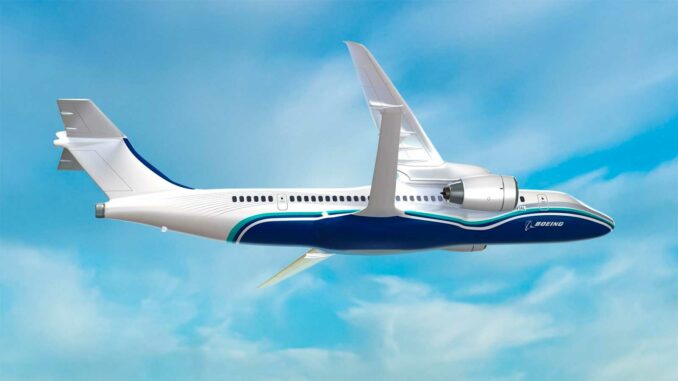
Wing struts, promises of 30% fuel savings, a partnership with NASA… then pause. The X-66A reveals the tension between innovation and financial survival at Boeing.
Summary
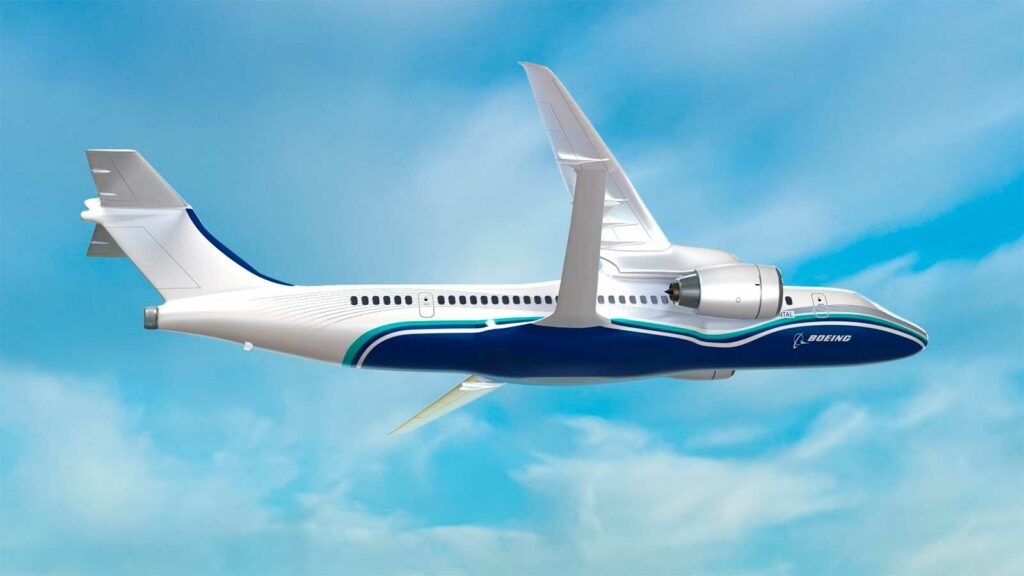
The X-66A was supposed to be the demonstrator that would put Boeing back in the technological race in the face of climate requirements and Airbus. Built around an MD-90 fuselage, it carried an ambitious idea: a very long and very thin transonic wing designed to significantly reduce drag and fuel consumption. The program, launched with NASA as part of the NASA Sustainable Flight Demonstrator, aimed for a first flight in 2028, with $425 million provided by the agency over seven years and approximately $725 million supplemented by Boeing and its partners. In April 2025, however, Boeing and NASA announced a pause, redirecting work toward a simpler demonstrator based on the ultra-thin wing. This freeze comes as no surprise: commercial aviation demands quick results, while Boeing is undergoing restructuring, production constraints, and financial pressure. The X-66A remains a valuable laboratory, but its shutdown highlights a reality: innovation does not survive long when industrial urgency takes control.
The X-66A, an X-plane designed to accelerate disruption
The X-66A belongs to a very special family: “X-plane” demonstrators designed to validate in flight a technology deemed too risky for a direct commercial program. The goal was not to produce a production aircraft, but to prove that a radically different architecture could operate at realistic cruising speeds, with a level of safety and performance compatible with a future airliner.
In this specific case, the breakthrough is structural. The X-66A uses a heavily modified MD-90 fuselage, on which Boeing had to install a very thin, exceptionally wide high wing supported by struts (cables). The challenge is clear: to improve aerodynamic efficiency, thereby reducing fuel consumption and lifecycle emissions.
This idea is not new in history. Wing-strut aircraft have been around for a century. What has changed is the flight regime: Boeing wants a strut-supported architecture that remains efficient in transonic cruise, around Mach 0.80, where modern single-aisle aircraft operate.
The key innovation: a long, thin wing structurally “held” by a strut
The technical promise of the X-66A can be summed up in one sentence: significantly increase the wing aspect ratio to reduce induced drag, without increasing weight and flex.
A modern single-aisle aircraft has a relatively thick and robust wing, designed to withstand stress without external assistance. The longer the wing, the greater the bending moments, which requires adding structure and therefore weight. This is the classic trap.
With a braced wing, some of the stress is absorbed by the struts. This makes it possible to manufacture a thinner wing that is lighter but equally rigid, and therefore more aerodynamically “clean.”
This point is important because Boeing was aiming for a massive improvement. The stated goal of the program was a reduction in fuel consumption of up to 30% compared to current single-aisle aircraft, combining the wing, more efficient engines, and overall optimizations. This figure does not mean “30% thanks to the struts.” It means “30% with the entire ecosystem.” . But even a fraction of this gain, validated in flight, would have been a powerful selling point.
The transonic lock that makes the concept difficult
At Mach 0.80, a very thin wing is attractive, but it can also become unstable or penalizing if it triggers compressibility phenomena, shock waves, and a sudden increase in drag.
The “transonic truss-braced wing” concept is precisely an attempt to resolve this paradox: an extremely thin wing, but controlled in transonic flight thanks to optimized geometry (sweep, profile, truss-wing interaction, lift distribution).
This is where the demonstrator comes into its own. In the wind tunnel, trends can be proven. In flight, the details that matter are validated: vibrations, flutter, control margins, gust tolerance, behavior in turbulence, and structural aging.
The NASA-Boeing collaboration: a tightly controlled budgetary and industrial mechanism
The program was not a blank check. The agreement between NASA and Boeing was based on a Funded Space Act Agreement, a formula that allows a demonstrator to be financed without resorting to a traditional military-type contract.
NASA was to invest $425 million over seven years. Boeing and its partners were to contribute an additional $725 million. This arrangement speaks volumes: the federal agency wants to accelerate a disruptive technology in the service of public objectives (efficiency, climate), but it also wants industry to take its share of the risk.
In practice, NASA contributes three key assets:
- testing facilities (wind tunnels, instrumentation),
- experimental certification expertise,
- the ability to converge simulation and flight data.
Boeing, for its part, brings industrialization capabilities, aircraft design, management of a complex transformation project, and access to engine and systems partners.
The X-66A project: a prototype that is expensive to “disassemble and reinvent”
The X-66A was to fly on an MD-90 base transported to Palmdale, California, for extensive reconstruction. This “reuse” choice reduces certain costs, but also increases the complexity of integration.
Transforming an existing aircraft into a demonstrator is not just a matter of gluing parts together. It requires re-qualifying structural areas, moving loads, rewiring, locally reinforcing, adapting flight control systems, and instrumenting the aircraft like a flying laboratory.
In this context, one detail was important: the engine. In 2024, Boeing and Pratt & Whitney announced a derivative engine, called the PW102XG, linked to the GTF family (PW1500G/PW1900G), partly for reasons of weight and integration. The simple fact of having to adjust the engine choice is revealing: the wing, the loads, and the overall configuration quickly shift the balance of a project.
Pausing the program: a technical decision… but above all a decision about priorities
On April 24, 2025, Boeing and NASA announced that the X-66A program was being paused indefinitely, while continuing research on the thin wing. The message is clear: the initial ambition is considered too costly or too risky at this stage, and the preference is to first validate the “core” technology in a simpler setting.
NASA explained that it wanted to focus on a ground-based demonstrator dedicated to validating the long, thin wing before eventually returning to the full truss-braced design. This makes sense from an engineering standpoint: if the ultra-thin wing does not deliver on its structural and aerodynamic promises, the transonic truss-braced architecture becomes an unnecessary refinement.
But let’s not kid ourselves. This pause also has an industrial cause: Boeing has reassigned engineering resources to its commercial programs under pressure. When a company needs to stabilize its production, it first cuts back on what does not produce short-term deliveries.
The advantages Boeing could derive from the X-66A, beyond fuel
Reducing fuel consumption is an obvious argument. But the appeal of the X-66A went beyond this single metric.
A credibility card against Airbus
Airbus is openly talking about hydrogen-powered aircraft and future architectures, while consolidating the A320neo. Boeing, on the other hand, has not launched a new single-aisle aircraft in a long time. The X-66A was a way of showing that the company is not doomed to incremental optimization.
A learning base for a future single-aisle aircraft
Even if the braced wing did not come to fruition, the technology for ground testing and validation of ultra-thin wings could have fed into the new generation of single-aisle aircraft around 2035. This includes a detailed understanding of flexing, materials, transonic margins, and certification.
A systemic effect on the American industrial chain
A demonstrator of this type mobilizes supply chains, composites, advanced simulation, tooling, and validation. In an aging industry, this maintains skills. A frozen project, on the other hand, disperses teams.
Simulation, the program’s true invisible “product”
There is a lot of talk about the wing. But the most valuable aspect is often elsewhere: the ability to correctly simulate such a flexible aircraft.
A very long and very thin wing introduces a strong coupling between aerodynamics and structure. The wing no longer simply “endures.” It deforms, and this deformation changes the flow, which changes the loads, which changes the deformation. It’s a loop.
To certify a future aircraft, these models must be mastered. The X-66A was supposed to produce a mass of flight data to recalibrate the simulations. Even if the aircraft doesn’t fly tomorrow, the program has already contributed to part of this knowledge base.
This is exactly why NASA insists on a thin-wing testbed: the priority becomes model validation, not the image of an X-plane in white paint.
Boeing’s situation, a context that makes innovation vulnerable
We must look at Boeing without filters. The company is emerging from several years of industrial turbulence, quality crises, and production delays.
Financially, Boeing posted a net loss of $11.8 billion in 2024, with very heavy cash consumption. Debt was reduced to around $53.9 billion at the end of 2024, notably after raising $24 billion in capital, but pressure remains high. Even in 2025, projections still point to cash burn, before a hoped-for return to positive cash flow in 2026, according to management statements and analysts.
Under these conditions, a technology demonstrator becomes an easy target. Not because it is useless, but because it does not “fix” the company in the short term.
And the market is unforgiving: customers want deliveries, regulators want robust processes, and investors want a stable production trajectory. Radical innovation can only survive if the industrial tool is healthy.
The X-66A: savior or mirage?
The answer lies in a simple nuance.
Technically, the X-66A was not a mirage. It was a coherent approach, built on decades of research (including the SUGAR studies) and a clear objective: to push the efficiency of a single-aisle aircraft without changing fuel. On paper, the idea is solid. And both Europe and the United States will need this type of breakthrough if carbon constraints really do become more stringent.
But industrially, the X-66A was a vulnerable gamble. It required teams, time, and internal stability that Boeing no longer had. It came at the worst possible time, when operational survival was taking precedence.
This project does not mean that Boeing has given up on innovation. It means that Boeing has been forced to prioritize. NASA, for its part, has chosen to save the technological core (the thin wing) rather than the complete showcase (the aircraft in flight).
The question that remains open is as much political as it is technical: if the X-66A does not fly, who will bring about the next breakthrough in the single-aisle segment? And how many years can the industry gain with optimizations before having to change the physics?
Sources
- NASA, “NASA and Boeing Consider New Thin-Wing Aircraft Research…”, April 24, 2025
- Aviation Week, “Boeing Puts X-66 On Ice But Will Continue Thin Wing Studies”, April 24, 2025
- The Air Current, “Why Boeing decided not to fly the X-66”, April 28, 2025
- Boeing, “Airplane Arrives at Boeing Site for X-66A Modification”, August 17, 2023
- FlightGlobal, “Boeing begins transforming MD-90 into NASA’s X-66A demonstrator,” January 8, 2024
- Boeing (Innovation Quarterly), “Truss-Braced Wing X-66A” (PDF), 2023
- Boeing, “Boeing Reports Fourth Quarter Results,” January 28, 2025
- Associated Press, “Boeing posts $3.8 billion Q4 loss…”, January 28, 2025
- Financial Times, “Boeing reports second-biggest annual loss after tough 2024”, January 29, 2025
- Reuters, “Fitch revises Boeing outlook to stable…”, June 30, 2025
War Wings Daily is an independant magazine.