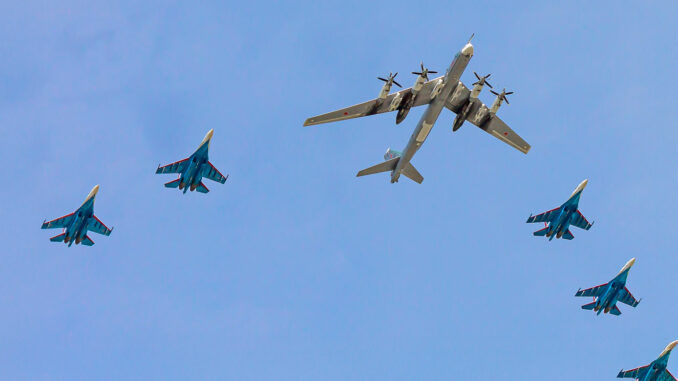
A patrol of Chinese and Russian bombers near Japan and South Korea reignites regional tensions and confirms the military rise of the Beijing-Moscow alliance.
Summary
On December 9, 2025, a new Sino-Russian patrol of strategic bombers flew over the vicinity of Japan and South Korea, in the East China Sea and the Sea of Japan. Two Russian Tu-95 bombers joined two Chinese H-6 bombers for a long-range flight, escorted by J-16 fighters and supported by a Russian A-50 radar aircraft. Tokyo and Seoul scrambled their Japanese and South Korean fighter jets, even though no aircraft violated national airspace. Officially, Beijing and Moscow are presenting this operation as the tenth joint strategic patrol in an annual exercise plan. In reality, the episode comes amid a worsening of relations between China and Japan, against a backdrop of tensions over Taiwan and a recent incident involving firing radars. This joint patrol is part of a broader strategy of Sino-Russian military cooperation, which tests the reaction of US allies in Asia and normalizes the presence of nuclear bombers near key locations such as Okinawa and the Miyako Strait.
The flyover that triggered Japanese and South Korean takeoffs
The patrol is conducted over international waters, but in highly sensitive areas. According to Japanese and South Korean authorities, two Russian Tu-95s take off from the Sea of Japan and then join two Chinese H-6s from the East China Sea. Together, they made a long transit to the western Pacific, notably near Okinawa and the Miyako Strait, before turning back. The mission lasted about eight hours and followed a strategic patrol profile, with segments in tight formation closely monitored by regional radars.
Tokyo announced that it had detected the formation well before it approached Japanese airspace. The Japan Air Self-Defense Force (JASDF) dispatched fighters, probably F-15Js and F-2s, to visually identify the bombers and track their flight path. For its part, Seoul reports that seven Russian and two Chinese aircraft repeatedly entered the Korea Air Defense Identification Zone (KADIZ) for about an hour, prompting the takeoff of armed South Korean fighters, even though the national air border was not crossed.
This type of response has become almost automatic. In a region where alert times are measured in minutes, not scrambling fighter jets would be a sign of weakness. The Japanese and South Korean armies therefore incur significant costs in fuel, flight hours, and fleet wear and tear to demonstrate that every Chinese or Russian strategic patrol will be closely monitored.
The air force deployed by Beijing and Moscow
The role of the H-6 and Tu-95 strategic bombers
The core of the patrol is based on the H-6/Tu-95 tandem. The Chinese H-6, derived from the Soviet Tu-16, has been modernized several times. In its latest versions, it can carry air-to-ground or anti-ship cruise missiles with a long range, sometimes exceeding 1,500 km. Its range exceeds 3,000 km, enabling it to strike targets around the first island chain—Japan, Taiwan, the Philippines—while remaining protected by China’s defense bubble.
The Russian Tu-95 is a Soviet-era turboprop bomber, but it remains a key vector of Russian nuclear deterrence. Capable of carrying cruise missiles such as the Kh-101, with a reported range of over 3,000 km, it can strike land or sea targets far from the Russian coast. Its relatively modest cruising speed of around 800 km/h is offset by a range of over 10,000 km thanks to in-flight refueling. Seeing a Tu-95 flying near the Japanese islands is therefore never insignificant: even in peacetime, it serves as a reminder that nuclear or conventional platforms with very long ranges can operate at the gates of the archipelago.
Escort fighters and radar aircraft as force multipliers
The patrol does not only include bombers. Japanese and Russian communiqués mention the presence of Chinese J-16 fighters in escort, as well as a Russian A-50 radar surveillance aircraft. The J-16, derived from the Su-30, is a modern multi-role fighter, equipped with active antenna radar and capable of carrying long-range air-to-air missiles. Its presence signals that Beijing is preparing for a dense combat environment, where bombers must be protected against potential enemy interceptors.
The A-50, the Russian equivalent of AWACS, acts as the “eye” of the formation. It coordinates trajectories, monitors Japanese and South Korean approaches, and provides a globalized image of the airspace within a radius of several hundred kilometers. The message is clear: the patrol is not a simple symbolic flyover, but a comprehensive command and control exercise, where Chinese and Russian aircraft train to operate as a coherent whole.
The Sino-Russian patrol as a political signal to Tokyo and Seoul
A “routine” but highly political exercise
Officially, Beijing and Moscow insist on the “routine” nature of these missions. The Chinese defense ministry points out that this is the tenth joint strategic patrol since 2019, carried out as part of an annual military cooperation plan. The two capitals emphasize that the aircraft remain in international airspace at all times and respect the law of the sea and the air.
But the timing and geography speak for themselves. The patrol comes at a time when Sino-Japanese relations are being strained by several sensitive issues. Tokyo has toughened its stance on a possible crisis in Taiwan, explaining that the island’s security is closely linked to that of Japan. Beijing has denounced these positions as “provocative.” At the same time, a highly publicized incident involving Chinese and Japanese aircraft near Okinawa has contributed to a climate of acute mistrust.
In this context, moving strategic bombers between Okinawa and Shikoku, just a few hundred kilometers from the US bases at Kadena and Iwakuni, is no innocent move. The patrol reminds Tokyo and Washington that China and Russia are capable of acting in concert in an airspace already saturated with allied forces.
A warning to South Korea and, beyond that, to the United States
Seoul is also being targeted. The KADIZ covers a large portion of the airspace off the peninsula, and the fact that Russian and Chinese bombers and fighters are repeatedly entering it without warning is testing South Korea’s responsiveness. By scrambling fighter jets, Moscow and Beijing are forcing Seoul to reveal, at least partially, its alert procedures, interception corridors, and certain radar parameters.
Beyond South Korea, it is the US military alliance in Asia that is being targeted. Washington is bound by defense treaties with Japan and South Korea. By increasing patrols near these two allies, Beijing and Moscow hope to test the US’s ability to coordinate air surveillance, but also to manage a possible simultaneous crisis in Europe and Asia. The strategic bomber patrol thus serves as a discreet but concrete reminder of the reality of a “two-theater” front for US forces.
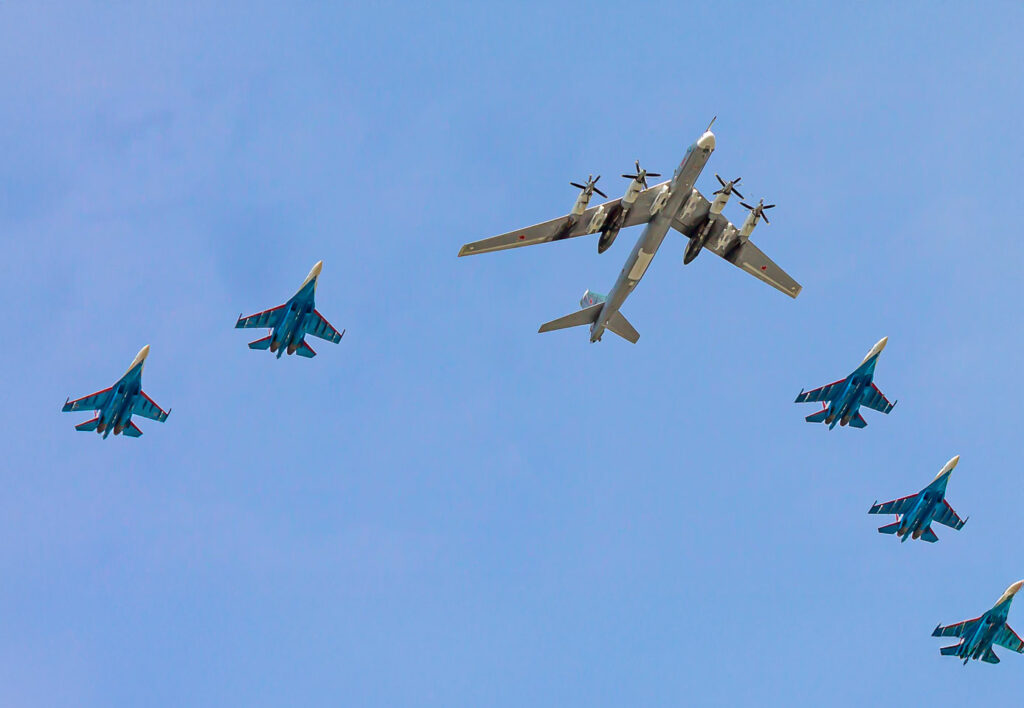
The place of joint patrols in Sino-Russian strategy
Structured cooperation since 2019
Since 2019, joint China-Russia air patrols have become a regular occurrence around Japan and South Korea, but also occasionally further afield, for example near Alaska. Their frequency—once or twice a year—and geographical scope reflect an escalation in cooperation. Over the years, the volume of forces engaged and the complexity of the routes have increased, from a few bombers to groups comprising several types of aircraft, fighters, refueling planes, and intelligence aircraft.
This cooperation does not mean that there is a formal military alliance. But it does show that they have some common interests: challenging the role of the US, trying to break up American strategic focus, and looking for more legitimacy for Chinese and Russian military operations in their wider neighborhood.
A testing ground for high-intensity joint operations
Militarily, these patrols are a full-scale laboratory. They allow China and Russia to test the interoperability of their communication systems, navigation procedures, and doctrines for the use of strategic bombers. They also provide valuable feedback on adversarial reactions: interceptor takeoff times, approach profiles, radar use, etc.
From China’s perspective, these missions reinforce the credibility of H-6 bombers as carriers of anti-ship missiles against US carrier strike groups. From Russia’s perspective, they offer an alternative training theater to Europe, facing technically advanced adversaries, without crossing the threshold of a direct incident with NATO. In both cases, the joint patrol serves as a demonstration of capability and a calibrated political signal.
The consequences for Japanese and South Korean air defense doctrines
For Japan, the repetition of these patrols poses a real sustainability problem. The number of interceptions of Chinese and Russian bombers by the JASDF has regularly exceeded 500 per year for several exercises, with a record of over 1,000 alert takeoffs at certain times. Each sortie consumes hours of flight time on aircraft, human resources, and the defense budget.
This operational pressure is pushing Tokyo to review its posture. Japan is investing in new long-range surface-to-air systems, strengthening radar coverage on its most exposed islands, and considering the deployment of additional batteries on strategic islands near Taiwan. The aim is to reduce dependence on manned interceptors alone and to have a full range of responses at its disposal, from passive tracking to active interception.
South Korea is following a similar logic. It is modernizing its radars, densifying its detection network, and working to better integrate its capabilities with those of the United States and Japan, despite sometimes tense political relations with Tokyo. Repeated overflights of the KADIZ by Chinese and Russian aircraft are perceived as a permanent “stress test” for South Korea’s air defense.
In both countries, the political impact is clear. Public opinion and political leaders see the reality of these patrols in images: photos of Tu-95s and H-6s taken from Japanese or South Korean cockpits, and flight path maps published by the ministries of defense. This fuels the debate on military budgets, the introduction of new US capabilities, and the evolution of doctrines on the use of force.
A risky routine in a sky saturated with armed forces
What Beijing and Moscow present as a “simple” strategic patrol is now a defining feature of the security landscape in Northeast Asia. Each time bombers fly near Japan or South Korea, the US allies are forced to respond in a costly and politically sensitive manner. Repeated patrols create an additional risk: that of accidents, misinterpretation, or clumsy maneuvers in skies saturated with military aircraft.
In the short term, none of the parties has any interest in allowing the situation to drift toward open confrontation. But the normalization of joint flights by potential nuclear bombers, escorted by fighter jets, in the immediate vicinity of states with advanced air defense capabilities leaves little room for error. The December 2025 patrol serves as a reminder that stability in Northeast Asia increasingly depends on managing risks at very close range between armed forces, rather than on grand diplomatic statements.
Sources:
– Reuters, reports on joint Chinese-Russian patrols and reactions from Japan and South Korea, December 9–10, 2025.
– The War Zone, “Joint Chinese-Russian Bomber Patrol Sends Japanese, South Korean Fighters Scrambling,” December 9, 2025.
– FlightGlobal, “Chinese H-6 and Russian Tu-95 bombers conduct joint patrol through Miyako Strait prompting JASDF scramble,” December 10, 2025.
– Global Times and Chinese Ministry of Defense, press releases on the 10th joint strategic patrol, December 2025.
– Japan Air Self-Defense Force / think tank studies on combined Chinese-Russian patrols and number of scrambles, 2019–2025.
War Wings Daily is an independant magazine.