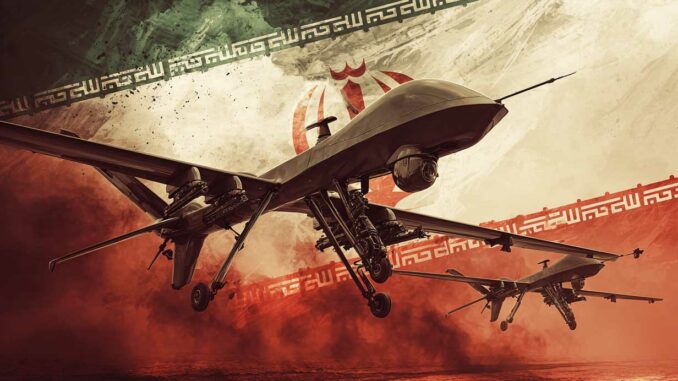
Between Iranian Shahed drones, infiltrated Israeli drones, and American MQ-9 drones, the war is also being fought in factories, warehouses, and components.
Summary
The conflict between the US, Israel, and Iran has confirmed a brutal reality: drones are no longer an appendage of air power, they have become one of its backbones. Iran relies on low-cost drones, particularly Shaheds, to saturate defenses and wear down enemy interceptor stocks. Israel combines surveillance drones, loitering munitions and, even more significantly, drones infiltrated or assembled clandestinely on Iranian soil to strike as close as possible. The United States, for its part, combines MALE drones such as the MQ-9 Reaper, intelligence, targeting, and now inexpensive systems inspired by the Iranian model. The decisive factor is not only tactical. It is industrial. This war highlights the pace of production, the simplicity of manufacturing, and the availability of engines, navigation cards, and commercial components. Whoever controls the supply chain, and not just the skies, retains the initiative.
Drones: a complete grammar of warfare
The word “drone” actually covers several families of tools. First, there are MALE drones, or medium-altitude, long-endurance drones, used for surveillance, identification, tracking, and sometimes striking. The American MQ-9 Reaper belongs to this category. It can carry up to 1,701 kilograms (3,750 lb) of payload, fly long distances for long periods of time, and fire Hellfire missiles or guided bombs. It is a theater aircraft, not a simple opportunistic device. In contrast, the Iranian Shahed-136 is a one-way drone, often referred to as a kamikaze drone or loitering munition. It does not return. It is designed to be launched in salvos, travel several hundred or thousand kilometers depending on the configuration, and then crash into its target. Between the two, Israel has long used intermediate platforms such as the Hermes, Heron, and Harop families, which combine persistent surveillance, target designation, and opportunistic strikes.
This point is essential to understanding the conflict. The three players are not playing the same game. Iran is looking for volume, attrition, and low marginal cost. Israel seeks precision, penetration, and operational surprise. The United States seeks ISR depth, joint coordination, and the ability to hold air defense, targeting, and strikes together. The drone is therefore not a single weapon. It is a war system. And that is precisely what makes the technical dossier so important.
The Iranian drone, designed to saturate rather than impress
Iran has made the drone a rational response to its limitations. Its fleet of combat aircraft is old. Its ability to sustain a conventional air war against Israel and the United States remains constrained. It therefore needed a weapon that was cheaper, simpler to produce, easier to disperse, and capable of circumventing technological asymmetry.
The Shahed-136 fits this logic perfectly. According to the Institute for Science and International Security, its estimated cost in 2022 was between $20,000 and $30,000 per unit. Even taking higher estimates, around $30,000 to $50,000 cited in recent analyses, this is still a far cry from the cost of a manned aircraft, a modern cruise missile, or even a Western MALE drone.
Iran’s logic was clear from the April 13-14, 2024 attack on Israel. According to Israeli figures reported by several official and semi-official sources, Iran and its partners launched around 170 drones, 30 cruise missiles, and 120 ballistic missiles, or more than 320 delivery vehicles. The important fact is not only the tactical result, limited by interception. It is the industrial demonstration. Tehran showed that it could coordinate a massive strike and combine slow drones, cruise missiles, and ballistic missiles to force a multi-layered defense to exhaust its resources.
The same pattern was seen during the June 2025 war between Israel and Iran. Reuters reported on June 17, 2025 that Iran had already fired nearly 400 ballistic missiles and hundreds of drones at Israel. Here again, the key is less the number of targets destroyed than the logistical pressure exerted on the opposing defense. A Shahed drone can cost tens of thousands of dollars. On the other side, interception often relies on much more expensive missiles or defense chains. The drone does not always win through direct destruction. It often wins through the economic exhaustion it imposes.
The Israeli drone, used as a weapon of penetration and surprise
Israel plays a completely different card. Its advantage lies not in sheer mass, but in the quality of its intelligence, operational integration, and clandestine depth. When the June 2025 campaign was launched, Reuters reported that Israel had sent Mossad commandos into Iran to neutralize certain weapons systems. More importantly, other reports published later indicated that drones had been introduced into Iran and, in some cases, secretly assembled on site before the attack. This is a major qualitative leap. The drone is no longer just launched from a distance. They are pre-positioned within enemy territory.
This method changes the geometry of warfare. An infiltrated drone reduces the distance to the target, bypasses some of the radar systems, and allows sensitive targets to be struck with virtually no warning. Israel has thus demonstrated that a clandestine network, supported by explosive or small drones, can complement the actions of piloted aircraft and missiles.
This is a hard lesson for all states: air defenses can be strong on the outside but remain vulnerable on the inside.
There is a greater lack of detailed public data on heavy platforms. We know that Israel deploys drones such as the Hermes 900, Heron, and Harop. Export contracts give an order of magnitude, but not always a specific unit cost. For example, Reuters reported a Thai contract worth 4 billion baht, or approximately $107.7 million, for Hermes 900s, without specifying the exact number of aircraft. Other contracts for Heron TP or UAS services are worth tens or hundreds of millions of dollars. It is therefore necessary to be rigorous: the precise costs of the Israeli drones used against Iran are not all public or comparable line by line with those of the Shahed. But one thing is clear: Israel accepts more expensive drones because it is looking for something other than raw saturation. It is looking for selective penetration.
American drones: ISR superiority and economic catch-up
The United States has long approached drones from the top of the spectrum. The MQ-9 Reaper remains emblematic of this school of thought. The official US Air Force data sheet gives a cost of $56.5 million for a package comprising four aircraft, sensors, a ground control station, and the main satellite link, in 2011 fiscal dollars. This does not mean that a Reaper is worth exactly $14 million in all configurations, but it does give an idea of the economic gap with a Shahed. We are talking about two different industrial worlds.
However, the American model offers what the Iranian drone cannot provide at the same level: endurance, sensor quality, data link, in-flight reprogramming, intelligence integration, and reversible strike capability. The problem is that this model is expensive and exposed. In 2025, the Associated Press reported that seven Reapers shot down in Yemen in a few weeks represented more than $200 million in losses. This shows the fragility of a sophisticated system when faced with an adversary who is willing to engage in a war of attrition.
That is why Washington has begun to correct its approach. In March 2026, Reuters reported the entry into combat of a low-cost American drone, the LUCAS, explicitly designed as a more economical response, with a price tag of around $35,000 per unit. The trajectory is clear: even the world’s leading military power now admits that it, too, must produce simpler drones that are quicker to manufacture and attritable, i.e., acceptable to lose. This is an implicit recognition of the relevance of Iran’s cost-volume reasoning, even if the operational objectives remain very different.
Production rate, which is sometimes more important than sophistication
In this war, production rate is almost as important as technical quality. The exact Iranian figures are difficult to verify, but several recent estimates cited by Reuters and the Financial Times are very high. In early March 2026, Reuters reported that Iran had a capacity of around 10,000 drones per month. The Financial Times reported that there were at least 10,000 Shahed drones in stock and that production sites were decentralized, smaller, and more difficult to neutralize. These figures should be treated with caution, as they are analysts’ estimates and not certified industrial figures. But even if we take a lower estimate, the meaning is clear: Iran has opted for diffuse, rustic, and resilient production.
The parallel with Russia helps to gauge what a ramp-up of Shahed architecture represents. Documents studied by the Institute for Science and International Security already showed in 2024 that Alabuga could target around 5,200 drones per year, then exceed 6,000 earlier than expected. Subsequent analyses even mentioned 5,000 Shahed-type drones per month at this site. This is not Iran, but it proves that an architecture initially perceived as rudimentary can become a veritable mass industry. This is precisely what Israel and the United States fear if Iranian production lines remain intact.
On the other hand, the United States and Israel retain a qualitative advantage, but ramp-up on complex platforms remains slower and more expensive. A modern army can field high-performance drones. It cannot always lose hundreds of them without budgetary or industrial pain. That is where the difference lies. The Iranian drone is inferior on a unit basis. It becomes strategic as soon as it is produced and launched in large numbers.
The supply chain, the real center of gravity of the conflict
Let’s call a spade a spade: the drone war is also a war of spare parts. Technical reports on the Shahed-131, Shahed-136, and Mohajer-6 recovered in Ukraine have shown a significant presence of foreign components. The Institute for Science and International Security mentioned parts designed or produced in Austria, Germany, the United Kingdom, and the United States, as well as Chinese copies or alternatives. Many are commercial, dual-use, or light civil aviation components. This means that a war drone can be born out of a gray supply chain that is fragmented and difficult to block completely.
US sanctions from 2024, 2025, and 2026 describe this network with useful candor. The US Treasury targeted entities supplying UAV components to Qods Aviation Industries, companies based in Iran, the United Arab Emirates, and China, as well as intermediaries in Turkey. In February 2026, Washington also pointed out that the Iranian company Mado produces the engines used on the Shahed-131 and Shahed-136, while Turkish companies served as financial intermediaries to acquire sensitive machinery.
The real key to success is therefore not just the explosives or the cell. It is the engines, GNSS cards, electronics, machine tools, payment circuits, and freight forwarders.
This is also why destroying finished drones is not enough. As long as the assembly line continues to receive components, stocks will be replenished. Conversely, a few well-targeted sanctions on engines, inertial units, guidance cards, or machining equipment can have a disproportionate effect. In this area, technology is directly linked to finance and international trade. The battlefield sometimes begins in a warehouse, a bank account, or an export invoice.
Drones are already changing the balance of the conflict
The impact on the conflict is twofold. On the one hand, drones give Iran a lasting means of exerting pressure. They enable it to strike from a distance, disperse launchers, complicate air defense, and wage a war of attrition. On the other hand, they give Israel a means of silent penetration, deep targeting, and operational sabotage. As for the United States, it remains the linchpin of the ISR layer and the defensive architecture, but it is forced to move towards less costly solutions if it wants to hold out in the long term.
Perhaps the most obvious lesson is this: technological superiority is no longer enough when the adversary has a better grasp of the economics of volume. An Iranian drone does not need to be superior to an American or Israeli drone to be useful. It only needs to be good enough, numerous enough, and simple enough to replicate. Conversely, a sophisticated Western drone must now prove that it is worth its cost in an environment where loss is no longer exceptional, but structural. This conflict is not just about who strikes best. It is about who can replace the fastest.
Sources
U.S. Air Force, MQ-9 Reaper Fact Sheet
U.S. Department of the Treasury, The Departments of Treasury and Justice Take Action Against Iranian Weapons Procurement Network, April 1, 2025
U.S. Department of the Treasury, Treasury Targets Networks Facilitating Illicit Trade and UAV Transfers on Behalf of Iranian Military, April 25, 2024
U.S. Department of the Treasury, Treasury Targets Iranian UAV Program, Steel Industry, and Auto Sector in Response to Iran’s Attack on Israel, April 18, 2024
U.S. Department of the Treasury, Treasury Targets Entities Procuring Sensitive Machinery for Iran’s Defense Industry, June 20, 2025
U.S. Department of the Treasury, Treasury Targets Iran’s Shadow Fleet, Networks Supplying Ballistic Missile and ACW Programs, February 25, 2026
Reuters, Israel used long-planned subterfuge in attack on Iranian nuclear targets, June 13, 2025
Reuters, Trump calls for Iran’s unconditional surrender as Israel-Iran conflict enters fifth day, June 17, 2025
Reuters, Iran launches retaliatory attack on Israel with hundreds of drones and missiles, April 14, 2024
Reuters, US debuts suicide drone in Iran after fast-tracked Pentagon procurement, March 3, 2026
Reuters, From India-Pakistan to Iran and Ukraine, a new era of escalation, June 26, 2025
Reuters, Thailand signs contract to buy Israeli-made Hermes 900 drones, September 21, 2022
Reuters, Israel Aerospace signs $600 million drone deal with Airbus for Germany, June 13, 2018
Reuters, Israel Aerospace gets $200 million UAV deal in Asia, June 1, 2021
Institute for Science and International Security, Iranian Drones Contain Western Brand Components, October 31, 2022
IISS, Tracking the Components of Missiles and UAVs Used by Russia in Ukraine, September 2025
CSIS, The Iran-Israel Air Conflict, One Week In, April 19, 2024
Financial Times, Iran turns to cheap drones as US and Israel target missile launchers, March 6, 2026
Reuters, Iran could disrupt the Strait of Hormuz with drones for months, March 4, 2026
War Wings Daily is an independant magazine.