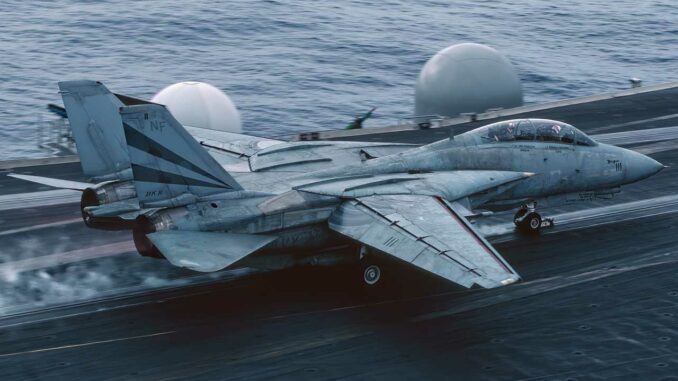
Why the United States destroys its F-14s and how Iran turned the Tomcat into a durable weapon, even achieving its greatest combat successes with it.
In summary
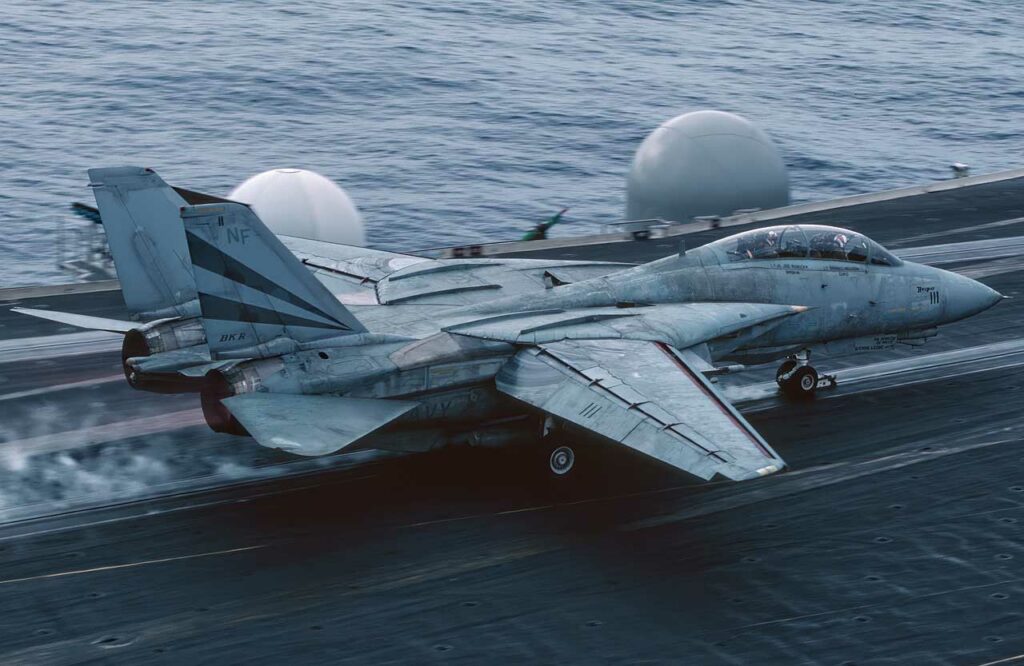
The F-14 Tomcat occupies a special place in aviation history. In the United States, it symbolizes Cold War naval superiority, very long-range interception, and the golden age of carrier-based aviation. However, since its official retirement from the US Navy in September 2006, Washington no longer treats its Tomcats as mere obsolete aircraft. A significant portion of the airframes, parts, and tools have been removed from circulation, banned from export, and then physically destroyed to prevent any recovery. The reason is clear: Iran remains the only other user of the F-14, and every part saved can extend the life of an Iranian aircraft. Paradoxically, it was in Iran that the Tomcat achieved its most notable combat results, especially during the Iran-Iraq War. The most spectacular case remains that of Jalil Zandi, credited with 11 aerial victories, a record for the F-14. This story says a lot about the technical value of the aircraft, but also about the logistical war of attrition surrounding it.
The F-14 Tomcat, an interceptor designed for extreme warfare
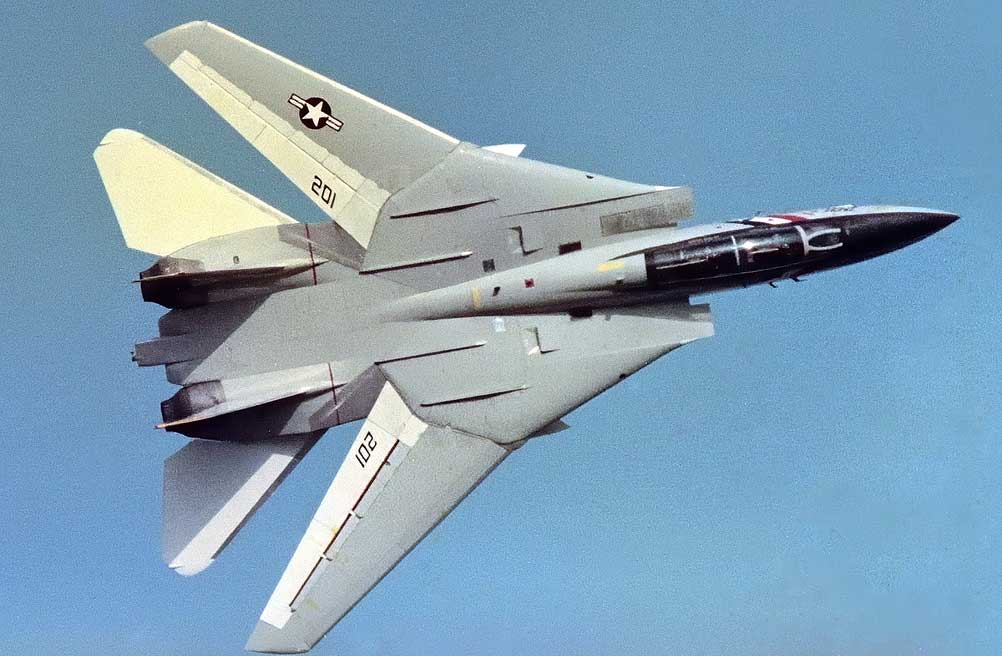
The F-14 Tomcat was not designed as just another fighter. It was designed for a specific mission: to defend a US carrier group against Soviet bombers and long-range anti-ship missiles. This explains its very particular technical design: two crew members, variable-geometry wings, powerful radar, and long-range firing capability unmatched by any other carrier-based aircraft of its time. The Tomcat could reach 2,485 km/h (1,544 mph), cruise at around 927 km/h (576 mph) and operate at an altitude of over 16,760 m (55,000 ft).
Its true uniqueness came from the combination of the AWG-9 radar and the AIM-54 Phoenix missile. The US Navy points out that the F-14 could guide up to six Phoenix missiles against six separate targets. In a landmark test, it fired six Phoenix missiles in 38 seconds at six separate targets approximately 80 km (50 miles) away, with four hits. In the context of the 1970s, this was a major leap forward. The Tomcat wasn’t just fast. It could see far, sort through multiple threats at once, and strike before the classic dogfight.
This architecture also explains why the F-14 made such an impression far beyond its raw numbers. It wasn’t the simplest or least expensive aircraft.
It was a complete weapons system, designed for high-intensity interception. This is also why its maintenance proved to be cumbersome, expensive, and demanding. When an aircraft is built to guard the skies at very long range, it becomes formidable in operation, but rarely economical in peacetime.
The American withdrawal that turned into a policy of destruction
The US Navy retired the F-14 from service in September 2006, after a 36-year career. The US military’s reasoning was simple: the F/A-18E/F Super Hornet was more versatile, easier to maintain, and better suited to current operational needs. In terms of budget and logistics, the Tomcat was no longer competitive. It remained spectacular, but it cost too much to maintain for a fleet that wanted to simplify its support chains.
But the withdrawal was not limited to ordinary scrapping. Very quickly, another issue arose: the resale of surplus military parts. In 2007, investigations showed that F-14 parts may have ended up in liquidation channels and thus, potentially, in foreign acquisition channels. The GAO then pointed out that control failures had allowed the sale of sensitive equipment, including F-14 parts, to the public, even though Iran was actively seeking such components. The American diagnosis was clear: allowing these parts to circulate created a risk to national security.
This led to a much tougher measure. The Defense Appropriations Act for fiscal year 2008 prohibited the Department of Defense from selling, directly or indirectly, any F-14, any parts specific to the F-14, or any associated manufacturing tools or dies, with the exception of museum pieces on U.S. territory. The law also prohibits any export license for this equipment to any non-US person or entity. In other words, Washington didn’t just turn off the tap: it welded the valve shut.
Hence the now famous image of American Tomcats being sent to the scrapyard or physically mutilated. This is not a bureaucratic whim. It is a strategy of logistical denial. As long as an F-14 exists as an organ bank, it can extend the life of another F-14. And since Iran is the only remaining operator, every landing gear, panel, beam, canopy, or subassembly spared represents a potential gain for the IRIAF.
Iran, the forgotten customer that became the most enduring user
This is where the Tomcat paradox lies. This aircraft, designed for the US Navy, ended up surviving politically and militarily in Iran. Before the 1979 revolution, Tehran had received 79 American F-14s. After the break with Washington, industrial support came to an abrupt halt. On paper, this should have quickly doomed the Iranian fleet. In reality, Iran kept some of its aircraft in service through cannibalization, local adaptation, improvised repairs, indirect purchases, and a forced increase in technical expertise.
This maintenance was much more than a DIY exercise.
Iran exploited the F-14 not only as an interceptor, but also as an advanced detection platform. Analysts cited in 2025 point out that, despite the age of the aircraft, the power of its radar remained useful for air warning and surveillance, almost as a poor substitute for certain AWACS functions. This is an important idea: an old fighter can remain militarily useful if it retains a credible sensor and a clear place in the chain of command.
This longevity should not be romanticized. It also reflects a structural weakness. Iran clung to the F-14 because it had no modern and sustainable Western alternative. In 2002, Air Force Magazine estimated that Iran had around 25 F-14s still in service or close to it. In 2025, open estimates remained vague, often around a few dozen aircraft, but with a high degree of uncertainty about the number actually operational. This opacity itself speaks volumes: the Iranian Tomcat has become a rare, aging asset that is difficult to quantify, but still important enough to be targeted.
The Iran-Iraq War that made the Iranian Tomcat a real combat weapon
The point most often misunderstood in the West is this: the Iranian F-14 was not an empty symbol. During the Iran-Iraq War, it had a real impact on the air battle. The IRIAF used it for air superiority, escort, defense of sensitive points, and long-range deterrence. According to estimates reported by several specialized sources, Iran attributes more than 100 aerial victories to its F-14s during the conflict. The exact figure remains debated, as is often the case with war statistics, but no serious observer disputes that the Iranian Tomcat was a major force multiplier.
Why was this aircraft so important? Because on the other side, Iraq had to deal with an interceptor capable of detecting targets from a distance, forcing caution and disrupting the freedom of action of offensive formations. Even when the Tomcat did not fire, its presence changed the enemy’s behavior. In aerial warfare, this is a crucial effect: causing the enemy to give up, disperse, or delay can be as important as shooting them down. The Iranian F-14 often produced this psychological and tactical effect.
The case of Jalil Zandi crystallizes this reality. He is widely credited with shooting down 11 Iraqi aircraft, including 8 confirmed and 3 probable according to references compiled from specialized documents and works. This makes him the most credited F-14 pilot in history. The details of his reported victories include MiG-23s, Su-22s, MiG-21s, and Mirage F1s. This record is important for one simple reason: it reminds us that the Tomcat was not only glorified by Hollywood. It also produced concrete results in the hands of countries other than the United States, and sometimes more spectacular results than in the US service itself.
The Tomcat became a strategic target until the 2020s
The story does not end with the Iran-Iraq War. In June 2025, the Israeli Air Force struck Iranian F-14s at an airport in Tehran. On June 16, the IDF announced that it had hit two F-14s. These aircraft may have been inoperable, but that does not change the fundamental issue: even on the ground, an old Tomcat can serve as a source of spare parts and support the rest of the fleet. This is precisely the logic behind the US’s brutal treatment of its own decommissioned aircraft.
Let’s be honest: if an adversary destroys your aircraft parked on the tarmac, it’s not just for show. It’s because they are targeting your logistical depth. An F-14 that is unable to take off can still keep another F-14 flying for months, sometimes longer. In the case of Iran, where every component counts, this reality is even harsher. Modern warfare does not only destroy the weapons that fire. It also destroys stocks, workshops, reserve airframes, and support networks.
The true meaning of this American and Iranian story
The F-14 Tomcat tells two stories in one. On the American side, it embodies technological power, then the cold rationalization of a system that has become too cumbersome, before ending up crushed so as not to strengthen an adversary. On the Iranian side, it embodies endurance, industrial improvisation, and the maximum exploitation of equipment that everyone had declared doomed for decades.
This dual destiny is rare. The United States wanted to physically erase part of its own operational heritage to prevent it from continuing to fight under other colors. And Iran, despite sanctions, shortages, and aging, has managed to make the Tomcat not a relic, but a real capability for a long time. This is precisely why Washington chose the shredder rather than simple storage. A military aircraft does not die when it no longer flies. It dies when nothing left of it can be reused. In the case of the F-14, the Americans understood this very early on. The Iranians, on the other hand, spent forty years proving the opposite.
Sources
Naval History and Heritage Command, F-14 Tomcat
Naval History and Heritage Command, F-14A Tomcat
Naval History and Heritage Command, F-14D Tomcat
NAVAIR, Backgrounder – AIM-54 Phoenix Missile
U.S. Government Publishing Office, National Defense Authorization Act for Fiscal Year 2008, Section 1035
U.S. Government Accountability Office, GAO-07-929R, Sales of Sensitive Military Property to the Public
CBS News, Shredding F-14s To Keep Parts From Iran, July 2, 2007
Business Insider, Iran Has the Last of the F-14 Tomcats. Israel Just Blew Some up, June 18, 2025
IDF, Two Iranian F14 Fighter Jets Were Struck and Neutralized by the IAF at an Airport in Tehran, June 16, 2025
IDF, Press Briefing by IDF Spokesperson BG Effie Defrin, June 16, 2025
Air Force Magazine, Air Power Classics, January 2015
Tom Cooper, Farzad Bishop, Iranian F-14 Tomcat Units in Combat, Osprey Publishing
Air Force Magazine, The Iran Problem, December 2002
War Wings Daily is an independant magazine.