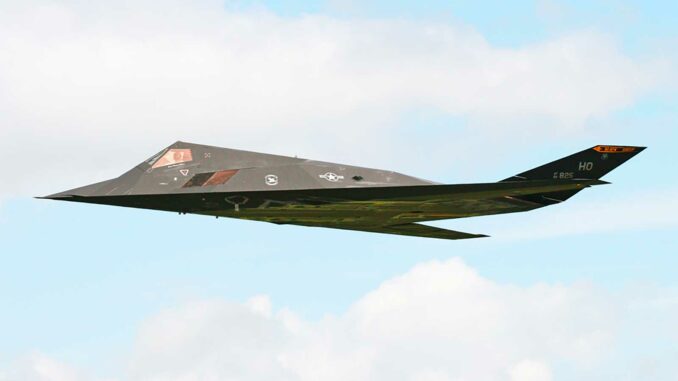
Officially retired, the F-117 is still flying. Why the US Air Force will continue to operate this stealth fighter until 2034.
Summary
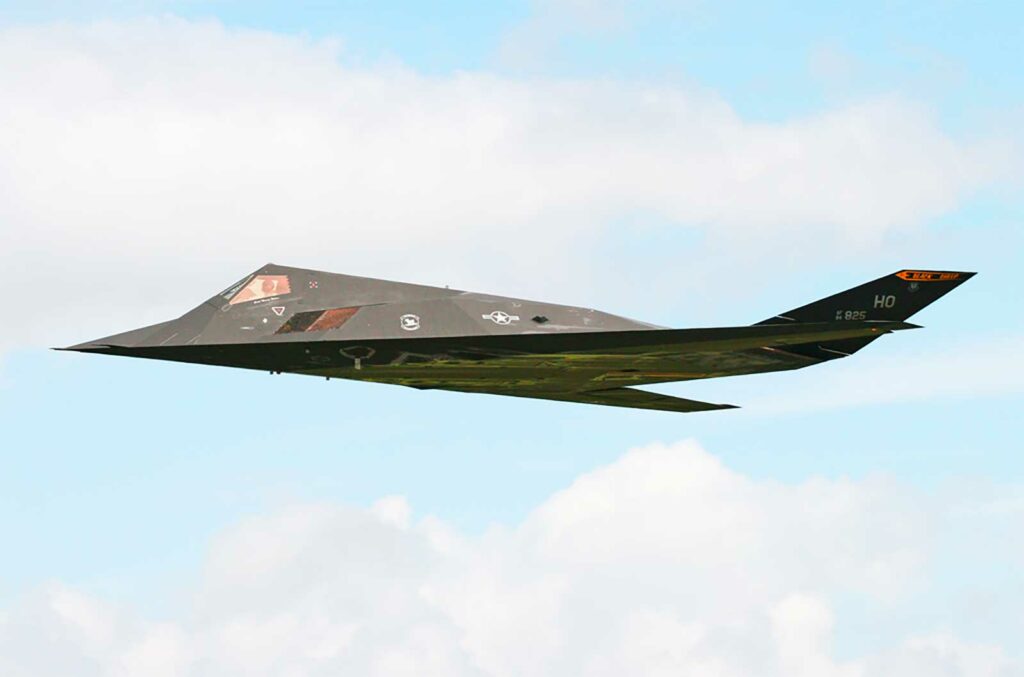
On January 3, 2026, several observers spotted an F-117 Nighthawk again over the Nevada Test and Training Range. This is no trivial event. Although withdrawn from active service in 2008, this stealth aircraft continues to be operated by the US Air Force in a discreet but structured manner. A reduced fleet is kept airworthy for Red Air missions, adversary sensor evaluation, and stealth coating research. An ongoing contract, active until 2034, governs these activities. The F-117 is no longer an operational combat aircraft, but it remains a unique testing tool. Its geometry, atypical radar signature, and older materials provide an irreplaceable testing ground for preparing for future conflicts and testing modern air defenses.
The reappearance of an officially retired aircraft
The F-117 is supposed to be a thing of the past. Retired from operational service for nearly twenty years, it no longer appears in the US Air Force’s public inventories. However, its regular appearance in the skies over Nevada confirms a lesser-known reality.
The Nevada Test and Training Range, a vast test area covering more than 12,000 km², remains the heart of American experimental activities. It is there that the F-117 is enjoying a second life, far from conventional operational bases. The flights observed are neither accidental nor exceptional. They are part of a supervised program that is acknowledged but deliberately kept out of the media spotlight.
The fleet in question is believed to be limited to around ten aircraft, taken from the airframes stored at Tonopah. These aircraft are kept in flying condition with a minimum level of modernization, sufficient to meet very specific needs.
The role of the F-117 in Red Air missions
The primary current use of the F-117 is in Red Air missions, i.e., simulating adversaries in air combat exercises. Unlike conventional aircraft used in this role, the F-117 brings a unique dimension: passive stealth.
When facing F-22 or F-35 pilots, the Nighthawk simulates a target that is difficult to detect with conventional radar. It forces crews to work on their multispectral detection, data fusion, and cross-platform coordination procedures.
Its subsonic speed, limited to approximately 1,040 km/h, and its lack of onboard radar are not handicaps in this role. On the contrary, they force the blue forces to rely on their external sensors, AWACS, and collaborative combat networks.
The F-117 does not mimic a modern Chinese or Russian fighter. Rather, it serves as an imperfect, realistic stealth target, and one whose limitations are well known. This is precisely what makes it an effective teaching tool.
A flying laboratory for stealth
Beyond training, the F-117 is a flying test bed. Its design dates back to the 1970s, with technological choices that are now outdated. But this apparent obsolescence is an asset.
The Nighthawk’s faceted airframe, combined with first-generation absorbent coatings, provides an ideal basis for testing the evolution of stealth materials. Unlike fifth-generation aircraft, the F-117 can be fitted with experimental coatings without compromising critical operational capabilities.
American engineers use it to assess the degradation of radar, infrared, and electromagnetic signatures over time. They also analyze the impact of weather conditions, wear and tear, and field repairs on actual stealth capabilities.
This work is essential. Modern stealth is not static. It is evolving in response to multi-band radars, passive sensors, and increasingly sophisticated processing algorithms.
Why the F-117 remains relevant in the face of modern sensors
One argument often comes up: why use an old aircraft when F-35s and B-21s exist? The answer can be summed up in one word: control.
The F-117 is fully understood by engineers. Its signature has been known, measured, and documented for decades. This allows for precise comparison of the performance of new radars or optronic systems against a stable reference.
When a radar detects an F-117 at a given distance, analysts know exactly what that means. They can isolate the sensor’s progress without being distracted by unknown variables related to technologies that are still classified.
In this sense, the Nighthawk acts as a stealth benchmark. It does not represent the current technological peak, but it is an indispensable basis for comparison.
The technical constraints of a resurrected aircraft
Keeping an aircraft designed more than forty years ago in the air is no small feat. The F-117 is based on a largely metal structure, with limited composite materials. Its General Electric F404 engines, although robust, require careful maintenance.
The actual availability of the fleet would remain modest, probably less than 50%, which is sufficient for occasional test missions. Flights are planned, short, and focused on specific profiles.
The avionics have not been extensively modernized. The navigation and communication systems are adapted to the bare minimum. The F-117 no longer seeks to fight, but to be observed, measured, and analyzed.
The contractual framework until 2034
The continued operation of the F-117 is based on a long-term contract, active until 2034. This legal and budgetary framework confirms that the US Air Force does not consider these flights to be transitional.
The exact cost is not public, but it remains marginal compared to the budgets of next-generation programs. Keeping a handful of aircraft airworthy costs much less than mobilizing modern platforms for risky or destructive tests.
This contract covers maintenance, logistical support, crews, and associated research activities. It guarantees a rare continuity in the field of military aviation.
The strategic message sent to adversaries
Seeing an F-117 still flying in 2026 is not just a technical curiosity. It is also a strategic signal. It shows that the United States is investing in a detailed understanding of stealth, including its limitations.
As China and Russia develop VHF radars, passive networks, and distributed sensors, the continued use of the F-117 reflects a desire to stay ahead of the curve. Testing one’s own weaknesses remains one of the most effective ways to make progress.
The Nighthawk also reminds us of an often-forgotten reality: technology never really disappears. It evolves, transforms, and sometimes finds an unexpected second life.
An irreplaceable platform despite its age
No other aircraft combines historic stealth, simple architecture, and controlled availability to this extent. Stealth drones could eventually fulfill a similar role. But they do not yet offer the same flexibility in terms of manned testing and complex scenarios.
The F-117 therefore continues to occupy a very specific niche. It is no longer a strike tool. It has become a tool for knowledge.
What the longevity of the F-117 reveals
The discreet maintenance of the F-117 in service raises questions about how armies manage their technological assets. Retiring an aircraft from service does not mean abandoning it. It can mean repositioning it.
The Nighthawk is no longer a symbol of air dominance. It has become a strategic learning tool. As long as stealth remains a key issue, it will retain its usefulness.
Its regular appearance in the skies over Nevada is not a relic of the past. It is a very contemporary reminder that understanding tomorrow’s warfare sometimes requires looking at yesterday’s machines.
Sources
- US Air Force – statements on the use of experimental platforms
- Nevada Test and Training Range – official documentation
- Lockheed Martin – history and technical data of the F-117
- Department of Defense budget reports
- Specialized analyses of US military aviation
War Wings Daily is an independant magazine.