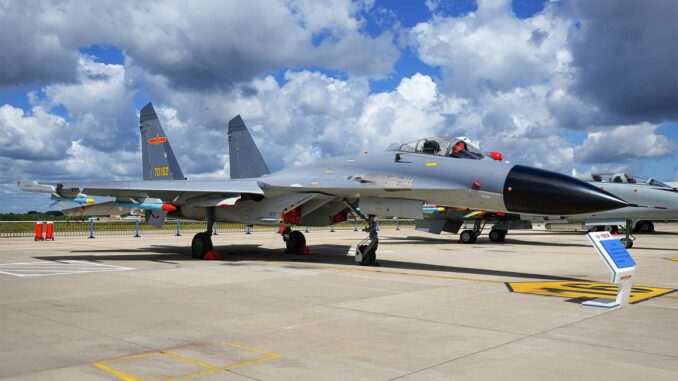
China is upgrading around 100 J-11Bs to the J-11BG standard with AESA radar and PL-10 missiles. This will enable it to turn the tables on Japan’s F-15Js.
In summary
The modernization of around 100 J-11B fighters to the J-11BG standard confirms a major trend in Chinese combat aviation: Beijing is not only focusing on new aircraft such as the J-20 and J-35, but also on the systematic upgrading of its existing fleets. According to several corroborating sources, the J-11BG is being equipped with a more modern AESA radar and the integration of recent missiles such as the short-range PL-10 and the long-range PL-15. The operational effect is clear: an old heavy fighter of Flanker design is regaining real relevance in a modern combat environment. However, we must remain precise. To say that the J-11BG is now “superior” to the Japanese F-15J only makes sense with some nuance. Compared to non-modernized F-15Js, the argument is valid. Compared to F-15Js upgraded to the JSI standard with APG-82 AESA radar, enhanced electronic warfare and new missiles, the hierarchy becomes much less obvious. What really changes is the ratio of mass, rate of fire and regional pressure.
The J-11BG that transforms an old Flanker into a credible fighter
The J-11B is not an insignificant aircraft in the history of Chinese military aviation. It represents the phase when China stopped relying solely on Russian airframes or imported sub-assemblies to build a national derivative of the Su-27. Over time, this aircraft has become one of the pillars of the PLAAF’s heavy fighter format and the Chinese naval aviation. Specialist estimates put the J-11B/BH fleet at around 150 to 160 aircraft, plus around 90 J-11BS two-seaters, which shows the real weight of this family in the Chinese order of battle.
The problem with the J-11B was well known. The airframe remained powerful. It had a large payload. The range and thrust of the two engines remained of obvious interest for air defense and long-range escort. On the other hand, the early versions suffered from a gradual lag in sensors, data links, and compatibility with the latest missiles. In modern air combat, this ends up weighing heavily. A fighter that carries a lot but detects less well, integrates less well and fires less far becomes a beautiful lump of metal, not a decisive advantage.
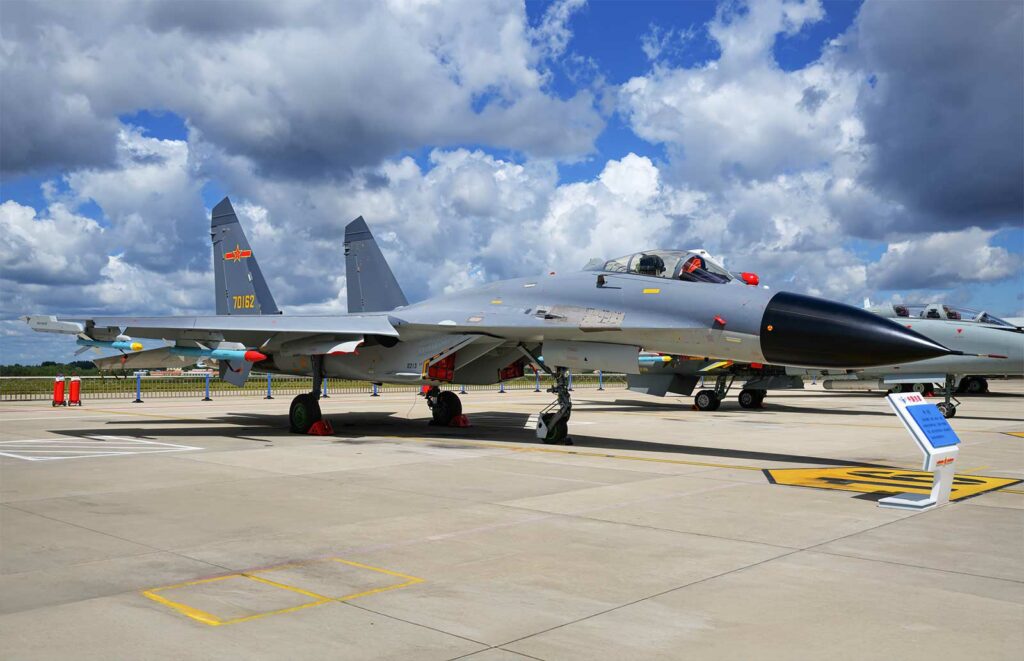
This is precisely what the J-11BG corrects. Since 2019, images and open analysis have pointed to a modernized version identifiable in particular by a light gray radome, interpreted as an indication of a new radar. Specialized work and observations relayed by the Chinese press converge on the same interpretation: the J-11BG is receiving an AESA and the integration of PL-10 and PL-15 missiles. In early 2026, several sources claimed that around 100 aircraft had already been modernized or were in the process of being modernized.
This figure has not been confirmed in detail by Beijing on a per-aircraft basis, but it is now consistently cited in several analyses.
The AESA radar that changes the tactical value of the aircraft
The key word here is AESA. An active antenna radar is not a cosmetic improvement. It is often the difference between an upgraded fighter and a truly modernized fighter. AESA generally offers better reliability, more flexible beam management, better resistance to jamming, and an increased ability to track multiple targets. The IISS also points out that AESA radars are more powerful and less vulnerable to jamming than older designs.
In the case of the J-11BG, this means two very concrete things. The first is that the aircraft can finally make more effective use of missiles beyond visual range, in particular the PL-15, which is one of the markers of China’s move upmarket in air combat. The second is that it regains real value in a saturated environment, facing numerous targets, more sophisticated jamming, and increasingly distant interceptions.
Let’s be clear: radar alone does not win an air war. But without modern radar, a heavy fighter like the J-11B would lose some of its architectural significance. Its value lies precisely in its ability to cover ground, stay in the air for long periods, carry a lot of fuel and weapons, and act as an interceptor or escort platform. The transition to the J-11BG standard restores consistency to this logic.
This modernization also has a smart industrial dimension. Beijing no longer reserves AESA for its new fighters such as the J-10C, J-16, and J-20A. It is spreading this technological building block to older aircraft. This is a quick way to expand a modern fleet without having to wait for the production rates of new airframes.
The PL-10 missile toughens close combat
The other important innovation is the integration of the PL-10. In the hierarchy of Chinese air-to-air weapons, the PL-10 represents a qualitative leap in close combat. Open technical analyses describe a missile with an infrared imaging seeker, thrust vectoring, and a high off-boresight capability, often compared to that of the American AIM-9X. The US Air University also points out that the PL-10E can engage at off-axis angles far superior to previous-generation missiles.
The advantage of this missile is simple. In a short-range duel, victory no longer depends solely on the ability to place the nose of the aircraft in line with the target. It depends on the combination of the missile, the helmet-mounted sight, and the quality of target processing. With the PL-10, the J-11BG is no longer just a heavy interceptor brought up to date. It is once again dangerous in close combat.
Here again, the comparison with Japan requires precision.
The F-15J has not remained static. Japan has been working for a long time on the AAM-5 family, then on an improved AAM-5B version, explicitly linked to the installation of an HMD and the improvement of close-range air-to-air weaponry on its fighters. Japanese budget documents clearly mention the installation and improvement of the AAM-4B and AAM-5, as well as the helmet-mounted display on the modernized F-15.
In other words, presenting the PL-10 as an argument that automatically makes the J-11BG superior to all F-15Js would be jumping to conclusions. What can be said with certainty is that China has closed part of the technological gap in close combat and has probably surpassed the non-modernized F-15Js in this regard.
The Japanese F-15J is not an adversary stuck in the past
The central argument of the subject therefore deserves to be revisited frankly. No, it is not rigorous to write without nuance that the J-11BG is now superior to the Japanese F-15Js in absolute terms.
Japan launched the JSI program to modernize part of its fleet. The official US DSCA database indicated as early as 2019 that Japan had requested the modernization of up to 98 F-15Js with APG-82(v)1 AESA radar, new mission computer, EPAWSS electronic warfare system, and other major upgrades, at an estimated cost of $4.5 billion. The Japanese Ministry then confirmed a more limited format of 68 aircraft to be modernized, a figure subsequently repeated by several industrial and specialist sources.
This is the decisive point. When faced with an F-15J JSI, the duel is no longer a battle between a refurbished Chinese aircraft and a Japanese interceptor from the 1980s. The F-15J JSI is also equipped with a modern AESA radar, upgraded electronics, improved weaponry, and an architecture closer to that of recent Eagles. Raytheon describes the APG-82(V)1 as an AESA radar designed to improve both the effectiveness and survivability of the F-15.
The honest conclusion is therefore as follows: the J-11BG will most likely be better than the non-modernized F-15Js in several key areas, particularly sensor-weapon fusion and access to the latest missiles. On the other hand, when compared to the F-15J JSI, the comparison will depend on much more subtle factors: actual radar quality, electronic warfare, crew training, data link quality, AWACS support, network posture, and above all, the number of aircraft available at any given time.
China’s mass weighs more heavily than a one-to-one comparison
This is where the analysis becomes really interesting. The media debate loves simple rankings. Which aircraft is “better”? Who beats whom? That’s not the real issue. The real issue is that China is increasing the density of its modernized aircraft at a rate that seriously complicates Japanese planning.
If around 100 J-11Bs have indeed been upgraded to the J-11BG standard, this means that Beijing has upgraded a very significant portion of its fleet of older domestic Flankers en masse, rather than confining them to secondary missions. This logic has a very direct effect in eastern China, in the East China Sea and around the disputed islands: it increases the number of aircraft capable of participating in interceptions, escorts, and patrols with a level of sensors and weaponry consistent with contemporary standards.
Japan, for its part, is modernizing, but on a smaller scale. The JSI fleet comprises 68 aircraft according to Tokyo’s plans, while the country continues to invest in the F-35A and F-35B. This produces a very high-quality force, but the format is not the same.
The operational context must also be taken into account. Japanese ministry documents show sustained Chinese air activity around the archipelago, and JASDF scramble statistics show that pressure from China remains structural. At the end of December 2025, Japan recorded 448 scrambles in the third fiscal quarter, 304 of which were related to China. This figure does not prove the technical superiority of an aircraft, but it does highlight the essential point: Tokyo is facing a problem of pace, wear and tear, and operational permanence, not just a problem of technical specifications.
China’s choice reveals a strategy that is colder than it appears
The modernization of the J-11BG says something about the Chinese approach. Beijing is not abruptly replacing all of its generations of aircraft. It is stacking layers. It is producing stealth fighters. It is developing highly advanced platforms. And at the same time, it is avoiding wasting still-useful airframes by bringing them up to a tactically credible level.
It’s a rational strategy. A modernized heavy fighter costs less and arrives faster than a completely new aircraft. It also allows the most sophisticated aircraft to be reserved for certain missions, without leaving gaps in air defense or regional presence. The J-11BG is therefore not a sign of weakness. It’s a force multiplier.
From Tokyo’s perspective, the problem is not only that the J-11BG is advancing. It is that this advancement is in addition to the J-10C, J-16, J-20, and Chinese detection and support capabilities. In a real confrontation, no one fights plane against plane in a tactical vacuum. They fight in a network.
The point to remember is therefore simple. China has not just modernized an old Flanker. It has avoided decommissioning and transformed an aging fleet into a reserve of immediately usable power. It is less spectacular than a sixth-generation fighter. It is also much more concrete.
War Wings Daily is an independant magazine.