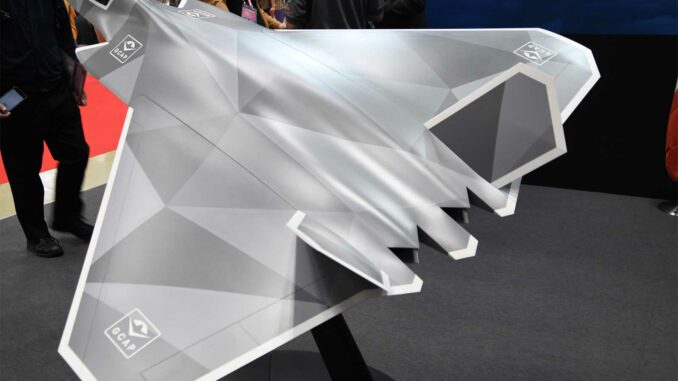
The GCAP has reached a milestone with the award of its first major contract to Edgewing. Japan, the United Kingdom, and Italy are entering a higher-risk phase.
In summary
The Global Combat Air Programme crossed a political and industrial threshold on April 3, 2026. The programme’s tripartite agency awarded Edgewing a first major international contract worth £686 million, or approximately $857 million. This amount does not finance the entire aircraft. It funds a key design and engineering phase. But the symbolism is strong. For the first time, a joint industrial structure involving the three countries is officially taking the lead on the design and development of a 6th-generation fighter jet. Japan, the United Kingdom, and Italy are ceasing to work in parallel under three separate national contracts. They are shifting toward a truly integrated approach. This is a major step forward. It is also a difficult gamble. Japan wants to replace its F-2s around 2035. The timeline is therefore tight. Yet integration between European and Japanese manufacturers remains challenging. Engineering cultures differ. So do strategic priorities. The GCAP is moving forward, but it is entering the phase where slogans are no longer enough.
The contract that moves GCAP from rhetoric to accountability
The contract announced in early April 2026 marks a fundamental shift. Until now, the GCAP has relied on a solid political framework, official cooperation among the three nations, and a gradual ramp-up by manufacturers. With the awarding of this first major international contract to Edgewing, the program moves beyond the preparatory phase. It enters the implementation phase. The program agency has entrusted the trilateral joint venture with design and engineering activities intended to maintain the pace of development. The announced amount is £686 million, or approximately $857 million according to the conversion reported in several publications on April 2 and 3.
It is important to understand what this means. This contract is not yet the major financial commitment for the entire program. Rather, it is a bridge contract. Defense News explains that it serves to sustain the effort until the end of June 2026, pending a broader budgetary framework, particularly on the British side. This implies two things. On the one hand, the program continues to move forward and avoids a lull. On the other, it remains dependent on public decisions that are not all finalized. The GCAP therefore does not suffer from a lack of ambition. It suffers primarily from a classic constraint of major military programs: politics makes promises quickly, but budgets follow more slowly.
The most important point lies elsewhere. Edgewing is not merely becoming a design office. The company, officially launched in June 2025 by BAE Systems, Leonardo, and Japan Aircraft Industrial Enhancement Co. Ltd., was conceived as the entity responsible for the design and development of the future air combat system.
Leonardo even specifies that Edgewing will remain the design authority throughout the product’s entire lifecycle, expected to extend beyond 2070. This detail is essential. In military aviation, control over design is the heart of industrial power. Whoever holds design authority does not merely assemble. They determine the architecture, the interfaces, the overall coherence, and future developments.
The industrial challenge between Europe and Asia that goes beyond mere distance
One might think the main problem is geographical. It certainly exists. Working between Japan, Italy, and the United Kingdom complicates coordination chains, the security of exchanges, the movement of engineers, and the harmonization of tools. But the real difficulty runs deeper. It concerns engineering methods, decision-making culture, the relationship to hierarchy, the protection of intellectual property, and how to resolve technical trade-offs.
Leonardo’s press release on the launch of Edgewing spoke of “effective knowledge and technology transfer” and a desire to build resilient supply chains. The phrasing is revealing. In such a program, technology sharing is necessary to work effectively. But it remains politically sensitive. Each nation wants sovereign capability. None wants to become a mere subcontractor to its neighbor. The British want to preserve the logic of Tempest. The Japanese want to avoid diluting what was originally part of their F-X project. The Italians want to retain real influence over sensors, integration, and mission electronics. It’s manageable. It’s not simple.
We must also speak frankly about the budgetary risk. Defense News explains that this initial contract serves as a bridge until more solid funding is secured, against the backdrop of British uncertainties regarding the Defense Investment Plan and a wider deficit in defense finances. When a program of this magnitude begins with a temporary contract because a partner has not yet fully secured its budget allocation, the signal is not catastrophic, but it is not reassuring either. This does not doom the GCAP. It simply shows that it remains vulnerable to national trade-offs, despite its international veneer.
The Real Value of Such a Program Despite Its Bureaucratic Burden
It would be wrong, however, to conclude that the GCAP is too cumbersome to succeed. Its strategic value is clear. The three countries want a 6th-generation aircraft capable of operating in an environment saturated with sensors, long-range missiles, advanced electronic warfare, and human-machine collaboration. They also want to avoid complete dependence on a single American solution. This is particularly sensitive for Japan, which has been seeking for several years to gain autonomy in the management of its air combat programs. Reuters had already noted that Tokyo viewed the GCAP as a way to reduce its dependence on American constraints related to certain equipment.
There is also an industrial interest. Such a program draws on thousands of engineers, hundreds of suppliers, and critical expertise spanning several decades. The program’s Wikipedia page, which compiles data from industry sources and official announcements, mentions approximately 9,000 people already involved in the project and more than 1,000 suppliers across the three countries.
Although these figures should be taken with a grain of salt depending on the phase, they give an idea of the industrial depth at stake. A program of this size is not just an aircraft. It is a comprehensive industrial policy.
Finally, there is a political interest. The GCAP permanently links Japan to two European powers in a very high-end segment of sovereignty. In a world where security alliances are becoming more fluid, this is a significant move. The United Kingdom sees it as a strategic lever post-Brexit. Italy sees it as a way to remain in the technological inner circle. Japan sees it as industrial and diplomatic assurance. On this point, the program is worth more than its future aircraft.
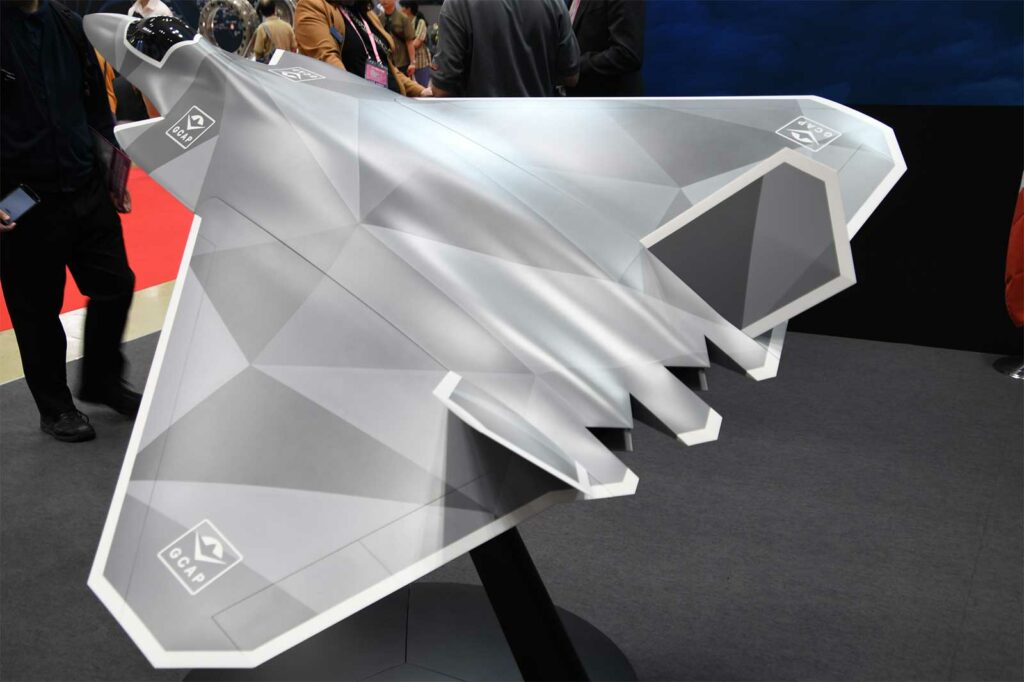
Technical feasibility will depend less on promises than on trade-offs
The feasibility of the GCAP is not the real issue. Technically, the three countries possess the core capabilities to develop a credible aircraft. BAE Systems, Leonardo, and Japanese manufacturers have substantial experience in airframes, sensors, integration, and mission systems. The problem isn’t whether they know how to do it. The problem is whether they can collectively maintain a schedule, an architecture, and a level of ambition compatible with 2035.
The first major contract awarded to Edgewing is therefore good news, but no guarantee. It proves that the program is moving forward. It does not yet prove that it will succeed. Three things will need to be monitored. First, the speed with which a second, broader contract will be signed following this bridge contract. Second, the ability of the three governments to solidify their national budgetary commitments without any hidden agendas. Finally, the manner in which Edgewing will actually exercise its design authority in the face of shareholders who remain powerful national champions.
The GCAP has just reached a very rare milestone: it has transformed a political coalition into an international prime contractor. It is an ambitious leap. It is also a new exposure to risk. If the system works, the program could redefine how allied nations build a fighter jet together. If it falters, it will serve as a reminder of an older lesson: in military aviation, sharing the dream is easy; sharing the decision is much harder.
Sources
Edgewing, announcement of the GCAP contract awarded to Edgewing, April 2, 2026.
Leonardo, “Global Combat Air Programme Agency places contract with Edgewing,” April 2, 2026.
Leonardo, official launch of Edgewing, June 20, 2025.
Italian Ministry of Defense, “Global Combat Air Programme Joint Statement,” July 7, 2025.
Defense News, “Money starts flowing for new GCAP fighter, as Britain sorts out finances,” April 2, 2026.
Ministry of Defense of Japan, official GCAP page and F-2 replacement timeline.
Reuters, cited in search results regarding Japanese concerns about the 2035 deadline, May 30, 2025.
Leonardo UK, GCAP overview page.
War Wings Daily is an independant magazine.